
Check out the headline on Fake news purveyor, The Guardian concerning the Geert Wilders verdict:
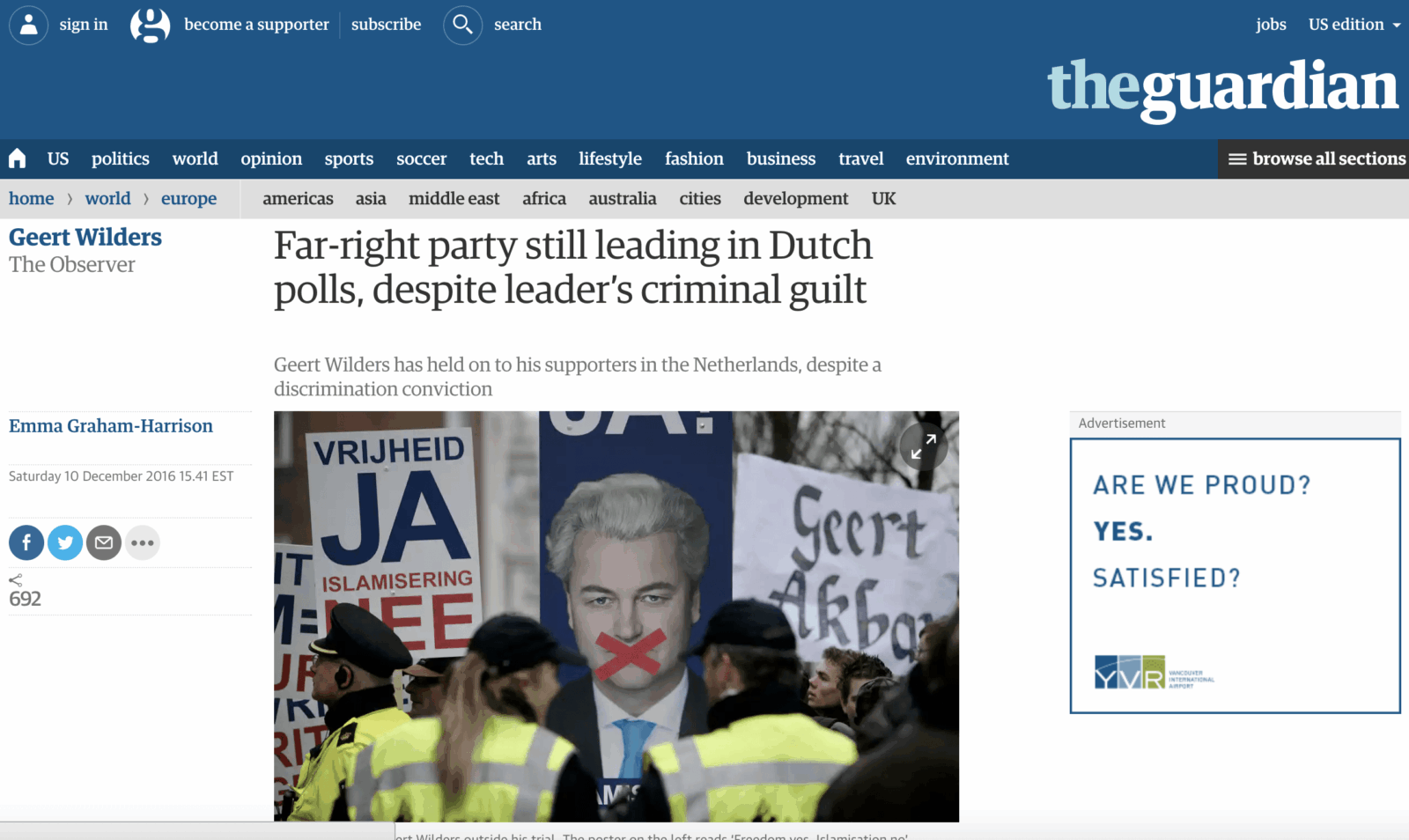
Did a court find Geert guilty on a criminal charge? Yes.
But the whole thing adds up to a Soviet style approach to reality.
The real headline should read, “Dutch Courts criminalize non-Marxist opposition views on immigration”.
Geert did not say anything that the leader of an opposition party is not obligated to say by his job description. If the vast majority of your antisocial behaviour problems are coming from Muslim illegals from Morocco, or even legal ones, the smart thing to do is bring in less of them. And that is exactly verbatim what he said.
And calling Geert Wilders far right to equate him the with National Socialist Workers Party of 1930s Germany, is a cheap rhetorical trick at best.
But really its outright dishonest. Even if you were to call him “far right wing” because like we at this site, believe in small government, maximum individual rights and responsibilities, and ending many of the institutions which are now state sponsored, like schools, it would still be wrong.
And they didn’t mean it that way anyway.
Geert Wilders believes homosexuals and Jewish people ought to be able to walk Dutch streets free of the current real danger of being attacked by Muslims, determined to turn Holland into a sharia compliant state.
That is the definition of a classical liberal. And in terms of state run institutions, he is pretty much far left, believing that the government should pay for most services from cradle to grave. Only he feels that this should apply to honest hard working people who have actually paid into the Dutch system via taxes or the truly disabled.
Not every thug that manages to trick their way into the country.
The Guardian uses a process that many who escaped from behind the Iron Curtain in then bad old days of the Soviet Union will remember from their fake news. Guilty of thought crimes. Telling truths that are not allowed.
And so now we have another data point for what is fake news.
H/T Babs
As an afterthought, Babs points out that The Guardian does not allow comments on this article. There are usually only two reasons for this, which boil down to one.
The expected result will be something the paper does not want others to see.


