
By Mary Rogers, CNN
February 16, 2011 — Updated 1804 GMT (0204 HKT)
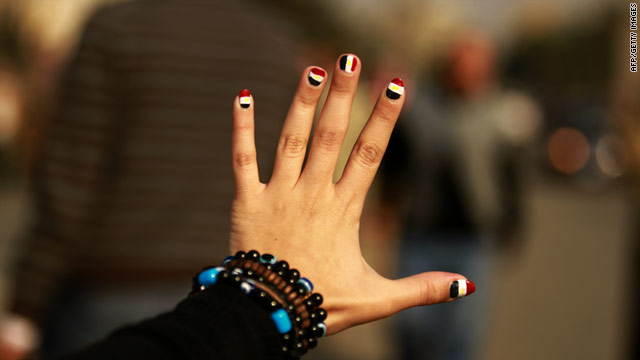
An Egyptian girl flashes her nails painted with the colors of her national flag in Cairo’s Tahrir Square.STORY HIGHLIGHTS
- If you are a woman living in Cairo, chances are you have been sexually harassed
- In 1994, shortly after I arrived in the city, a man walked up to me and casually grabbed my breast
- Behavior of men includes groping, stalking, lascivious looks and indecent exposure
- The only real protection women can have is when the attitudes of men change
Editor’s note: CNN producer and camerawoman Mary Rogers has lived and worked in Egypt since 1994. She joined CNN in 1981 and has covered conflicts in Somalia, Sierra Leone, the Congo, Iraq, Chechnya, Israel, Gaza, the West Bank, Lebanon and Afghanistan. Recently she filmed the uprising in Tunisia.
Cairo, Egypt (CNN) — Several months before the revolution, I wrote a piece for CNN.com on the sexual harassment of women in Cairo.
News of the chilling attack on CBS reporter Lara Logan, as well as other sexual assaults against women during Egypt’s uprising, show that attacks against women have not gone away.
I speak from experience. While most of my days covering Tahrir Square during the last few weeks were free from harassment, there was one day when I was groped. Another colleague almost had her pants ripped off by a gang of thugs.
If you are a woman living in Cairo, chances are you have been sexually harassed. It happens on the streets, on crowded buses, in the workplace, in schools, and even in a doctor’s office.
According to a 2008 survey of 1,010 women conducted by the Egyptian Center for Women’s rights, 98 percent of foreign women and 83 percent of Egyptian women have been sexually harassed.
It happens on the streets, on crowded buses, in the workplace, in schools, and even in a doctor’s office.
–Mary Rogers
I was walking home from dinner recently when a carload of young men raced by me and screamed out “Sharmouta” (whore in Arabic.)
Before I could respond, they were gone, but I noticed policemen nearby bursting with laughter. I am old enough to be those boys’ mother, I thought.
This incident was minor compared to what happened in 1994, shortly after I moved here. It was winter, and I was walking home from the office, dressed in a big, baggy sweater, and jacket. A man walked up to me, reached out, and casually grabbed my breast.
In a flash, I understood what the expression to “see red” meant. I grabbed him by the collar and punched him hard in the face. I held on to him, and let out a stream of expletives. His face grew pale, and he started to shake. “I’m sorry. I’m sorry,” he whispered.
But the satisfaction of striking back quickly dissipated. By the time I walked away, I was feeling dirty and humiliated. After a couple of years enduring this kind harassment, I pretty much stopped walking to and from work. Continue Reading →


 Thousands of Shi’ite protesters gather in the heart of the Bahraini capital of Manama today after a man was killed in clashes between police and mourners at a funeral
 A Bahraini boy mounts the Pearl Monument in Manama today and defiantly waves a flag as the protest grows


