
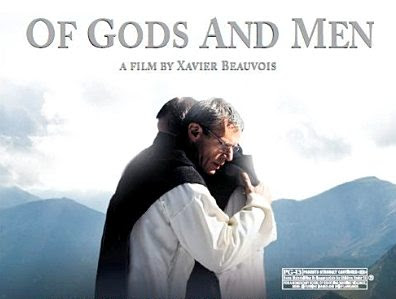
A French film entitled Of Gods and Men (Des hommes et des dieux), which won the Grand Prix at Cannes last year, has now been released with English subtitles. It is based on a true story of seven French monks kidnapped and massacred by Islamic bandits in Algiers in 1996.
Below is a review of the movie written for Gates of Vienna by the New York-based writer David Gurevich.

Of Gods and Men and Heroism of Faith
by David Gurevich
From pedophilia to corrupt Vatican banks, it has been a while since anyone in the media had a good word to say about the Catholic Church, one of biggest bêtes noirs of liberal media and artists. But in a new French movie by Xavier Beauvois called Of Gods and Men, such concerns are the last thing on the minds of eight monks quietly tilling their modest garden and treating villagers at the foot of Atlas Mountains in Algeria.
The monks are elderly and in poor health, but they happily persist in doing God’s work, and in between hoeing their garden and selling honey at the market and treating cases of eczema among local Arab children they never forget to praise the Lord. In fact, their choral singing, choreographed in a measured ascetic non-Hollywood way, makes for the most striking scenes. So how can such an unassuming group become a subject for such a richly dramatic and exceptionally timely film, based on the events that took place in Algeria in 1996?
Modernity invades abruptly. The anti-government Islamic Front issues an ultimatum: All foreigners must leave the country. At a nearby construction site, Croatian workers end up with their throats cut. The village elder’s granddaughter is stabbed for not wearing hijab. Finally, a local government official offers to post soldiers on the monastery territory (and is vehemently rejected) and then suggests that the monks should leave — “I can’t protect you.”
This is the real starting point when this deceptively simple routine of life of a religious community becomes a high drama of human heroism — and what inspires this heroism. Up until this scene, the Eight are rather nondescript old men in cassocks, save for their leader Christian (Lambert Wilson) and the elderly Dr. Luc (Michel Lonsdale).
As they debate whether they should leave or stay, they emerge as individuals, with their own human foibles and aspirations — one misses his family, his little grand-nephews and -nieces; yet he realizes that after so many years the monastery has become his real family, that serving God has glued them together as nothing else can, for it is the very meaning of the Faith and serving God that transcends human emotions. “I never meant to be a martyr,” says another. “But you already gave your life to God,” Christian argues.
And so they embark on this day-to-day struggle, trying to preserve faith in the face of everyday threats that come both from the Islamists who demand medical treatment and from the military who demand that the monks give up the rebels. And then there are the villagers who beg them to stay — “you are the branch, and we are the birds” — or, in other words, without you we’ll be done for. The monks cannot leave, and in a war like this the peaceful don’t survive. Continue Reading →




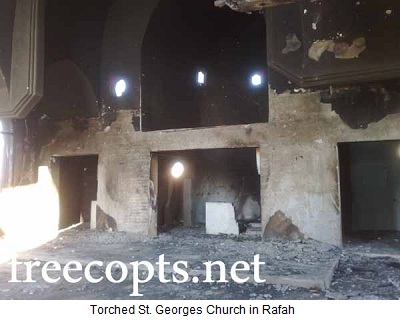 On September 15, 2010, an Islamic Jihadist Forum called Islamic Atahadi (Challenge) Network, which is said to be an affiliate of Al-Qaida, published on its website under the title “Images of the Church under construction in the Pyramids and how to demolish it.” The Forum showed photos of St. Mary and St. Michael church in Talbiya, which was still under construction, gave its members instructions on how to demolish the church by using sugar; “An easy and affordable way for the demolition of the church before its completion, no need for demonstrations, no need for the use of weapons or explosives, you only need to introduce certain quantities of sugar, yes normal sugar.” They went on to explain how to introduce reasonable quantities of sugar inside the forms prepared for pouring the columns, “because sugar affects concrete and cancels the chemical reaction which makes the sand and gravel hold together with the cement.” They advised in their step by step instructions that timing was very important in the process; the best time being immediately before pouring the roof.
 Father Rybinski; photo – salezjanie.pl