This is the same women who appeared on French TV recently to explain the real meaning and purpose of Islamic street prayers.
“The secret of all victory lies in the organization of the non-obvious.” -Marcus Aurelius

This is the same women who appeared on French TV recently to explain the real meaning and purpose of Islamic street prayers.
(Thank you M., Xanthippa, Richard and all who sent in materials today)
This agreement below, between Angela Merkel and Horst Seehofer, was moments ago handed to the press and tweeted out by the CSU MP Dorothee Bär.
Original translation:
“In order to better regulate, control and prevent secondary migration, we come to this agreement:
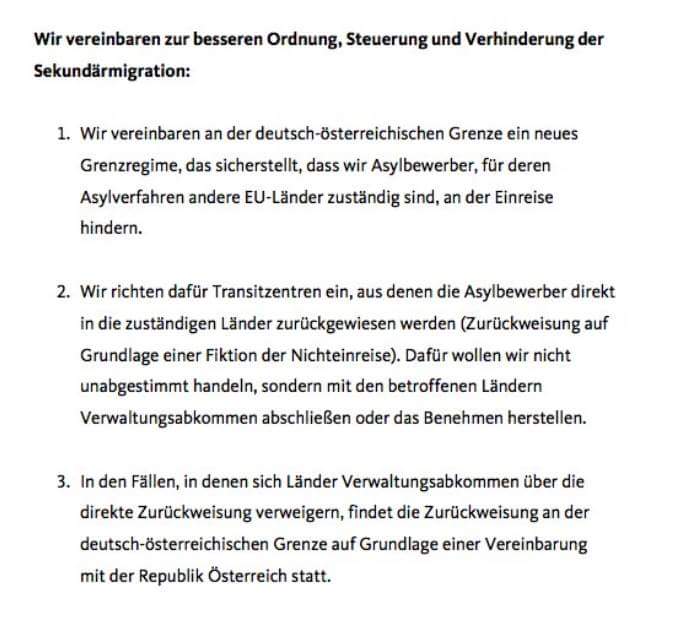
The original document as it was handed out to the press
Merkel’s part in this agreement is one single sentence: “We do not want to act uncoordinated, but come to administrative agreements, or establish communication, with the concerned countries.” This allows her to save face, while still conceding to Seehofer.
The true issue at the core of this was whether Germany has got sovereign national borders and can refuse people entry. Merkel, who ideally would like for Germany to dissolve into a supranational, non-democratic EU superstate, had, again, denied national sovereignty two weeks ago (“EU law should always have priority over German law”, on “Anne Will” talkshow on Sunday, June 10), which sparked the crisis between her and conservative new Interior Minister Seehofer. The media onslaught that ensued against Seehofer was so strong that nobody really expected him to come out of this alive.
This is an important day in the fight of Germans for their right to national self-determination, and to even exist as a nation.

Angela Merkel on her way to a crisis meeting this morning.
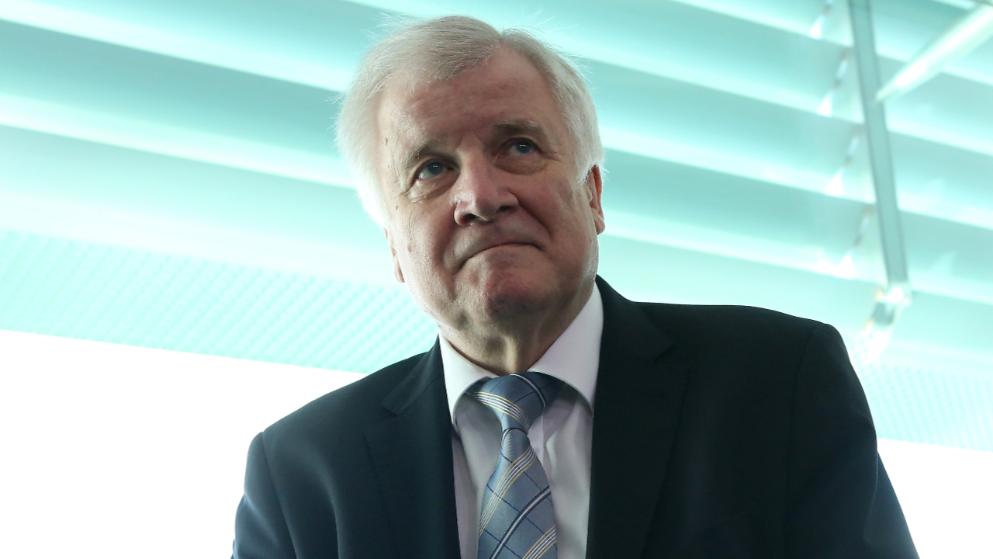
Merkel’s constestor, former Bavarian premier and new German Interior Minister Seehofer.
Local Community Attack Grooming Gang Suspects!
Angela Merkel’s challenger Horst Seehofer has announced to resign from his offices as German Interior Minster and head of the CSU, if no consensus can be reached over his demand to turn away illegal migrants at the border – a demand Merkel staunchly rejects.

Sunday’s CSU board meeting in Munich, photo: private/Facebook
On June 14, Merkel had asked Seehofer give her time to negotiate “European solutions” “with the same effect [as turning away illegal migrants at the border]” at this week’s European Summit (June 26.-27.).
The summit’s results were then presented to the German public as a full success; Merkel’s “European solution” was found; all countries had made concessions to Angela Merkel. No one in the German sphere seemed to realize that the negotiations were in fact a win for the countries who opposed migration (see Orban Wins At EU Summit: No One Takes Migrants They Don’t Want). Only yesterday, Saturday (June 30.), when Hungary, the Czech Republic and Poland sent out memos, refuting that they had made resolutions with Merkel, the German public slowly began to understand that they had been fooled.
Today’s CSU board meeting lasted until late in the night. Attendees passed details to the tabloid Bild: “Seehofer unmistakably made clear what he thought of Merkel’s negotiation results in Brussels: nothing.” He called the prior evening’s discussion with Merkel on the matter “pointless and ineffective”.
In the meantime, after Poland, Hungary and the Czech Republic, Greece’s Yanis Varoufakis came out in strong terms about Angela Merkel’s “European Solutions”:
“There is no deal really, this is a typical EU fudge. They have agreed on phrasing. They celebrated it, but this hides that there was no agreement on the substance.
They gathered in Brussels to reform the Dublin agreement, which was never designed to cope with mass migration flows. Also to resolve secondary migration, which the CSU demanded action on and even put the Merkel’s government in jeopardy over it.
It is a complete failure of the European Union that has been packaged as a success, but that isn’t new, is it?”
Around 10PM, news agencies suddenly reported that Seehofer had just resigned from his office as Interior Minister and leader of the CSU. The Süddeutsche Zeitung, Germany’s equivalent of the Guardian or the Washington Post, and state TV, immediately published obituaries on Seehofer.
A board member of the CSU though messaged that Seehofer had not resigned but offered his resignation, to test if he had the CSU’s full support for challenging Merkel. Seehofer allegedly stated that he had three options: to give in to Merkel, which he refused; to challenge her, for which he needed the party’s support, or to resign. According to members, the CSU expressed their support.
But when Seehofer finally left the building, he told attending press that he would resign from all offices within the next three days if no consensus on turning away illegal migrants at the border was found.
The outcome of all of this is entirely unpredictable at the moment. The way Merkel’s team are detached from reality – the majority of the population support’s Seehofer’s position – reminds of the end days of the DDR though.
H/T @AmyMek
THIS is Londonistan. Do not let yourselves fall as we have fallen. pic.twitter.com/AwsC0fSF6m
— Katie Hopkins (@KTHopkins) June 30, 2018
Thank you C for the translation.
Some chick just went nuts on the #Toronto cops and got herself arrested ? just every day walk. pic.twitter.com/Z1SWj0qac9
— Lauren Southern (@Lauren_Southern) June 29, 2018
This is really good. Thank you Richard.
Part 1. The man, his motives, his history:
Part 2: Breitbart, the media’s deceptions against non-leftists, the good guys in the FBI:
Part 3: Israeli far left, (Haaretz) media attacks on law enforcement, Walter Durante and the NYT leftist agenda