GREECE: ATTACK ON POLICE, EXPLOSION IN ATHENS

***@*****06.html” target=”_blank”>ANSAMED:

H/T Gates of Vienna:

ANSAmed) – ATHENS, OCTOBER 28 – A bomb went off this morning in Athens in front of an Olympiakos club in the Pangrati area, resulting in material damage but no injuries. The explosion occurred a few hours after a previous attack by anarchist-insurrectionary guerrilla forces against the police in which six police officers were injured (two critically), as well as one passer-by, by bullets shot from a Kalashnikov. Media sources report that the bomb this morning, of an unspecified force, was set off shortly after 4am local time (3am in Italy). A number of cars were also damaged. Minister for Public Order Michalis Chrisochoidis has said that “we are at war, and we will fight”. This morning’s explosion came almost as if in confirmation of the minister’s words. Yesterday’s attack was on a police station in the Agia Paraskevi district at the changing of shifts, resulting in more police officers present. A group of four, some of whom on motorcycles (three of which were later found) began shooting Kalashnikovs wildly and threw a smoke bomb in order to make their getaway. One of the police officers fired back and may have injured one of the attackers. The officer injured the most seriously, hit in the abdomen and chest with four bullets, has been operated on and is in critical but stable condition. Among those injured there is also a woman. No group has claimed responsibility for the attack but investigators believe that it must have been one of the most well-known groups, Revolutionary Struggle or the Sect of Revolutionaries. Chrisochoidis has been to see those injured and has ensured them that “Greece will not become a land of fear”, and that the response will be “rapid and decisive”. President Karolos Papoulias and all political groupings have condemned the “cowardly terrorist act”, which occurred only 12 hours after the Council for the Destruction of Order claimed responsibility for incendiary attacks in Thessaloniki against the offices of government representatives and the headquarters of the Italian-Greek Chamber of Commerce. (ANSAmed).
What is ‘desecration’ of a Koran exactly

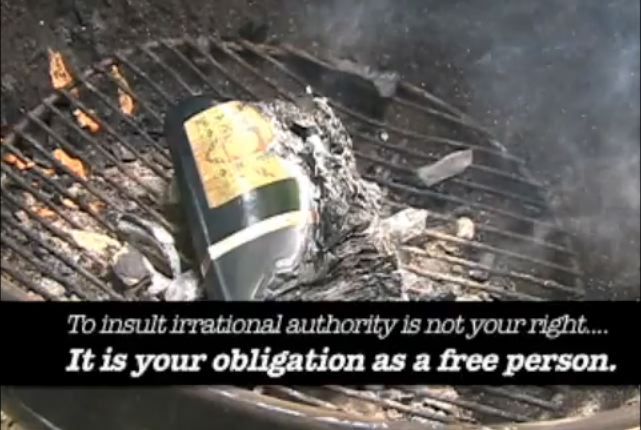
Koran burn insultLet’s see, we had riots in Greece when rumors circulated about a policeman ‘mistreating’ a koran, so I guess that is desecration, fair enough…

We had several Christians killed, their houses burned, and many families dislocated when Mosques trumpeted that one Christian family had torn a page from a Koran in Pakistan, so I guess that is desecration even when it was utterly untrue and again… well fair enough… sort of….

Then, we had some Muslims smuggling Heroin into Europe in a hollowed out Koran and no riots killings burnings or even condemnations at all so, I suppose, that is not a ‘desecration’. I suppose Mohamed must have been an apothecary…

And today, we have a koran hollowed out and bombs placed inside them in order to kill as many of the unwitting as possible in Iraq.

So, granted this is a small sample, but it gives us a place to start.

Desecration of Koran, therefore, must be when anyone not Muslim handles the holy book of Islam in any manner whatsoever that can be construed as disrespectful, and reported truly or falsely in that manner. Desecration of a koran is a tactic for political gain using the politically correct who think that a book is important merely because a non westerner says it is.

Desecration of a koran is not when that book is destroyed,mutilated or carved out for the purpose of advancing Islam in such ways as smuggling dangerous drugs to harm the infidel and raise money for jihad. It is not desecration when it is filled with explosives to kill other Muslims so long as those Muslims are of some other flavour than the bomber, as technically it’s still jihad to advance Islam.

Glad we cleared that up.

Eeyore

Yeay! Another instalment of, Cargo-Bike Imam! Travel:

This one is a lot more subtle than last nights homocidal extravaganza. In this, he merely extols children to spit on certain nations in Europe while praising other ones. Can you guess the criteria for what makes a good country and what makes a bad one?

Muslim Europe: the demographic time bomb transforming our continent

Telegraph News 

Muslim InvasionThe EU is facing an era of vast social change, reports Adrian Michaels, and few politicians are taking notice

Britain and the rest of the European Union are ignoring a demographic time bomb: a recent rush into the EU by migrants, including millions of Muslims, will change the continent beyond recognition over the next two decades, and almost no policy-makers are talking about it.

The numbers are startling. Only 3.2 per cent of Spain’s population was foreign-born in 1998. In 2007 it was 13.4 per cent. Europe’s Muslim population has more than doubled in the past 30 years and will have doubled again by 2015. In Brussels, the top seven baby boys’ names recently were Mohamed, Adam, Rayan, Ayoub, Mehdi, Amine and Hamza.

Europe’s low white birth rate, coupled with faster multiplying migrants, will change fundamentally what we take to mean by European culture and society. The altered population mix has far-reaching implications for education, housing, welfare, labour, the arts and everything in between. It could have a critical impact on foreign policy: a study was submitted to the US Air Force on how America’s relationship with Europe might evolve. Yet EU officials admit that these issues are not receiving the attention they deserve.

Jerome Vignon, the director for employment and social affairs at the European Commission, said that the focus of those running the EU had been on asylum seekers and the control of migration rather than the integration of those already in the bloc. “It has certainly been underestimated – there is a general rhetoric that social integration of migrants should be given as much importance as monitoring the inflow of migrants.” But, he said, the rhetoric had rarely led to policy.

The countries of the EU have long histories of welcoming migrants, but in recent years two significant trends have emerged. Migrants have come increasingly from outside developed economies, and they have come in accelerating numbers.

The growing Muslim population is of particular interest. This is not because Muslims are the only immigrants coming into the EU in large numbers; there are plenty of entrants from all points of the compass. But Muslims represent a particular set of issues beyond the fact that atrocities have been committed in the West in the name of Islam. Continue Reading →

Stratfor: Return of classical terrorism. Greece

By Fred Burton and Ben West

stratfor-logo

Greek anti-terrorism police officer Nektarios Savas was shot and killed June 17 while guarding a state witness in an Athens neighborhood. Savas was parked in an unmarked vehicle outside the residence of Sofia Kyriakidou, the wife and key witness in the trial of Angeletos Kanas, a convicted member of a defunct Greek militant group. At 6:20 a.m., shortly after sunrise in Athens, Savas had just gotten coffee and was settling in for his shift when two gunmen approached his vehicle and fired 24 rounds into it, hitting him 18 times and wounding him fatally. The assassins then sped away on motorcycles driven by two other accomplices. Savas was never able to draw his weapon.

Although the witness Savas was protecting was in the house at the time of the shooting, the gunmen do not appear to have made any attempt to harm her.

Two groups claimed responsibility for the murder, “Revolutionary Sect” and “Rebel Sect,” but groups using slight variations of these names have claimed responsibility for dozens of attacks so far this year. It is very common for militant groups to claim responsibility for attacks using different names to confuse their pursuers. We believe the group behind most of the recent attacks is “Revolutionary Struggle” (EA).

EA (its initials in Greek) is thought to be a spinoff from the Greek terrorist group November 17 (N-17) and has been operational since at least October 2003. It shares a similar ideology with N-17, which rejected democracy, capitalism and outside influence in Greece — especially from the United States. EA rejects EU policies in Greece that it claims hurt the working class. EA was very vocal in the run-up to the 2004 Olympics in Athens, carrying out attacks against businesses and the police to protest the high levels of security in the country and the high price tag that came with hosting the games. Continue Reading →

ATHENS, June 17, 2009 (Reuters) — Two gunmen shot dead a Greek anti-terrorist policeman guarding a witness in Athens on Wednesday then fled on a motorcycle, police said.

ATHENS, June 17, 2009 (Reuters) — Two gunmen shot dead a Greek anti-terrorist policeman guarding a witness in Athens on Wednesday then fled on a motorcycle, police said.47540871

In the worst attack since riots in December launched a wave of urban guerrilla violence in Greece, the 41-year-old officer was shot several times at close range and died in his car in the densely populated Patissia area of Athens.

“It was a cold-blooded murder … they just drew their guns and murdered him,” police spokesman Panagiotis Stathis told reporters at the scene.

The recent violence has rocked Greece’s conservative government, clinging to a one-seat majority in parliament as its popularity plummets, mainly as a result of a slowing economy.

The early morning attack was similar to the shooting of a policeman in January, claimed by the Revolutionary Struggle urban guerrillas, Greece’s most militant leftist group. That officer survived the attack.

In Wednesday’s shooting, the policeman and father of one child, had just taken over a shift guarding a witness involved in a case against an urban guerrilla group.

The unidentified attackers quickly disappeared in the streets of Patissia and a manhunt was launched in the area to locate them.

Police said there was no warning or any claim of responsibility for the attack, the latest of several against the police in Greece this year.

Leftist and anarchist guerrilla groups have launched a wave of violence against police, political and business targets since a policeman shot dead a teenager in Athens in December, prompting Greece’s worst riots in decades.

There was no immediate reaction to the attack from the government.

(Reporting by Dina Kyriakidou, Editing by Ralph Boulton)