
Australians must be howling over the name of this East Euro state. Ask one what a ‘Dag’ is sometime.
Category Archives: Russia
Chechen rebels order separatist leader death-website
25 Aug 2009 07:54:05 GMT
Source: Reuters
MOSCOW, Aug 25 (Reuters) – Chechen rebels called on Tuesday for prominent separatist leader Akhmed Zakayev to be killed, saying he had abandoned Islam by recognising the legitimacy of the restive region’s Kremlin-backed government. Zakayev, who lives in London, represents the moderate wing of the separatist movement and has clashed with radical Islamist insurgents in Russia’s southern republic of Chechnya. Islamist rebel website www.kavkazcenter.com said Zakayav had recognised the authority of Ramzan Kadyrov, the Kremlin-backed leader of the region. “Public remarks show that he (Zakayev) has fallen away from Islam,” the website said, adding that Doku Umarov, Chechnya’s most wanted separatist leader, was behind the order. “The court has ruled that the killing of this apostate is a duty for Muslims.” It did not say what court had issued the ruling. Zakayev, 50, fought Russia as a senior rebel commander in two wars with Moscow in 1994-2000. After Russia regained control of the province, he fled to Europe and acted as an official rebel envoy until 2007. Russia has tried to extradite Zakayev for 13 alleged crimes including kidnapping and murder, but a British court rejected the request in 2003, causing a diplomatic row. Kadyrov said last month that he would welcome Zakayev’s return and possibly offer him a job in the regional culture ministry. But there were no indications Russia was ready to drop charges against him. Kadyrov faces strong criticism from human rights bodies after kidnappings and killings of human rights and charity activists in Chechnya. He denies any link to the killings. (Reporting by Amie Ferris-Rotman, editing by Tim Pearce)
Nuclear riddle of missing ship as pirates demand a £1m ransom
Although there is no reported connection with Islam in this story, it has all the signs of being just that. So I will go out on a limb [a strong limb] and tag it with Islam. 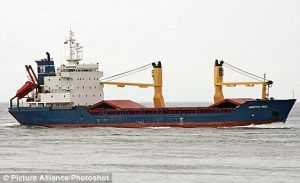
MailOnline…Pirates last night demanded a ransom of almost £1million for the release of the cargo ship which sparked an international search after vanishing from the English Channel a fortnight ago.
Police in Finland confirmed the ransom demand was made to the Finnish owners of the 4,000-ton Arctic Sea and that the case was now being treated as ‘a hijacking with aggravated extortion’.
They said the armed gang had warned they would pose a ‘threat to the life and health’ to the 15 Russian crewmen on board unless their demands are met.
The ransom demand came as The Mail on Sunday established radiation tests were carried out at the port of Pietarsaari in western Finland, where the Maltese-flagged ship Arctic Sea started its voyage.
The Turkish-built vessel, which was carrying £900,000 worth of timber, is feared to have been stormed by pirates looking for a ‘secret cargo’.
The fact that nuclear tests were conducted will fuel speculation that the ship did have a hidden cargo.
Enquiries by this newspaper have established that no checks were carried out on what was being transported in the hold prior to its departure from Finland on July 23.
And the FSB, the Russian security service, as well as MI5 have been involved in the investigation into the hijacked vessel.
Last night Finnish Detective Chief Superintendent Jan Nyholm said: ‘Yes, it is true that there has been a demand for ransom in cash and that it was made to the company which owns the ship, Solchart Management in Finland.’
Another police spokesman, Markku Ranta-Aho, said the ransom demand was for less than $1.5million (£900,000) – that it was ‘significant, but not huge’.
Finnish police also suggested the armed gang demanding the ransom were the same bandits who boarded the vessel off Sweden on July 24 – although other sources claimed it was a different group.
The police released the information after a news blackout during which they had tried to trace the ship, but did not say when the ransom demand was made. They said the hijackers had not been in touch with them.
It is the first time in modern maritime history that a ship has disappeared without trace in European shipping waters.
Until now, ship hijackings have been confined to Somali pirates seizing vessels off the coasts of Africa and in the Indian Ocean.
Yesterday there were reports that the Arctic Sea’s automatic identification system – which helps locate its whereabouts – briefly emitted a signal from the Bay of Biscay,
300 miles west of La Rochelle on France’s east coast. Continue Reading →
Muslim Gang kills seven in Russian sauna
 BBC NEWS…Russian police are hunting gunmen who killed seven women at a sauna and four policemen at a checkpoint in the troubled southern region of Dagestan.
The attack happened on Thursday in the town of Buynaksk, 41km (25 miles) from the regional capital Makhachkala.
Police say they know the identities of some of the gunmen, who fled into a forest after the attack.
Separately, four policemen and two militants were killed in a clash near Grozny, in neighbouring Chechnya.
Moscow has been keen to portray Chechnya and the region as an area returning to normal after years of unrest.
But these latest attacks form part of a wider pattern: a growing anti-Kremlin, Islamist insurgency that appears to be spreading across the North Caucasus, the BBC’s Gabriel Gatehouse reports.
On Friday police shot and killed three militants near a village in Dagestan’s Derbent district, officials say.
In Thursday’s attack in Dagestan, at least 15 gunmen opened fire on a traffic police checkpoint on the edge of Buynaksk, Russian media quoted local police as saying.
The gunmen are reported to have hijacked a minibus, which they later abandoned.
They went on to attack a sauna at a nearby health complex, killing seven women workers there.
Dagestan has been plagued by violence in recent years, much of it linked to the conflict between security forces and separatist rebels in Chechnya, a mainly Muslim Russian republic.
Russian forces have fought two wars against Islamist rebels in Chechnya since 1994. The conflicts claimed more than 100,000 lives and left it in ruins.
Clashes with militants are also common in Ingushetia, which borders on Chechnya to the west.
Stratfor: Iran, Russia, when is Obama Bush?
Very interesting analysis by Stratfor on Iran and Russia. I find the way they think facinating and agree or no, there is a lot to learn in this analysis. In foreign policy the ways Obama is identical to, and in some ways, more Bush than Bush is worth the read alone. Enjoy and please do comment.
Eeyore
Hypothesizing on the Iran-Russia-U.S. Triangle
August 10, 2009
By George Friedman
For the past several weeks, STRATFOR has focused on the relationship between Russia and Iran. As our readers will recall, a pro-Rafsanjani demonstration that saw chants of “Death to Russia,” uncommon in Iran since the 1979 revolution, triggered our discussion. It caused us to rethink Iranian President Mahmoud Ahmadinejad’s visit to Russia just four days after Iran’s disputed June 12 presidential election, with large-scale demonstrations occurring in Tehran. At the time, we ascribed Ahmadinejad’s trip as an attempt to signal his lack of concern at the postelection unrest. But why did a pro-Rafsanjani crowd chant “Death to Russia?” What had the Russians done to trigger the bitter reaction from the anti-Ahmadinejad faction? Was the Iranian president’s trip as innocent as it first looked?
A Net Assessment Re-examined
At STRATFOR, we proceed with what we call a “net assessment,” a broad model intended to explain the behavior of all players in a game. Our net assessment of Iran had the following three components:
Despite the rhetoric, the Iranian nuclear program was far from producing a deliverable weapon, although a test explosion within a few years was a distinct possibility.
Iran essentially was isolated in the international community, with major powers’ feelings toward Tehran ranging from hostile to indifferent. Again, rhetoric aside, this led Iran to a cautious foreign policy designed to avoid triggering hostility.
Russia was the most likely supporter of Iran, but Moscow would avoid becoming overly involved out of fears of the U.S. reaction, of uniting a fractious Europe with the United States and of being drawn into a literally explosive situation. The Russians, we felt, would fish in troubled waters, but would not change the regional calculus.
This view — in short, that Iran was contained — remained our view for about three years. It served us well in predicting, for example, that neither the United States nor Israel would strike Iran, and that the Russians would not transfer strategically significant weapons to Iran.
A net assessment is a hypothesis that must be continually tested against intelligence, however. The “Death to Russia” chant could not be ignored, nor could Ahmadinejad’s trip to Moscow.
As we probed deeper, we found that Iran was swirling with rumors concerning Moscow’s relationship with both Ahmadinejad and Ayatollah Ali Khamenei. Little could be drawn from the rumors. Iran today is a hothouse for growing rumors, and all our searches ended in dead ends. But then, if Ahmadinejad and Khamenei were engaging the Russians in this atmosphere, we would expect rumors and dead ends.
Interestingly, the rumors were consistent that Ahmadinejad and Khamenei wanted a closer relationship to Russia, but diverged on the Russian response. Some said the Russians already had assisted the Iranians by providing intelligence ranging from Israeli networks in Lebanon to details of U.S. and British plans to destabilize Iran through a “Green Revolution” like the color revolutions that had ripped through the former Soviet Union (FSU).
Equally interesting were our Russian sources’ responses. Normally, they are happy to talk, if only to try to mislead us. (Our Russian sources are nothing if not voluble.) But when approached about Moscow’s thinking on Iran, they went silent; this silence stood out. Normally, our sources would happily speculate — but on this subject, there was no speculation. And the disciplined silence was universal. This indicated that those who didn’t know didn’t want to touch the subject, and that those who did know were keeping secrets. None of this proved anything, but taken together, it caused us to put our net assessment for Iran on hold. We could no longer take any theory for granted. Continue Reading →
Russia takes notes on Iran, and Twitter
Interestingly, Russian cyberwar artists seem to have managed to keep Twitter off line for several consecutive days now. Why one may wonder, would Russia spend any resources to make sure Twitter cannot function.
As Stratfor reported, there is a Georgian blogger who is well read and respected who routinely posts to Twitter as well as his own blog. Clearly, Moscow noticed the extent to which Twitter played a part in fomenting a peoples rebelion in the streets of Iran.
Below, the Stratfor report:
Georgia: Single Blogger Targeted Through Attacks on Social-Media Sites
August 7, 2009
With a single Georgian blogger as the target, Twitter, Facebook, LiveJournal and Google’s Blogger were attacked with Twitter facing a site-wide outage, CNET News reported Aug. 6, citing Max Kelly, chief security officer at Facebook. “It was a simultaneous attack across a number of properties targeting him to keep his voice from being heard,” Kelly said of the blogger with the account name “Cyxymu,” which is the name of a Georgian town.
Twitter taken out by DDOS attack. Target Georgian blogger
This SITREP from Stratfor, explains why Twitter was down all day yesterday, and shows other targets of the DDOS attack.
Georgia: Single Blogger Targeted Through Attacks on Social-Media Sites
August 7, 2009
With a single Georgian blogger as the target, Twitter, Facebook, LiveJournal and Google’s Blogger were attacked with Twitter facing a site-wide outage, CNET News reported Aug. 6, citing Max Kelly, chief security officer at Facebook. “It was a simultaneous attack across a number of properties targeting him to keep his voice from being heard,” Kelly said of the blogger with the account name “Cyxymu,” which is the name of a Georgian town.
Russia, Georgia: Georgian Blogger Blames Moscow For Attack
August 7, 2009
The Georgian blogger known as Cyxymu blamed the Kremlin for the attack on Aug. 7, The Guardian reported. Cyxymu was the target of a cyberattack on Aug. 6 that affected hundreds of millions of Web users. “Maybe it was carried out by ordinary hackers but I’m certain the order came from the Russian government,” Cyxmu said. Cyxmu is the Latinized name for Abkhazia, one of Georgia’s breakaway republics. Cyxmu, who gave his real name as Georgy, is an active critic of Moscow’s politics in the Caucasus and was the victim of a similar attack last year that crashed LiveJournal.
Stratfor: Analysis on Obama’s Russia trip. Interesting.
Second war in Georgia imminent?
Multiple analysts are speculating that Russian recent activities such as vetoing continuation of the OSCE observation mission point towards plans for Second Russia-Georgia War shortly after the Kavkaz 2009 exercise by Russia. Last year’s Russia-Georgia War began after the Kavkaz 2008 exercise.

Postimees citing BNS citing kasparov.ru citing Andrey Illarionov: http://www.postimees.ee/?id=135012
The Moscow Times, Yulia Latynina: <http://www.themoscowtimes.com/article/1029/42/379020.htm>
Times Online, Tony Halpin: <http://www.timesonline.co.uk/tol/news/world/europe/article6571961.ece>
Thank you to our friend in Russia’s near far.
Police killed in Dagestan attacks

Chechen Muslim points to ringleader
BBC NEWS- Two police officers have been killed and two others wounded in a series of attacks in the southern Russian republic of Dagestan, officials say.
In the first incident, a police major was shot in the head while on his way to work in the capital, Makhachkala.
Another officer who had taken part in an operation to arrest gunmen suspected of killing a policeman three days ago later died in a gun battle in the city.
Police chief Shamil Guseinov said two militants involved were then shot dead.
Overnight, two other policemen were wounded when their car was attacked by gunmen on a road in Dagestan.
The Caucasus republic has long been plagued by violence often linked to Muslim separatist rebels in neighbouring Chechnya.
Last week, Dagestan’s Interior Minister, Adilgerei Magomedtagirov, was shot dead at a wedding reception in Makhachkala.
The leader of the Jamaat Shariat rebel group on Thursday issued a statement on its website claiming responsibility for the killing.
“We carried out a special operation to annihilate God’s worst enemy and one of the leaders of blasphemy in Dagestan,” said Ibragim Gadzhidadayev, who is wanted for the murder of a Dagestani MP.
Russia losing the Islamist war in Dagestan
From a Russian News source:
(Please click here for video of Dagestan capitol city)

Daghestan’s interior minister shot dead in south Russia
Hat tip Jdamn:
MAKHACHKALA, June 5 (RIA Novosti) – The interior minister of the southern Russian republic of Daghestan was assassinated on Friday afternoon while at a wedding reception in the capital, Makhachkala.
Lt. Gen. Adilgerei Magomedtagirov, 52, was wounded in the heart and died in hospital without regaining consciousness, an Interior Ministry spokesman said.
Preliminary reports said Magomedtagirov was shot when a sniper opened fire from the rooftop of a neighboring building at him and several other high-level officials as they walked out of the restaurant at approximately 1:00 pm [10:00 GMT].
Meanwhile, a source in the Interior Ministry said there could have been the second sniper who fired from a building on the opposite side of the street. The source said that Magomedtagirov’s bodyguards returned fire.
Several Interior Ministry officials were hospitalized after the incident, including the head of the anti-tax crime department, Abduldzhapar Magomedov, the father of the bride.
Abdurazak Abakarov, head of logistics at the ministry, also died in hospital while four other members of the group have undergone surgery and are said to be in a serious condition. One man was discharged after receiving treatment.
Security in Makhachkala has been tightened following the incident. Daghestan has seen a rise in violence linked both to militants based in neighboring Chechnya and local criminal groups. Continue Reading →
Islamist insurgency in Dagestan
from the BBC
Russia recently ended its decade-long “counter-terrorism operation” against separatist rebels in the neighbouring republic of Chechnya, but the fighting has spilled into other regions.
[kaltura-widget wid=”c4lox5dhfu” width=”410″ height=”364″ addpermission=”3″ editpermission=”3″ /]
Excellent analysis on the demonization of Israel and what proportion really means.
From The Australian:
FEW places on earth have been as systematically brutalised over the past decade as Chechnya. So you might have thought that the Russian Government’s decision last week to declare an end to its “counter-terrorism” operations in the territory would have been an occasion for sombre reflection in the Western media. Forget it. It’s a 600-word news item at best.
Here’s a contrast to ponder. Since the beginning of the second intifada in the autumn of 2000, about 6000 Palestinians have been killed by Israeli fire. That figure includes combatants as well as those killed in January’s fighting in Gaza.
As for Chechnya, there are no solid figures for the number of civilians killed since the second war began in late 1999; estimates range from 25,000 to 200,000. Chechnya’s population, at a little more than one million, is about one third or one fourth that of the Palestinians. That works out to between 25 and 200 Chechen deaths per 1000 as against 1.5 to two Palestinian deaths per 1000.
Now type the words Palestine and genocide into Google. When I did so on Monday, I got 1,630,000 results. Next, substitute Chechnya for Palestine. The number is 245,000.
Taking the Google results as a crude measure of global outrage, that means the outrage over the Palestinian situation was 6.6 times greater than over the Chechen one. Yet Chechen fatalities were between 13 to 133 times greater.
Final calculation: With an outrage ratio of 6.6 to one, but a proportional kill ratio of one to 13 (at the very low end), it turns out that every Palestinian death receives somewhere in the order of 28 times the attention of every Chechen death. Remember that in both cases we’re mainly talking about Muslims being killed by non-Muslims.
I’ll admit this math exercise is a bit of a gimmick. But it raises a worthwhile question: Why is Palestinian life so dear in the eyes of the world, and Chechen life so cheap?
Maybe the answer is that the Palestinian cause is morally worthier than that of Chechnya. But that can’t be right. Yes, Chechen terrorists have committed spectacular atrocities, notably the 2004 Beslan school massacre. Yet modern terrorism is a genre Palestinians practically invented. As it is, Chechnya has been suffering grievously under Russia’s thumb since the 1800s. (Just read Tolstoy’s Hadji Murad.) If colonialism is your beef, the case for Chechen independence is inarguable.
Maybe, then, the answer is that there is no shortage of imagery of Palestinian death, and thus it engages more of the world’s attention. By contrast, the Russians imposed a virtual media blockade on Chechnya, and journalists who covered the story, such as Anna Politkovskaya, had a way of ending up dead.
But imagery need not be televised to be vivid, nor does the world lack for testimonials of Russian brutality. “I remember a Chechen female sniper,” a Russian soldier told Los Angeles Times reporter Maura Reynolds. “We just tore her apart with two armoured personnel carriers, having tied her ankles with steel cables. There was a lot of blood, but the boys needed it.”
Maybe it’s that the Israeli-Palestinian conflict is simply more important strategically than Russia’s war against Chechnya, in the same way that the attacks of 9/11 mattered more in the scheme of things than, say, atrocities by the Tamil Tigers in Sri Lanka.
Yet even before 9/11, there was evidence that al-Qa’ida was feeding money and arms to Chechen fighters, putting Chechnya squarely into the context of what became the global war on terror. Evidence of al-Qa’ida involvement in the Israeli-Palestinian conflict is sparser and only came to light in 2007.
Of course, the Israeli-Palestinian conflict inflames the Muslim world in a way the Chechen one does not. But why is that, when so many more Muslims are being victimised by Russia?
Then too, why does the wider world participate in the Muslim world’s moral priorities? Why, for instance, do high-profile Western writers such as Portuguese Nobel laureate Jose Saramago make “solidarity” pilgrimages to Ramallah but not to the Chechen capital of Grozny? Why do British academics organise boycotts of their Israeli counterparts but not their Russian ones?
Why is Palestinian statehood considered a global moral imperative, but statehood for Chechnya is not?
Why does every Israeli prime minister invariably become a global pariah, when not one person in 1000 knows the name of Chechen President Ramzan Kadyrov, a man who, by many accounts, keeps a dungeon near his house in order to personally torture his political opponents? And why does the fact that Kadyrov is Vladimir Putin’s handpicked enforcer in Chechnya not cause a shudder of revulsion as the Obama administration reaches for the reset button with Russia?
I have a hypothesis. Maybe the world attends to Palestinian grievances but not Chechen ones for the sole reason that Palestinians are, uniquely, the perceived victims of the Jewish state. That is when they are not being victimised by other Palestinians. Or being expelled en masse from Kuwait. Or being excluded from the labour force in Lebanon. Things you probably didn’t know about, either.
As for the Chechens, too bad for their cause that no Jew is ever likely to become president of Russia.
Accessed 22 April 2009, http://www.theaustralian.news.com.au/story/0,25197,25367401-7583,00.html
09-04-22, Brett Stephens, “Outrage reserved for Israel,” theaustralian.news.com.au, 22 April 2009, http://www.theaustralian.news.com.au/story/0,25197,25367401-7583,00.html (accessed 22 April 2009).
Hat tip INSIGNIS
Ukraine Says 3 Tried to Sell Nuclear Bomb Material
The Russian was made to believe by undercover agents that the radioactive material was to be delivered to a Muslim organization.
MOSCOW — The metal cylinder supposedly contained eight pounds of plutonium 239, a highly dangerous radioactive material that could be used in a nuclear weapon or a dirty bomb. The price: $10 million, sought by three Ukrainian men, officials said Tuesday.
The men did not make a sale, the officials said, but were arrested in an undercover operation in Ukraine last week that was conducted by the Ukrainian Security Service. Still, while the plot was foiled, it underscored longstanding concerns that unsecured radioactive material in the former Soviet Union might fall into the wrong hands.
Marina Ostapenko, a spokeswoman for the Ukrainian Security Service, said it had turned out that the radioactive material was not plutonium 239. A preliminary analysis indicated that the material was most likely americium, a much more common and less potent radioactive material, Ms. Ostapenko said in a telephone interview from Kiev, the Ukrainian capital.
She said americium could be deployed in a dirty bomb but not in a nuclear weapon.
“They wanted to sell it as plutonium,” she said. “They were asking for $10 million for it because they thought that it was plutonium.”
Ms. Ostapenko declined to disclose further details and she would not identify the three men who were arrested, other than to say that one was a lawmaker in the western region of Ternopol, and the other two were local businessmen.
The men were arrested last Thursday and charged with illegally handling radioactive materials. If convicted, they could face up to 15 years in prison, officials said.
In a statement, the Ukrainian Security Service said it had determined that the radioactive material was produced in Russia before the Soviet Union’s collapse in 1991 and might have been smuggled into Ukraine from a nearby country.
Ukraine has no nuclear weapons, though it does have nuclear reactors and was the site of the Chernobyl accident. All of the former Soviet republics have repudiated nuclear weapons, with the exception of Russia, which inherited the Soviet arsenal.
Experts have repeatedly warned that poor safeguards, political instability and widespread corruption in the former Soviet republics could make it possible for people to obtain nuclear materials and sell them.
The American government has spent hundreds of millions of dollars in recent years to try to help governments in Russia, Ukraine and other former republics protect nuclear materials.
In 2006, officials in the former Soviet republic of Georgia aressted a Russian man who was offering to sell 100 grams of highly refined uranium, about 3.5 ounces, for $1 million. The Russian was made to believe by undercover agents that the radioactive material was to be delivered to a Muslim organization.
Iran, nuclear weapons and the big question.
According to a Stratfor.com’s assessment of the recent IAEA report, Iran has significantly higher amounts of low enriched uranium, yet a slow down of progress at a processing plant and a dome built at the Arak heavy water facility in order to prevent satellite photos from being taken. Also, only 136 new centrifuges have been built to augment Iran’s existing 3600 centrifuge cascades.
I will do my best to decrypt this information. I am certain I will make many errors. Anyone wishing to correct any factual errors would be most appreciated should they choose to do so in the comments section below this article.
To make a bomb by enriching U238 into U235 you need to have approximately 93%+ pure U235. To make fuel for a reactor you need 5% or less. Low enriched presumably means way more than enough for a reactor but perhaps not quite enriched enough to make nuclear weapons.
Iran appears to have a two fold plan for the manufacture of nuclear weapons simultaneously. One, is the refinement of U238 into U235 by means of high speed centrifuges to isolate the U235 from the host ore, U238. The refined product post centrifuge is easily made into materials that will detonate a nuclear explosion of the kind we are so familiar with. I wish to be clear on this as there are many terms often used which are confused for each other and which are themselves confusing. U235 with little technology can be fashioned into a nuclear bomb of a Hiroshima or larger size weapon fairly easily. The difficulty comes from obtaining the material to detonate, the U235. Iran is reported to have as stated above, 3600 + 136 arrays presumably working 24/7 to obtain the necessary materials for a bomb. It is through the use of these centrifuges designed and sold by Pakistani nuclear technician A. Q. Khan that this material, U235 is produced. Please watch this documentary for a good in depth analysis on Khan and his centrifuges and how they are used to make nuclear weapons.
I have no idea how many bombs of what size can be produced per unit time using this method but the IAEA some years ago stated they believed that Iran had enough refined U235 to make 10 bombs and that was years ago.
Here is a BBC report which specifies the 10 bomb number
The second method is reprocessing Uranium after it has been through a nuclear reactor for another isotope, ‘plutonium’. If you have the right kind of reactor and reprocessing plant weapons grade plutonium is relatively easy to get but making the bomb is quite difficult. Instead of needing 2 polished hemispheres of U235 which are forced to slam together with a common explosive like Semtex, a commercial plastic explosive, plutonium needs to be made into a complex array of parts of a sphere with very precisely machined explosives all around in complex geometries. In the US, these are sculpted by experts using remote control robots carefully crafted at distances away of miles and monitored on screens. In essence, a U235 bomb is easy to make but the materials are hard to get. A plutonium bomb is hard to make but the materials are easy to get. Both kinds of bombs are still massive public works projects of course. The US project for the first atomic weapons may have been the largest public works project ever done including the pyramids up to that point.
Many speculate that Iran is playing at developing nuclear weapons as a bargaining chip to gain access and authority in Iraq. North Korea seems to have done the same except they did indeed develop nukes and have been instrumental in assisting Iran and it’s partial proxy Syria in developing the technology to build weapons of the plutonium variety as we see from this recent report on the isotopes found at the Syrian facility bombed over a year ago by Israel.
So lets examine what is known about Iran and nuclear weapons.
Iran seems to be doing everything possible to manufacture them and makes frequent albeit veiled references to their intended use on Israel and the USA.
The UN based IAEA has made statements saying that Iran likely has the materials to make several nuclear weapons. The UN itself, seems to be a pawn in many ways of the OIC so one may choose to accept that the UN would understate the development program to facilitate Iran’s program or one may not. Even if you do not the IAEA seems to indicate that development is advanced.
Several reports show that Syria was indeed using North Korean technology to develop nuclear weapons of the plutonium variety from the CIA to Israeli intel, including today’s reports on various specific isotopes that where found at the site the Israeli’s bombed a little over a year ago.
The USA is so keen on placing anti ballistic missile sites in the Caucasus and central Europe against Iranian missiles they are prepared to have serious conflicts with Russia on the matter. Ultimately Russia may choose to join the project as both parties seem to feel the Iranian threat is real. Russia actually has more to worry about from Iran than the US does in some ways which may explain why Russia delayed building a reactor for Iran for over 12 years past its promised operational date. However, more and more evidence is appearing that Iran intends to use its nukes to create an EMP effect, which would have more devestating consequences to the US and the west than a direct strike on a city.
Here is a link to an excellent Stratfor analysis about the Iranians nuclear weapons program. There is tons of really solid information here. However I suspect that the Iranians have and are capable, of moving a lot faster than they predicted. This article was written before the recent tests of 2 stage solid fuel rocket tests which would indicate an ability to launch a nuclear weapon in position for an EMP. It is well worth reading anyway. Most of that they say does apply and stratfor gets more right than wrong. But I wonder if they would revise this now. Iran seems qutie advanced on the programs and the US and Russia clearly take it very seriously.
Lastly, I would suggest to anyone interested in this subject to sit back and watch this most excellent lecture on the manufacture of nuclear weapons and as en passant remarks, the speaker, a professor of nuclear physics at Cal Tech, explains much of the reasons for the Iraq invasion and the WMD issue there. Cal Tech is where nuclear weapons where invented. It really is a fantastic lecture.
I will be updating and editing this for some time for clarity as I think this is an important subject and one on which information is scarce, obtuse and usually incomprehensible. I very much would like to make this a sort of decoder ring for much popular press reporting on the issue. Most reporters of course have little understanding of the issues and so do not represent the information at all well. Please feel free to email me or add thoughts and corrections in the comments section to help clarify this.
Eeyore for Vlad