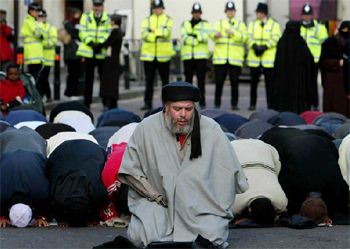
Taliban officially reneges on it’s side of the ‘peace deal’ with Pakistan

Taliban suspend peace talks with Pak govt

Press Trust of India, Monday April 27, 2009, Islamabad
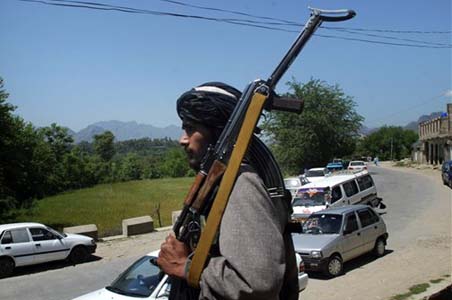
Taliban on Monday suspended talks with the Pakistani government on the Swat deal to protest against the military operations in Dir, adjoining Swat Valley, in which so far 30 militants and an army officer have been killed.

As the Pakistani forces intensified the operations for second day on Monday, Tehrik-e-Nifaz-e-Shariah Muhammadi spokesman Izzat Khan told reporters that no peace talks would be held with the government unless the security forces halted the operations.

Taliban spokesman Muslim Khan also said the militants will not lay down their arms at any cost. The Swat peace deal stipulated that the militants would lay down their arms once the demand for enforcing Islamic Sharia law in the once Pakistan’s famous tourist resort was implemented.

Continue Reading →

Depressing news out of Pakistan

From The Guardian UK:


Their deaths were squalid, riddled with bullets in a field near their home by Taliban gunmen as the execution was captured on a mobile telephone.

In footage which is being watched with horror by Pakistanis, the couple try to flee when they realise what is about to happen. But a gunman casually shoots the man and then the woman in the back with a burst of gunfire, leaving them bleeding in the dirt.

Moments later, when others in the execution party shout out that they are still alive, he returns to coldly finish them with a few more rounds.

Their “crime” was an alleged affair in their remote mountain village controlled by militants in an area that was only recently under the government’s sway. It was the kind of barbarity that has become increasingly familiar across Pakistan as the Taliban tide has spread.

But this time, with black-turbaned gunmen almost at the gates of Islamabad, the rare footage has shown urban Pakistanis what could now await them.

Admiral Mike Mullen, chairman of the United States Joint Chiefs of Staff, has warned that Islamic extremists could take over the nation.

In the past few days the footage has circulated among Pakistanis who usually show little interest in the rough ways of the distant frontier regions.

They have now started to wake up to the fear that al-Qaeda-linked rebels from the frontier could take over their nation.

The killings happened in Hangu district, in North West Frontier Province, about two hours drive from the regional capital Peshawar. The punishment was administered by a local group of the Pakistani Taliban, the Islamic militia which has swept across the NWFP towards the capital Islamabad.

Continue Reading →

Taliban pushes Pakistan to the brink

From The National Post April 24:

Taliban fighters have taken control of strategic sites and could strike at Pakistan's largest dam and sites holding nuclear weapons.ReutersTaliban fighters have taken control of strategic sites and could strike at Pakistan’s largest dam and sites holding nuclear weapons.

Pakistan tottered on the edge of a precipice this week as the Taliban made a concerted push into mountain districts that overlook Islamabad.

Near panic seized Pakistan’s allies, as masked and heavily armed Taliban terrorists invaded the Buner district, just 115 kilometres northwest of the capital Islamabad, overran government offices, looted foreign aid agencies and established makeshift sharia courts that banned everything from music to shaving.

The strategic consequences of the invasion are immense.

It exposed far more than Pakistan’s fragility or Islamabad’s vulnerability. It thrust the worst possible doomsday scenario to centre stage.

The Taliban, backed by al-Qaeda, are now established in a district that straddles two crucial targets.

Just 50 kilometres southeast of Buner lies the Tarbela Dam, the largest earth-filled dam in the world. It provides central Pakistan with most of its electricity and the country’s farmers with most of their water.

Thirty kilometres further on lies the Wah Cantonment, an army ordinance complex that produces almost all of Pakistan’s weapons and military supplies – including nuclear weapons – in a collection of 14 massive factories that employ up to 40,000 people. Continue Reading →

Deals with the devil. The crossroads in Pakistan

Below please find an article from earthtimes.org keeping in mind, these are the people who the government of Pakistan made a peace deal with, which was immediately breached by the Taliban, unsurprisingly. I hope never again to read the phrase ‘suicide bomber nursery’ again as long as I or anyone else lives.

suicide_bomber_training_5Tank, Pakistan – Haneef Mehsud was a normal teenager who spend most of his time hanging out with friends and playing cricket before he was recruited by the Taliban and turned into a suicide bomber. Less than a month after his 17th birthday, Haneef killed two soldiers when he rammed an explosives-laden vehicle into an army convoy in late 2008 on a road not far from his home in Pekai, a hamlet in the militancy-plagued South Waziristan region of northern Pakistan.

“We tried to stop him when he visited the family two weeks before the attack and informed us that he was soon going to embrace shahadat,” or martyrdom, Haneef’s father, Ghazi Mehsud, recalled. “I don’t know what they [the Taliban] did to my son,” Ghazi said as tears rolled down his cheeks and disappeared in his long grey beard. “His mother and sisters were crying, but he stood there like a stone. He only requested us to forgive him in the name of the love we had for him and left.”Ghazi moved to the neighbouring district of Tank in the North-West Frontier Province, which is also the gateway to South Waziristan, to save his second teenage son from the influence of his fellow tribesman and local warlord Baitullah Mehsud, who he blames for Haneef’s recruitment and death. But hundreds more children are still undergoing brainwashing at dozens of “suicide nurseries” run by the ethnic Pashtun militant commander. Mehsud, in his 30s, has emerged as the most dangerous militant commander in recent years. He heads Tehrik-e-Taliban Pakistan, an umbrella group for around a dozen Pakistani militant outfits and has close links with al-Qaeda. Continue Reading →

Swat’s Taleban expand operations

border-map
from BBC

Taleban militants from Pakistan’s troubled district of Swat have expanded operations into nearby regions after a peace deal with the government.

Dozens of militants have been streaming into bordering Buner district to take over mosques and government offices.

Buner is part of the Malakand region which has just seen the implementation of Islamic Sharia law.

This is part of a peace deal with the militants who had been fighting security forces since August 2007.

Mian Iftikhar Hussain, information minister for North West Frontier Province, said he had received reports of the Taleban expansion.

Recent reports said the Taleban had ransacked the offices of international aid and development agencies working in Buner.

Some employees of the agencies were also briefly taken hostage before being released on Monday.

Patrols

The Taleban have banned the playing of music in cars and are also using mosques to invite local youth to join them.

The Taleban have also started regular patrols in the district.

Buner’s police chief, Rashid Khan, said the police had lodged an official complaint over the matter.

But the Taleban are not mentioned in the reports, which only names “unknown persons” as the culprits.

Mian Iftikhar Hussain maintains that the Taleban must disarm as agreed under the peace deal.

“Even Sufi Mohammad has said that there is no reason for the Taleban not to disarm,” he said.

He was referring to the head of a local religious group who has been acting as the government’s chief negotiator with the Taleban.

“We initially adopted the path of dialogue and reconciliation, but this is as far as we can go,” Mr Hussain said.

“We implemented Sharia law as it was a demand of the people, not just the Taleban.

“If they continue with their activities, they will not have the support of the people.

“The majority of the people are now with the government. The government will not stand by and tolerate [the violation of] the peace deal.”

Meanwhile, the Taleban say they will continue to operate in the valley and will not lay down their arms until Sharia is fully implemented.

“We told [non-governmental organisations] to stay away from Malakand division”, Muslim Khan, a spokesman for the Swat Taleban, said.

On Monday, he said there was “no question” of the Taleban laying down their arms.

He said his movement’s aim was the enforcement of Sharia law in all of Pakistan.

Bernard-Henri Levy on Daniel Pearl. Listen to this lecture. Please.

Bernard-Henri Levy is one of France’s leading public intellectuals. In this lecture, he critiques present-day leftist politics for its anti-liberalism, anti-Americanism, and for being soft on radical Islamism. He draws from his latest book “Left in Dark Times: A Stand Against the New Barbarism”.

Women pelted with stones in Afganistan for protesting new pro rape law

AfghanistanFrom Ottawa’s Metro daily paper:

KABUL – Dozens of young women braved crowds of bearded men screaming “dogs!” on Wednesday to protest an Afghan law that lets husbands demand sex from their wives. Some of the men picked up small stones and pelted the women.

“Slaves of the Christians!” chanted the 800 or so counter-demonstrators, a mix of men and women. A line of female police officers locked hands to keep the groups apart.

The warring protests highlight the explosive nature of the women’s rights debate in Afghanistan. Both sides are girding for battle over the legislation, which has sparked an international uproar since being quietly signed into law last month.

The law says a husband can demand sex with his wife every four days, unless she is ill or would be harmed by intercourse. It also regulates when and for what reasons a wife may leave her home without a male escort.
Though the law would apply only to the country’s Shiites, who make up less than 20 per cent of Afghanistan’s 30 million people, many fear its passage marks a return to Taliban-style oppression of women. The Taliban, who ruled Afghanistan from 1996-2001, required women to wear all-covering burkas and banned them from leaving home unless accompanied by a male relative.

Governments and rights groups around the world, including Canada, have condemned the legislation, and U.S. President Barack Obama has labelled it “abhorrent.” Afghan President Hamid Karzai has remanded the law to the Justice Department for review and put enforcement on hold.

A host of Afghan intellectuals, politicians and even a number of cabinet ministers have come out against the law. But those who decry the legislation face quick criticism from conservative Muslim clerics and their followers, as Wednesday’s protests showed.

“You are a dog! You are not a Shiite woman!” one man shouted to a young woman in a head scarf.

The woman, who held a banner reading “We don’t want Taliban law,” replied quietly: “This is my land and my people.”

The demonstrators chose a risky spot to hold their protest – in front of the mosque of the legislation’s main backer – and were easily outnumbered by supporters of the law. They said many women had been stopped on their way to the protest.

In the end, more women demonstrated in favour of the law than against it, with a few hundred Shiite women marching with banners to join the angry men. They blamed foreigners for inciting the protests.

“We don’t want foreigners interfering in our lives. They are the enemy of Afghanistan,” said Mariam Sajadi, 24.

Sajadi is engaged to be married, and said she plans to ask her husband’s permission to leave the house as put forth in the law. She said other articles – such as the one allowing husbands to demand sex – have been misinterpreted by westerners prejudiced against Islam. She did not elaborate.

On the other side of the shouting, Mehri Rezai, 32, urged her countrymen to reject the law.

“This law treats women as if we were sheep,” she said.

Both sides say they are defending their constitutional rights but Afghanistan’s constitution is unclear. It defers to Islamic law as the highest authority, but also guarantees equal rights for women.

Abbas Noyan, a Shiite legislator who opposes the law, said he is hopeful it will be changed. But others are less sure, and even the country’s minister of women’s affairs, who is female, has declined to comment on the law.

New York-based Human Rights Watch maintains that the judicial review ordered by Karzai is unlikely to be truly independent because those leading the process come from a conservative Shiite background.

Our armchair jihadists

An interesting look inside London, England’s  Muslim sub-culture.

znews_muslim_in_england_1

Times Online, April 12-2009

After being shot, Sami Yousafzai fled Pakistan for London, thinking he was escaping Islamic extremism. He was shocked by the menacing support for the Taliban he found here

I still don’t know who wanted me dead. I’d been sitting in my car one day last November, not far from my house in the northwest Pakistan city of Peshawar, when a group of strangers walked up. One of them pointed a pistol through my window.

I remember that he wore a turban and shalwar kameez – the tunic and baggy pants common in the area – and that he had a long beard, dyed red with henna.

He shot me in the chest, hand and arm and then fled with his friends.

Miraculously, none of the bullets hit any arteries or vital organs. As soon as a doctor had patched me up, I booked a flight to London, where I planned to lie low for a while to rest and seek further medical help for a bullet that was lodged in my arm.

But more than that, I just wanted to be somewhere calm and safe, far from AK-toting gunmen, the suicide bombers and the daily, random violence of Pakistan’s borderlands.

My sense of relief at being in London didn’t last long. In one of the city’s many south Asian neighbourhoods I saw a tall young Afghan who reminded me of my would-be assassin, striding down the street like a bad dream. He, too, had a long beard and wore a shalwar kameez plus a big, loose turban of white silk.

Anyone dressed like that in Islam-abad would immediately have been picked up for questioning by the police. I had flown halfway across the world to get away from killers who resembled this young Londoner. I stared after him until he was gone from view. Continue Reading →

Canadian dies in Afghan blast

Globe and Mail Update

Kandahar, Afghanistan — On a day that was to be reserved for the pomp and ceremony of the Canadian battlegroup’s change of command here, soldiers are instead mourning the death of Canada’s 117th casualty in Afghanistan.

Trooper Karine Blais, 21, was only the second Canadian female soldier to die in combat. She lost her life around 5 p.m. Monday in the often mountainous district of Shah Wali Kowt, north of Kandahar city, when the vehicle she was riding in struck a deadly improvised explosive device.

“This young woman’s life did not go to waste,” said Brigadier-General Jonathan Vance in a statement released Tuesday morning in Kandahar. “Her life was lost in the pursuit of peace and stability,” he said.

Trooper Blais, from 12e Régiment Blindé du Canada based at Canadian Forces Base Valcartier, was serving with the 2nd Battalion, Royal 22e Régiment Battle Group – the famed francophone regiment nicknamed the Van Doos. She had only been on the ground in Kandahar for two weeks.

“She was an energetic soldier who gave 100 per cent to every challenge she faced, using a unique sense of humour, based on her honesty,” Brig.-Gen. Vance said. “Frank and direct, she demonstrated the qualities of a future leader who was respected by all members of her squadron,” he said.

Four of Trooper Blais’ comrades were also injured in the blast. They were ultimately airlifted to the medical facility at Kandahar air field following the incident, although fierce sand and rain storms delayed the helicopter Monday night.

Two remained in hospital Tuesday morning.

This is the Quebec-based battlegroup’s first death on their six-month tour. Although it officially begins Tuesday, soldiers have been phased into their posts across Kandahar over the past couple of weeks.

“The days and months ahead will be extremely difficult for those who knew Karine, and we must stand together to support all of those for whom she had a profound effect,” said Brig.-Gen. Vance. “Her dedication to the overall mission is commendable.”

Trooper Blais leaves behind her mother Josée, her grandmother Laurette and one brother, Billy.

Pakistani Cleric: Swat Deal Gives Taliban Immunity

[kaltura-widget wid=”iy0n2ukur4″ width=”410″ height=”364″ addpermission=”3″ editpermission=”3″ /]

Of course the murders and other crimes committed by the Taliban, including selling and profiting from drugs, are all part of jihad so are legal under Islamic law.

From ABC News

Pakistani cleric claims deal imposing Islamic law in troubled valley grants Taliban immunity

Asked Tuesday in a television interview if the new courts would hear complaints from Swat residents about Fazlullah or his followers, Muhammad said they could not.

“We intend to bury the past,” Muhammad told the ARY channel, sitting off-screen because he considers photographic or TV images to be against Islam. “Past things will be left behind and we will go for a new life in peace.”  I’m amazed there is room what with all the heads buried both figuratively and non

Asked if the Taliban would enjoy such immunity, a provincial government minister only pleaded for calm so that peace could take hold.

“Everyone should understand what we have gone through and what kind of hardship people in Swat have suffered,” Wajid Ali Khan said. “We can look into any disputes and controversy at some later stage.”

After weeks of foot-dragging, Zardari approved the Sharia regulation late Monday only after Parliament voted unanimously to adopt a resolution urging him to sign it.

His apparent reluctance has fueled doubts about whether the pact will hold. Few of the estimated 500,000 people displaced by the fighting have felt confident enough to return.

The resolution also diluted Zardari’s personal responsibility for a pact that has drawn fierce criticism from rights groups as well as Pakistan’s foreign backers, who are pumping billions of dollars into the country in hopes of stabilizing its pro-Western democracy.

Federal Information Minister Qamar Zaman Kaira said Tuesday that the pact was little more than a tactical maneuver in the country’s “long war” with extremists.

“Those people who want to hijack Pakistan and destabilize Pakistan, they used (the demand for speedy justice) as a propaganda tool,” Kaira said. “We have taken that idea out of the hand of the exploiters.”

He insisted the Sharia legislation would not introduce a version of Islamic law like that introduced by the former Taliban regime in Afghanistan.

“It is a misconception that we are going to enforce Mullahism,” he said.

A spokesman for the Taliban said the militants would cooperate. If the law is quickly implemented, “the world will see how much peace and prosperity comes to this region,” Muslim Khan said.

Young love, Spring time and Sharia

young-love

Afghan Taliban execute eloping pair: official

From yahoo news

HERAT, Afghanistan (Reuters) – Taliban militants publicly executed a man and girl on Monday for eloping when she was already engaged to marry someone else, an official said, in a sign of the grip the Islamists have over parts of Afghanistan. Hashim Noorzai, head of Khash Rud district in southwestern Nimruz province, said the two were executed by gun shots in front of a crowd of villagers.He said he had no details on how the Taliban had come to be involved in passing judgment on them but that much of the mainly desert district was under control of the militants. Nimruz is a sparsely-populated area near the Iranian and Pakistani borders where foreign or government troops have little presence. Like much of the south of the country, it has become a stronghold for Taliban fighters who were driven out of Kabul by U.S.-backed Afghan forces in 2001 but are making a comeback in the south and east.A Taliban-led insurgency against Afghanistan’s U.S.-backed government has grown in recent years, and the militants have occasionally carried out their form of justice, including public executions, in towns and villages under their control. Taliban spokesmen were not immediately available for comment.