Likely next Italian PM confronts usual questions about Islam, immigration
“The secret of all victory lies in the organization of the non-obvious.” -Marcus Aurelius

WARNING:
The wife of the couple in this interview is known for wearing overly revealing clothing, nearly on top of exaggeratedly enhanced mammary glands. This may cause some degree of distress in some viewers (and is likely intended to by the interview subject) and laughter in others.
But the interview is also revealing.
On Romanian TV just now it was announced that Romania will only except non-Muslim refugees from Syria, selected from a refugee camp in Turkey.
40 people for 2018, and 69 in 2019 for a total of 109 altogether.
Thank you Marianpiti for the rapid info!
The following is a documentation of an interview with the German artist, activist for the rights of indigenous peoples, and UN advisor Rebecca Sommer, by the Polish website EuroIslam from January 18, 2018.
Rebecca used to support Muslim “refugees” in Germany, and describes how her experience made her gradually change her mind over core issues.
It is a long text but well worth the read. Please note that there is currently a mistranslation circulating, claiming that she said to she was moving to Poland. This is inaccurate; she said she knows Germans who are moving to Poland.
Thanks to Ava Lon for the translation.

Rebecca Sommer, Photo©Rebecca Sommer/Earthpeoples
Natalia Osten-Sacken: Rebecca, you’ve worked many years with refugees and immigrants, you’re a well-known human rights activist. Already before the big wave of immigration in 2015, you were well known for fighting for unlimited admission of these people to Germany. What influenced the change of your views?
Rebecca Sommer: I would like to point out that I have never fought for “unlimited” admission of migrants, because it is impossible for any country to adopt infinitely. I am a humanist and human rights activist. The first years I believed that people who come here are real refugees, happy that they will be safe now and that they will show a good faith in order to adapt here and to integrate. But with time, an unpleasant awakening came about step by step. The reasons for this were so complex that I just couldn’t ignore it anymore.
I believed that these medieval views would change over time. I placed great trust in our libertarian, equitable European values, and I naively thought that every person must delight in them and take them on.
For sure, one of the main turning points, as in many of us, was New Year’s Eve 2015 in Cologne. Then I finally had to admit to myself that this type of behavior describes the overwhelming majority of Muslims with whom I had to deal with in my life. It was the moment when I said to myself: “Rebecca, now you have to slow down, at least because you are women’s rights activist, with your responsibility to them as a woman.” I have tried to justify these constantly repeated patterns of behavior and thinking, their way of perceiving the world – which are based on their religion, Islam, and their culture – for example, in such a way that they are new here. I believed that these medieval views would change over time. I placed great trust in our libertarian, equitable European values, and I naively thought that every person must delight in them and take them on.
But after looking back through the years of repetitive experiences and myself in my work environment as a volunteer, I had to admit to myself that when it comes to Muslim Continue Reading →
A report from the 18th day of the trial of Hussein Khavari, who killed and raped 19-year-old Maria Ladenburger on October 16, 2016. An original translation from Die Welt:
By Christine Kensche
January 26., 2017
More lies – and a peculiar view of women: At the trial of Hussein K. in the Maria L. murder case, Greek police officers report of their investigations. In 2013, K. had hurled a female student over a quay wall on Corfu.
The sun is setting at the horizon, the facades are shimmering in shades of terracotta, the sea is Greece-blue. A narrow sidewalk winds along the bay. View over a waist-high handrail: the quay wall is plunging ten meters, down there are rocks, waves, a narrow stripe of grit.
Over this handrail, Hussein K. had hurled a young woman. “The girl was lucky”, the police officer resumes. She landed on the stripe of gravel and broke her bones. If she had landed on the rocks, she would probably have been dead.
On this day 18 of the homicide case in Freiburg, holiday films are shown. Chief Prosecutor Eckart Berger took these films when he went to Corfu in his holidays. On this island, Hussein K. committed his first crime that went on records, before he came to Freiburg as an allegedly under-aged refugee and raped and murdered student Maria L.
Berger took the trouble so that the court can visualize the crime scene. Two police officers from Greece came and recall their investigations. What they have to tell from Hussein K.’s interrogation, sounds all too familiar with his statements at the Freiburg district court. It is the same pattern of lies – and a peculiar picture of women.
Hussein K. and his first victim met in the early morning hours of May 26., 2013, in Corfu city. Spyridoula C., who was a 20 year and a student at that time, describes it as following: It was around 2:20 AM when she walked home from a bar at the promenade, and saw K. approaching on the other side of the street.
Bitter laughter in the auditorium
He crossed the street blazingly fast and started punching her, grabbed her handbag and pushed her to the ground. Then she saw the headlights of a car and screamed for help. K. grabbed her and lifted her over the handrail, headfirst. C. grasped on to the fence and begged him not to hurt her. Hussein K. told her to shut up. He detached her grasp and threw her over the handrail.
There is a bitter laughter in the auditorium when the Greek officers describe his arrest. He was carrying a document that identified him as an asylum seeker from Afghanistan, birthday: 01.01.1996. He had stated Nov. 11, 1999 to German authorities. The question of age is of critical importance in this trial for the degree of penalty.
The Greek investigators had managed that same night to arrest K. The student was able to describe him quite well, and besides, she had noticed that his trousers were wet. Even though he had changed clothes in the meantime, investigators found the grey Nike sneakers, now wet, too, which Spyridoula C. had described.
In the interrogations, Hussein K. got tangled up in contradictions, the two officers report. For example, he had alleged that he was drunk and had wanted to clean himself in the sea. “He definitely wasn’t drunk”, says the chief of investigations. He thinks that K. wanted to rob the student’s handbag, and then, when cars came and he feared discovery, he threw her down the quay wall. Later then he wanted to see if she was still lying on the bay.
But at that point, the gravely injured 20-year-old had already managed to drag herself home, half unconscious. At a confrontation in the hospital, she identified Hussein K.
K. confessed. But his “confessions” is a concoction of lies and half-truths, just „like the one he served at the start of the Freiburg trial. Yes, he and the student had met on the street to the harbor. But she got scared of him for no reason at all and suddenly started screaming. He “pushed her out of the way” in order to be able to walk past her on the narrow promenade.
“It is only a woman”
Sebastian Glathe, Hussein K.’s attorney, repeatedly probes why there was no attorney at the interrogation back then. K. renounced an attorney, says the chief of investigations. Why would he have done that, asks Glathe. “Maybe he thought he would not get sentenced anyway”, replies the police officer. Hussein K. was “cool” and “indifferent” during the interrogation, he says. At one point, he commented: “But it is only a woman”.
A Greek court sentenced Hussein K. to ten years prison, according to youth criminal code, for robbery and attempted murder. But in an amnesty, K. was released already in October 2015 and came to Germany. The Freiburg lawsuit is prolonged, among other reasons, for the testimony of the Greek officers. They are to help the decision in an important point: preventive detention.
In order to be able to impose it, the court needs to prove that the accused has got a so-called leaning to grave crimes, and will be dangerous in the future, too. For this, experts analyze the past: which crimes did the suspect already commit? How did he proceed? The analysis of the background is to give clues as to how he will act in the future.
The preventive detention needs to be imposed in the verdict, or at least reserved. It is not a punishment but meant to protect society of a perpetrator who will still be dangerous after serving his sentence. Psychiatrists will evaluate every two years if the arrested person still poses a risk. He will remain in detention as long as the prognosis for him is negative – in theory, this can be until his death.
So there is a lot at stake for Hussein K. He seems to understand that, unlike normally, on this day, he often leans over to interpreter and attorney and whispers to them. Admittedly, it appears that there were no sexual motivations for his crime on Corfu; at least his victim did not notice anything like that. But the psychiatric expert will have taken note of the indifference and brutality with which K. committed this earlier crime.
There is another striking detail that had surfaced on an earlier day of the trial. When the German investigators analyze the Facebook profile of Hussein K., they discover a picture of a werewolf towering over an undressed woman.
Judge Kathrin Schenk wants to know why he chose that motive. “I googled wolf”, replied the accused. But now the Greek investigators describe the clothes that Hussein K. wore back then: in that night in May 2013, when he threw a woman down a cliff, he wore a black T-shirt with the face of a wolf.

The werewolf picture that Hussein Khavari had posted on his Facebook profile. Source: Facebook
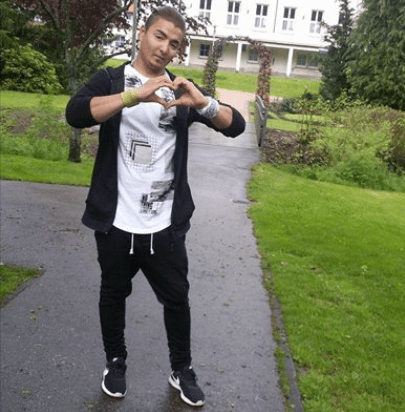
Hussein Khavari, posing on Facebook. Source: Facebook

Medical student Maria Ladenburger. Source: Facebook
An original translation of a press release by Dortmund Police.
Dortmund (ots) – Joint Press Release of Dortmund Prosecution and Dortmund Police
As announced in press releases no. 0141, 0142 and 0144, Dortmund police formed a Kap commission to investigate after a homicide in a school at Dammwiese in Lünen.
According to the current state of investigations, the accused and his mother had an appointment with the school’s community worker. According to the community worker, the 15-year-old has got a police record for violence, and was deemed aggressive and unfit for school, and had, for these reasons, temporarily attended a different school. But this measure failed, which was why he now was to attend Käthe Kollwitz school again.
While they were waiting for their appointment, the later victim met upon the attacker. According to the suspect, the victim looked at his mother repeatedly in a provocative manner. This angered the 15-year-old so much that he stabbed a knife into his schoolmate’s neck.
Before the deed, there were already confrontations between the later victim and the suspect. Investigations will have to probe whether this was the ultimate motive.
The postmortem confirmed that the violence was cause of the death. The weapon was seized at the scene of the crime.
The police records on the accused are meagre and do not show earlier relations with the victim.
The victim’s family is being taken care of by Dortmund police’s office for the protection of victims.
The 15-year-old will appear before the committing magistrate tomorrow.
Translator’s note:
According to Dortmund police, the victim is a 14-year-old German boy from Lünen, the perpetrator is a 15-year-old boy, born in Germany, but with Kazhak and German nationality.
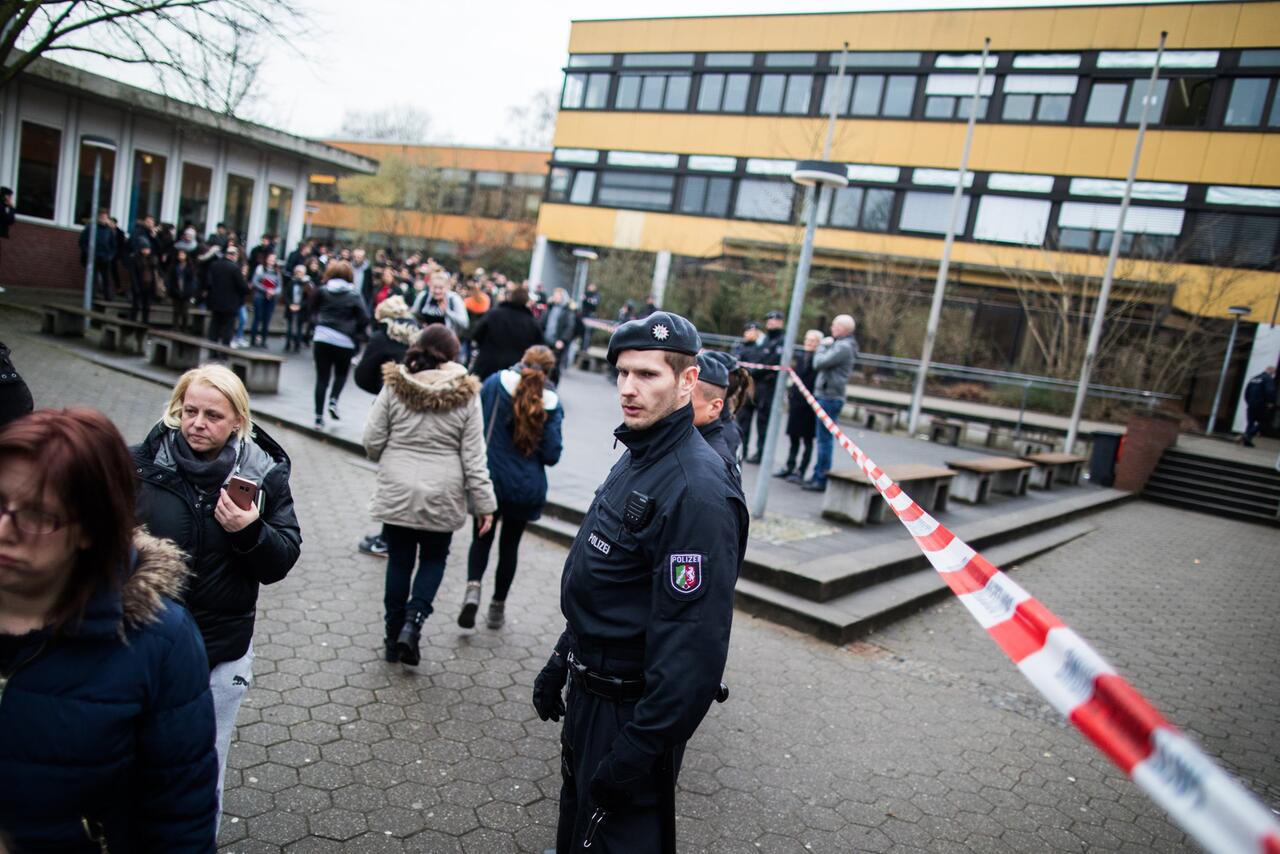
Kätze Kollwitz School in Lünen
Preface: “Concerned Citizen”, besorgter Bürger, is a recent, sarcastic pejorative for people who criticize the government’s “refugee” policies, implying that only losers would be concerned. Example: “I wonder if Germany can handle that many migrants” – “Haha, look at this concerned citizen!”
An original translation from Achse des Guten.
Thilo Schneider
I have a 19-year-old daughter. She is, in my opinion, a pretty and ambitious girl, funny and sensitive. Back then, 36 months ago, I did not care if she went to town or to a club, on her own or with a friend. I thought it was cool when she and her girlfriends took the train to visit other major German towns, maybe party. She is young, full of life, it is her bloody right to explore the world.
These times are over. I am worried. I have lost faith in the state protecting her and her girlfriends when I’m not there. I lost trust that the people she will meet will respect her dignity and her integrity. I am worried for her. I don’t want to constrain her, but I lose sleep when she’s not home. We did not read for her at bedtime, and we did not do math homework with her, so that some asshole from some weird country gropes her because, in his eyes, she is an “unbeliever slut” and “worthless”. And I don’t trust that anyone will help her if she is in duress. After all, she is “only” a “German”.
I am aware that there are also filthy pigs among those “who have been living here for a bit longer” [Merkel’s recent expression to avoid the word “Germans”], who can’t keep their hands off others, but in my opinion, this is not an argument to invite people in, sort of as a “compensation”, who have a — let’s say “conservative” — view of women, and where our state isn’t even interested in who they are, how old they are, and what they are up to.
I am sorry that she can’t grow up in the same free country that I grew up in. I am sorry that she can’t go to a swimming pool without taking care, without constantly being on the lookout for whether trouble is imminent, and without keeping “an arm’s length distance”. As if anyone whose entrance ticket I subsidize with my tax money would care. Thank you to those who opened the flood gates without examining who is coming in. I imagine that neither I, nor my children deserved this.
Perfect target for “the new arrivals”
My son was beaten up by Russians. Just because. Because they could. He did not fight back, to prevent worse. He was right. There is no point in resisting. Our children were not raised in, and for, violence. This makes them, when the state fails, perfect targets for the “new arrivals”. The “integration industry”, which battens itself at the public trough, does not even watch in indifference. They watch as appeasers, insulting and downplaying, spitting on the victims of the collateral damage of their protégés who allegedly “seek refuge”.
We spend Christmas behind concrete barriers, the controls at concerts are stricter than at the airport. And, yes: some districts with predominantly newly arrived inhabitants are now filthy and dirty and not a good place to live. Because it is the people living there who lack any consideration and respect for other people’s property, because they have completely different challenges and desires.
They have no obligation to the greater common good outside their own family and clan. And those zones are under the rule of the relevant clans. And they behave accordingly. They hate me, and the country that reached out to them when they were in need. They still like to take our monthly welfare cheques.
And I am getting older and wondering where I can find affordable living, where I won’t have to dwell under threat for life and limb. Yes, I am concerned. I am a concerned citizen. Now go ahead and ridicule me.
“Reichsbürger” planning to build an army
In the last 12 months, this group, which refuses to recognise Angela Merkel’s government, has grown officially from 10,000 to 15,600 in a single year. As violence continues to spread across the continent, new members are being recruited weekly.
The German Federal Homeland Security Agency (Verfassungsschutz) has indications that the ‘Reichsbürger’ (named after Adolf Hitler’s Third Reich) are armed and dangerous.
Many members of the group have military training, having served their national conscription, a (now suspended) term of compulsory national service in the German state army.
Thanks to Anton for tracking and translating this one. There may be more on this later.
An original translation from Haller Kreisblatt, H/T Crossware:

Andreas Eickhoff,Nicole Donath,Christina Zimmermann, January 18., 2018
Borgholzhausen. There were dramatic scenes during a police action in a refugee accommodation in Borgholzhausen at 4 in the morning. The officers were deployed because a married couple from Azerbaijan was to be deported. When two police officers, an employee of the foreigners’ office Gütersloh, a physician, and a security guard entered the apartment of the couple, their two adult daughters, and visitors, were there, too. A brawl ensued. Then the conflict escalated, one of the women managed to seize the weapon of one of the police officers. Shots were fired, but they did not wound anyone.
The two police officers and the physician managed to escape from the apartment, but the employee of the foreigners’ office, and the security guard did not. The family barricaded themselves in the apartment with the two. Police sent out an emergency alert.
Special forces were deployed. Before the SEK [German special police force] arrived on site, the people involved surrendered. The woman had to undergo emergency medical care: apparently, she had wounded herself with a knife, and was taken to a hospital in Halle. The man was taken away in handcuffs. One of the daughters and the visitor of the family were taken into police custody, too.
Apart from police and SEK, two ambulances from Halle, the chief emergency doctor, and the chief of the emergency services were on-site. Investigations are ongoing..
The county of Gütersloh has now made a statement on the incident of Thursday morning. In a press statement, county commissioner Sven-Georg Adenauer announced that the consequent deportation would still be carried out. “It would send out a fatal signal if violent resistance were to change that”, he said.
The deportation had been carefully organized by the foreigners’ office, and was accompanied by police and a security guard, because one had expected difficulties, due to the persistent and explicit refusal to voluntarily leave the country, said Thomas Kuhlbusch, department head of health, order and law.
According to the county of Gütersloh, the family had first entered Germany in 2004 under a false name, and – after their asylum application had legally bindingly been rejected for being obviously unfounded – had left Germany 2011 under the impression of pending deportation. In 2012, the oldest daughter applied for a visa, and received a residence permit, as she had skilled employment.
The married couple then, again, illegally entered from Azerbaijan in 2013 with their youngest daughter. While the asylum applications of the parents remained without success, and their duty to leave the country became legally binding, the youngest daughter, too, received a residence permit due to special rules of the alien law and her successful integration.
The fact that the deportation was to take place so early in the morning was, according to the district of Gütersloh, due to the available flights and the flight schedules: The flight for the married couple was to board at 1.40 PM in Frankfurt am Main to Baku. “The authorities in the countries of arrival, in this case in Baku, the capital of Azerbaijan, normally want to get the paperwork done on the day of arrival”, the district announced. Only starting early here makes this possible. In this case, even medical care for the husband in Baku had been organized, a physician was to receive him directly at the airport.
Translator’s note:
Haller Kreisblatt provide more background in a follow-up. Have your handkerchiefs ready, as it is so inspiring:
“(…) left the country in 2011 due to the pending deportation.
This must have been tough especially for the daughters of the couple who felt at home in Germany. The older one of the two, who lives in Bielefeld these days, was always taking a stand for other people, she was the pupils’ speaker at the lower secondary school Halle, settling disputes, and helping the younger kids, and was even awarded with the “Sozial-Award” of the Volksbank for her social commitment.
An ordinary, friendly family, their former acquaintances say. But in fact, according to Haller Kreisblatt information, the parents have police records, especially for theft.”


An original translation from Lausitzer Rundschau:
January 17., 2018
Police Raid
On Wednesday, police arrested a person in Berlin during a raid. Investigations against a Syrian-Polish gang are ongoing.
Berlin. German and Polish investigators are proceeding with raids against nine suspects from a family clan. Two persons were arrested in Germany. There is a search ongoing for another person. The charges: organized trafficking of foreigners. By Andreas Blaser

It was still dark when police chief Markus Pfau gave the mission order to more than 170 officers of the Federal Police. Their target was a Syrian-Polish gang of traffickers, who allegedly trafficked more than 100 persons from Syria to Germany. As Pfau, leader of the investigating Federal Police office for crime fighting in Halle says to Rundschau, two people were arrested in the Germany-wide raids. It is a 26-year-old female Polish national of Syrian ethnicity, and a 40-year-old Syrian. They have been brought before the committing magistrate and are now in custody. A search for a third person is still ongoing, as well as for three more Polish nationals. There are a total of nine suspects, but not all of them are wanted with an arrest warrant. The members of the gang are organized in a family-like structure, according to Federal Police. Head of the traffickers, who seemed to have been organizing the operations, is the 26-year-old female Polish national who was arrested in Germany. She is the main accused.
Most of the accused are from Syria, but have migrated to Poland already years ago, and have grown up there. Some of them married Polish citizens and therefore hold dual citizenship. According to investigations by Federal Police, the gang of traffickers begun approximately in the second half of 2016 trafficking Syrians to Germany. Their method: The Syrians, who hadn’t been living in their homeland anymore, but in the meantime in the Gulf region in the United Arab Emirates, some of them for quite a long time, organized Polish tourist visas – but with false details and with the help of the traffickers. From the Gulf region, they flew to Poland – very likely to the capital of Warsaw – and then travelled on overland to Germany. The large Autobahn transits in Frankfurt at the Oder, Görlitz-Ludwigsdorf, but also Guben, Forst and Podrosche in Saxony were probably used. Once in Germany, the Syrians applied for asylum, in order to be able to claim the benefits associated with it.
The investigations of Federal Police and Polish Border Protection might be able to shed new light on the repeated cases of trafficking in the border regions of Brandenburg and Saxony. Over the past months and years, large groups of refugees have repeatedly been apprehended who apparently illegally crossed the border. Most of these were Iraqis and Russians from Islamic Chechnya though.
According to Federal Police’s statements, the traffickers received about € 8,000 per person, which means that, according to the current state of investigations, the gang made about € 300,000. But if the police’s estimate of about 100 trafficked persons turns out correct, the gang’s earnings will be remarkably more. The profit explains why the traffickers issued strong pressure to receive their margin. The current investigations of police end in the first quarter of 2017, which suggests more cases in later activity of the gang.
Even when the current police action of wednesday was focused on Berlin, the officers were busy until afternoon in almost all German states. There, and in Berlin, mobile phones, digital storage devices and a large sum of money were seized. Police spoke of “significant assets”.
According to police and judiciary, the accused are charged with the professional and gang-like trafficking of foreigners. In addition, there are investigations against several accused for the suspicion of social fraud and fraudulent application for asylum. Even some of the members of the Syrian-Polish family are suspected to have applied as politically persecuted asylum seekers in Germany.
An original translation from Die Welt:

Tuberculosis Bacteria
By Claudia Sewig, January 16., 2018
Scientists substantiated the outbreak of a multiresistant strain of Tuberculosis. It was discovered in 29 refugees who had come to Germany via the Horn of Africa.
The tuberculosis trend which had been declining for many years has turned around. This is what the Robert-Koch-Institut (RKI) in Berlin had announced at World Tuberculosis Day 2017, pointing out a relation with current migration movements. Scientists at the National Reference Centre (NRZ) at the Borstel research center pat(district Segeberg) managed to substantiate a Europe-wide outbreak of a multiresistant strain of Tuberculosis with 29 refugees. The strain showed a remarkable combination of resistance to four different antibiotics.
The increase of cases with persons with migration background caused the NRZ scientists to conduct further research. In general, newly arriving refugees are screened for transmittable diseases in the entry exam according to paragraph 62 of asylum law (AsylG). This includes an x-ray of the respiratory tract, which can determine a tuberculosis infection. But only ten percent of the people who are infected with the pathogen become ill – half of them in the first year after infection, the other half even later.
Since the law for protection against infection (IfSG) was introduced in January 2001, numerous characteristics of each tuberculosis patient are recorded and, in anonymised form, transferred by the 400 health offices in Germany via the 16 land offices to the Robert Koch Institute.
Refugees came over Horn of Africa
The research center Borstel now announces in a publication in the professional journal „The Lancet Infectious Diseases“ that the researchers from Schleswig-Holstein and their colleagues of the National Reference Center for Mycobacteria (NZM) Switzerland identified a hitherto unknown Tuberculosis pathogen in 2016.
The moleculobiological examination in combination with patient interviews enabled the scientists to partially reconstruct the chain of infection. The data pointed to the infection to have occurred before the arrival i Europe, in a Libyan refugee camp at Bani Walid.
It is likely that the strain developed from a clone of a tuberculosis strain that is common at the Horn of Africa, and developed the critical combination of resistancies. All 29 patients from seven European countries were refugees who had migrated to Europe via the Horn of Africa.
There were no refugees from Hamburg, Schleswig-Holstein or Lower Saxony [i.e. northern Germany] among the 14 cases in Germany, according to the statement. „The patients are mainly unaccompanied underage refugees who registered in Baden-Württemberg“, says Dr. Katharina Kranzer, chief of the NRZ at the research center Borstel. But as the outbreak was still ongoing, more cases might surface.
In September 2015, in what has been the largest influx of refugees to Hamburg until now, nine people were precautionally taken to the University Hospital Hamburg-Eppendorf (UKE). A paramedic had noticed, in a tent at the main strain station, symptoms of the highly infectious disease with three refugees who were waiting to continue their journey there. They could be released from the UKE only hours later.
70 percent of those fallen ill are foreign nationals
“It was only through analysis of the genome that the strain of the outbreak was unambiguously identified”, says Professor Stefan Niemann, author of the study and leader of the research team molecular and experimental mycobateriology at the research center Borstel, and of the tuberculosis department of the German Center for Infection Research. “But in order to be able to fully benefit from the advantages of this technology it needs to be incorporated into routine screening and monitoring for tuberculosis.”
Niemann refers to himself and his colleagues as genome detectives, having been analyzing the genome of the tuberculosis bacterium. “In order to be able to determine the tuberculosis strain, we developed a quick test,” says Niemann. Additionally, in Borstel, in a pilot project, all laboratory samples from tuberculosis patients from Hamburg, Hannover and Frankfurt are being analyzed. “We have material from Hamburg from 1996 on”, says the researcher, hoping that other cities will join in on the project.
According to RKI, a total of 5915 cases of tuberculosis were registered in 2016, meaning 7.2 newly falling sick per 100,000 inhabitants. The analysis by nationality showed visible differences in the risk of illness: The incidence with foreign nationals was 42.6 per 100,000 inhabitants and thus was 19 times higher than in the German population (incidence 2.2).
This discrepancy has increased, compared to the previous year (factor 16.6). The difference was especially notable in young adults. Altogether, 30.9 percent of those who had fallen sick had German nationality; 69.1 were foreign nationals..
The analysis by country of birth shows that the number of foreign-born patients steadily increased over the past years, and constituted three quarters or 74.3% of all registered cases in 2016. The most frequently stated countries are Somalia, Eritrea, Afghanistan, Syria and Romania. “But it would be wrong to assume that you can’t become infected by tuberculosis in Germany, and that it is always transmitted abroad”, points out Niemann. “30 percent of the cases occur via transmission in Germany.”