
The slippery slope of thought crimes

The left has done a masterful job of lulling people into allowing speech and thought crimes to be on the books as legislation when they simply should never, ever have been made into legislation, and even contradicted specific rights laws such as we have in Canada and the USA. “Hate Crimes” of course, is the perfect example. A judge already had the ability to factor in motive when passing a sentence for a real crime should he feel it mattered.

And now from the Italian high court:

Telling migrants to “go home” is racism, rules Italy’s top court

In a landmark decision, Italy’s highest court has ruled that telling migrants to “go away” is racism.

The Court of Cassation ruled Thursday that telling non-EU foreigners to leave the country legally counts as racial discrimination, even if racial slurs are not explicitly used.

The case relates to a man in his early 40’s who appealed for a reduction in his sentence for injuries against another person, which had been increased on grounds of racial discrimination.

The man and his co-defendant had clashed with two non-Italians after they approached them in a club in the town of Gallarate in Lombardy and said, “Why are you here, you need to go home.”

The applicant argued that his comments were unrelated to race.

The court, however, found that using generic expressions of contempt toward foreigners that are clearly based on their ethnic or religious backgrounds is equivalent to racism.

A couple of years ago, a Dutch court found Geert Wilders, a leader of the opposition in the Netherlands, guilty of speech and thought crimes because he openly opposed the current government’s immigration policies, which is his actual job! Not to mention an absolutely essential component of any democracy anywhere and any-when.

He suggested they change immigration to have fewer Moroccans, which represent a grotesquely disproportionate part of violent crime there and present an existential threat to Dutch culture. This is what opposition parties do. Recommend alternatives to legislation and people vote for it or not.

But they convicted him and fined him for doing exactly his job. And now that they have that conviction, the rest is just a matter of sentencing for the rest of us.

And now, Italian courts have done what leftists always do. Expand the definition of what constitutes the evil thought or word, and control all aspects of our day to day transactions.

This is the incremental implementation of communism ideologically speaking. A counter-revolution must take place.

A large crowd chanting in Italian to illegal and unwanted migrants of “Go home now” would probably be a good first step.

 

The process begins in Korea

This is like a time machine. You can see how various powers are trying to further divide the Korean people, clearly to destroy them and using muslim migrants in the exact same way they have in Europe and North America over the past 2 decades. Remember when you could object a little like the Koreans are? Korea still has a sense of themselves as a people and a culture and a set of values. So they still have a chance.

I hope they manage to preserve it and learn from our example of what failure looks like. Certainly in much of Europe, almost certainly in Canada, and the US remains uncertain.

South Koreans resist arrival of Yemeni asylum seekers

There has been a backlash after a thousand Yemenis exploited a visa loophole to apply for refugee status. Many South Koreans are concerned that Muslims will fail to integrate into their society.

(Loophole, refugees, if I were Korean I would be after Soros right about now.)

Yemeni asylum seekers taken into custody after fight

Two Yemeni asylum seekers have been taken into custody on the southern island of Jeju for using violence against each other in a fight over washing dishes, police said Monday.

The two, who are aged 36 and 37 and work as crewmen, allegedly brandished weapons or punched each other Sunday afternoon after quarreling over washing dishes in the crewmen’s quarters they live in, police said.

Police said they’re questioning the two and will decide how to deal with them after consultations with immigration officials.

How Jeju became haven for Yemeni refugees

As of June 21, 486 Yemenis, who escaped from their war-torn country in search of hope and a better life, are staying on the island, seeking asylum. 

The island is divided as some farmers are sympathetic about granting refugee status to the asylum seekers amid a sweeping backlash against the Yemeni refugees. 

“For the Yemenis, Korea is portrayed as a land of opportunity,” said Kim Dae-yong, founder and president of the Jeju Islamic Culture Center. “Word of Korea spread fast among those Yemeni refugees in Southeast Asian countries because Korea is livable and as we recently have seen on this island, asylum seekers are even allowed to work here.”

He said neither the Jeju local government nor the immigration office had imagined the island would become a haven for refugees when the local government teamed up with Air Asia last year to offer direct flights between Jeju and Kuala Lumpur. 

The Yemenis initially flew to Malaysia where foreigners can stay up to 90 days without a visa. Unable to extend their stay in the Southeast Asian country, they looked for other visa-free destinations where they could stay permanently. South Korea, which grants asylum to refugees if strict conditions are met, has been emerging as an attractive destination. 

[…]

The official said islanders are concerned about the Yemenis, noting the public opinion about the refugees on Jeju is not quite different from the overall atmosphere of the country. 

“People here heard a lot about what happened in Europe, such as Germany, after the influx of refugees. Citizens are concerned about security and their own safety. I know some are worried Yemenis would steal jobs previously held by Koreans. I think few people here are convinced by such claims. The primary source of the backlash against Yemeni refugees here is fear for security,” he said. 

Many of the Yemenis stay at cheap tourist hotels and some have become homeless and sleep in parks. 

Some residents and tourists, feeling unsafe, called for the local government to take necessary measures to ensure their safety.

Poland, another valued Ambassador to the obvious

Germany: Agreement Between Merkel and Seehofer

This agreement below, between Angela Merkel and Horst Seehofer, was moments ago handed to the press and tweeted out by the CSU MP Dorothee Bär.

Original translation:

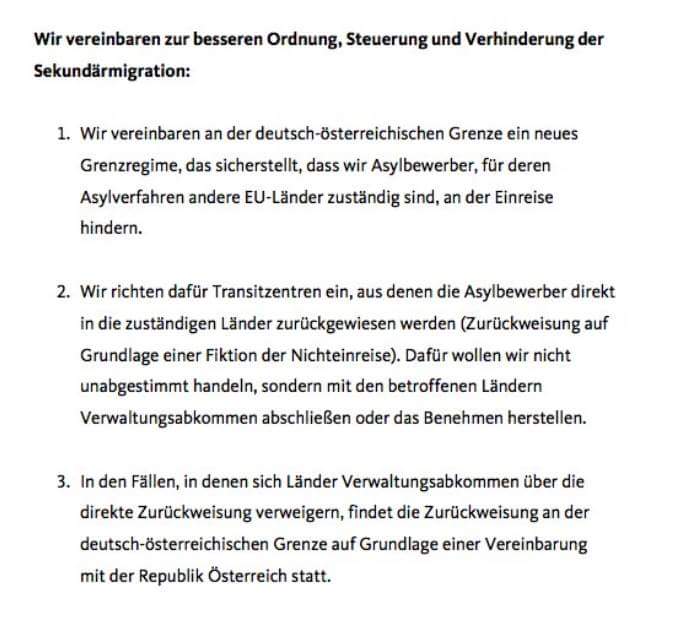
“In order to better regulate, control and prevent secondary migration, we come to this agreement:

  1. We agree to a new border regime at the German-Austrian border, which ensures that asylum seekers for whose asylum procedures other EU-countries are in charge, will be refused entry
  2. To do so, we will establish transit centres, from which the asylum seekers will be directly sent back to the countries in charge (refusing entry on the basis of the legal implication of non-entry). We do not want to act uncoordinated, but come to administrative agreements, or establish communication, with the concerned countries.
  3. In those cases where countries refuse administrative agreements, the rejection at the German-Austrian border will be on the basis of an agreement with the Republic of Austria.”

    The original document as it was handed out to the press

Merkel’s part in this agreement is one single sentence: “We do not want to act uncoordinated, but come to administrative agreements, or establish communication, with the concerned countries.” This allows her to save face, while still conceding to Seehofer.

The true issue at the core of this was whether Germany has got sovereign national borders and can refuse people entry. Merkel, who ideally would like for Germany to dissolve into a supranational, non-democratic EU superstate, had, again, denied national sovereignty two weeks ago (“EU law should always have priority over German law”, on “Anne Will” talkshow on Sunday, June 10), which sparked the crisis between her and conservative new Interior Minister Seehofer. The media onslaught that ensued against Seehofer was so strong that nobody really expected him to come out of this alive.

This is an important day in the fight of Germans for their right to national self-determination, and to even exist as a nation.

Angela Merkel on her way to a crisis meeting this morning.

Merkel’s constestor, former Bavarian premier and new German Interior Minister Seehofer.

German Government Crisis: Seehofer Suggests Resignation

Angela Merkel’s challenger Horst Seehofer has announced to resign from his offices as German Interior Minster and head of the CSU, if no consensus can be reached over his demand to turn away illegal migrants at the border – a demand Merkel staunchly rejects.

Sunday’s CSU board meeting in Munich, photo: private/Facebook

On June 14, Merkel had asked Seehofer give her time to negotiate “European solutions” “with the same effect [as turning away illegal migrants at the border]” at this week’s European Summit (June 26.-27.).

The summit’s results were then presented to the German public as a full success; Merkel’s “European solution” was found; all countries had made concessions to Angela Merkel. No one in the German sphere seemed to realize that the negotiations were in fact a win for the countries who opposed migration (see Orban Wins At EU Summit: No One Takes Migrants They Don’t Want). Only yesterday, Saturday (June 30.), when Hungary, the Czech Republic and Poland sent out memos, refuting that they had made resolutions with Merkel, the German public slowly began to understand that they had been fooled.

Today’s CSU board meeting lasted until late in the night. Attendees passed details to the tabloid Bild: “Seehofer unmistakably made clear what he thought of Merkel’s negotiation results in Brussels: nothing.” He called the prior evening’s discussion with Merkel on the matter “pointless and ineffective”.

In the meantime, after Poland, Hungary and the Czech Republic, Greece’s Yanis Varoufakis came out in strong terms about Angela Merkel’s “European Solutions”:

“There is no deal really, this is a typical EU fudge. They have agreed on phrasing. They celebrated it, but this hides that there was no agreement on the substance.
They gathered in Brussels to reform the Dublin agreement, which was never designed to cope with mass migration flows. Also to resolve secondary migration, which the CSU demanded action on and even put the Merkel’s government in jeopardy over it.
It is a complete failure of the European Union that has been packaged as a success, but that isn’t new, is it?”

Around 10PM, news agencies suddenly reported that Seehofer had just resigned from his office as Interior Minister and leader of the CSU. The Süddeutsche Zeitung, Germany’s equivalent of the Guardian or the Washington Post, and state TV, immediately published obituaries on Seehofer.

A board member of the CSU though messaged that Seehofer had not resigned but offered his resignation, to test if he had the CSU’s full support for challenging Merkel. Seehofer allegedly stated that he had three options: to give in to Merkel, which he refused; to challenge her, for which he needed the party’s support, or to resign. According to members, the CSU expressed their support.

But when Seehofer finally left the building, he told attending press that he would resign from all offices within the next three days if no consensus on turning away illegal migrants at the border was found.

The outcome of all of this is entirely unpredictable at the moment. The way Merkel’s team are detached from reality – the majority of the population support’s Seehofer’s position – reminds of the end days of the DDR though.


German Interior Minister Seehofer calls crisis meeting with police & anti-terror chiefs

From WestMonster:

German Interior Minister, Horst Seehofer, has called a meeting with the heads of the country’s police and security services to discuss the consequences of Merkel’s disastrous refugee policy.

Bild reports the President of the Federal Criminal Police Office (BKA), the President of the Federal Police and the President of the Federal Office for the Protection of the Constitution (BfV) will all attend the crisis talks, as Seehofer seeks to shore up support against Merkel.

The newspaper claims: “Above all, it is about the consequences of the uncontrolled mass migration of refugees to Europe and Germany since January 2015 and about the impact of this immigration on the respective fields of work of the three security authorities.”

“These include the crime of foreigners and immigrants (BKA), the extremist and terrorist potential (BfV) and the unauthorized entry and residence of migrants in Germany (Federal Police).”

The Minister and the three agencies will hold a joint press conference after the meeting, revealing a bit more information about what was discussed inside – which could be hugely damaging to Angela Merkel if the agencies come out in support of Seehofer.

Click to continue:

H/T Gates of Vienna