“The secret of all victory lies in the organization of the non-obvious.” -Marcus Aurelius
The story at Spencer Fernando:
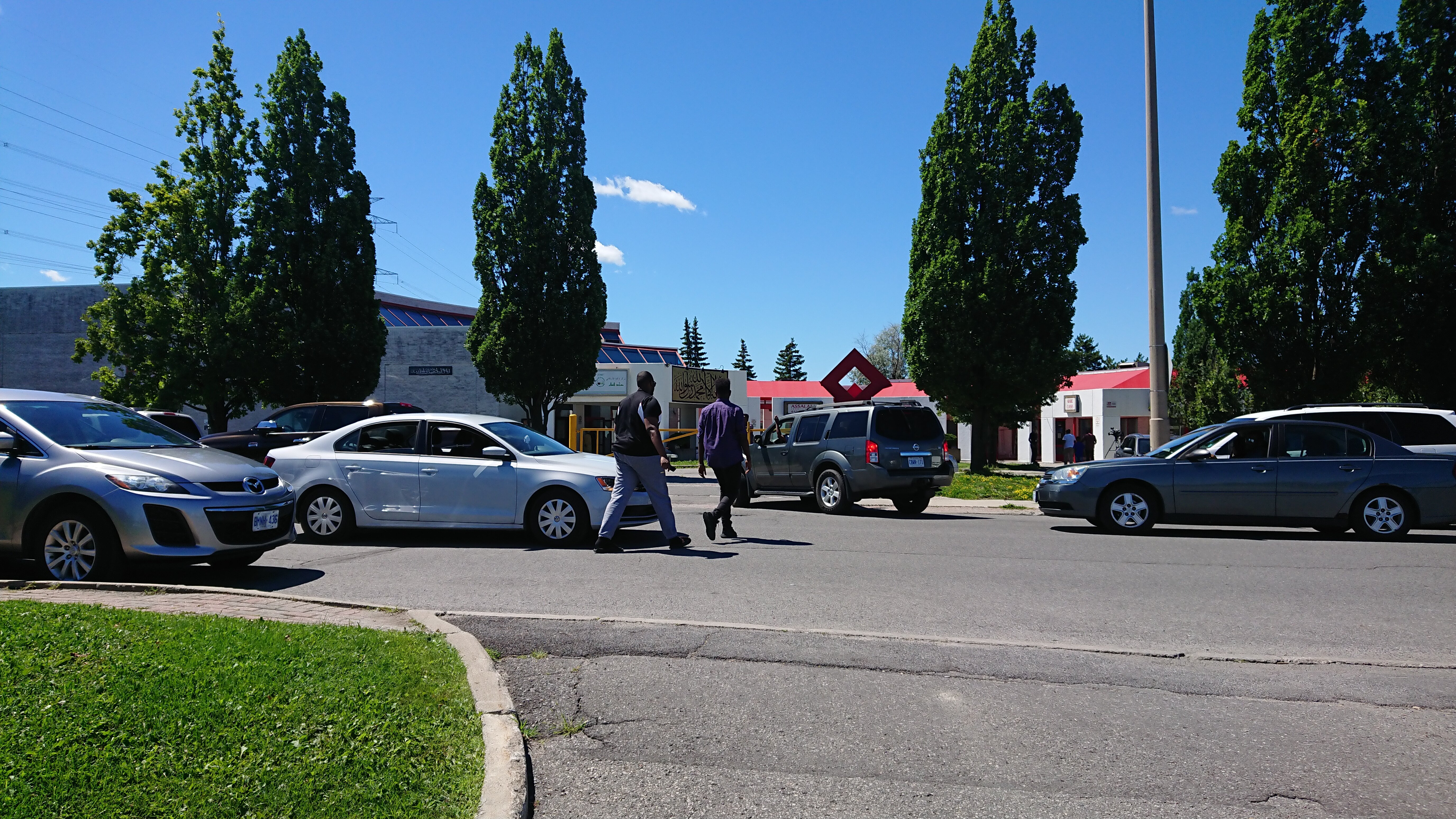
A number of disturbing guest speakers, and serious concerns over an attendee who was jailed for trying to join Islamic State, has led the Canada Revenue Agency to revoke the charitable status of the Ottawa Islamic Centre.
Here’s what the CRA said about the Ottawa Islamic Centre Assalam Mosque:
“Many of the views expressed by the organization’s speakers are misogynistic, homophobic, racist and/or promote violence.”
Additionally, according to Global News, “The CRA was also concerned that “radicalized individuals” had attended the mosque, one of whom, Ashton Larmond, is now imprisoned for attempting to join the so-called Islamic State.”
The Rebel asks some excellent questions, after doing the research all media should have been doing.
related:
Yes this video focuses on one. But according to a very well done study in the US going back some 6 or 7 years approximately, 80% of mosques teach jihad and hate of the other. Why? Because Koran. Thats why.
Thank you C for all the work that went into this one.
Related:
Muslims up the level of death threats against Islam-relaist, Geert Wilders.
Dutch Party for Freedom MP, Geert Wilders, has received numerous death threats since heannounced that he is holding a Mohammad cartoon competition.
Wilders, the leader of the second largest party in the Netherlands, will hold the drawing competition at his party’s parliamentary offices in The Hague.
The judges include an American cartoonist, Bosch Fawstin, the winner of a Mohammad cartoon competition that took place in Texas three years ago.
The Texas competition was attacked by two gunmen, who were taken out by security. ISIS claimed responsibility, but that claim could not be verified.
Thank you C for the translation.
An original translation by SIMONXML with many thanks!
Mon 23 April, 5:00 pm
Written by, Milena Holdert
Editor, Andreas Kouwenhoven
It is now certain that 30 Islamic organizations in the Netherlands applied for funding from the Gulf States in recent years or have actually received money from these countries. This involves millions of euros from Kuwait and Saudi Arabia. The evidence comes from information that the Dutch government has kept secret for years, but which the NRC Handelsblad newspaper and TV journal Nieuwsuur managed to get their hands on.
Financing from conservative Gulf states is controversial because of the concern that they are exporting their fundamentalist variant of Islam, Salafism, to Dutch mosques. The Dutch House of Representatives has been asking for transparency about the money flows for years.
Lists
The information concerns three lists of names of Dutch mosque organizations that have requested funding from Gulf countries. Kuwait and Saudi Arabia have been secretly keeping the Ministry of Foreign Affairs informed about this since 2010. One of the lists contains concrete payments to mosques complete with detailed amounts.
Combined with information already known about financing, it’s estimated that 10 percent of all Dutch mosques have asked for money from the Gulf countries or actually received funding from these countries.
The government has already asked the Dutch Scientific Research and Documentation Center (WODC) to map the extent of foreign mosque funding. That did not yield anything in 2015. Now it appears that the government already had information from the Gulf States, but did everything it could to keep this data hidden from the WODC researchers.
Growth of Salafism
Partly as a result of foreign funding, fundamentalist Islam, Salafism, is growing in the Netherlands. While there were thirteen Salafist mosques in the Netherlands four years ago, now there are 27 – according to a confidential memo from the anti-terrorism coordinator NCTV, which is in the hands of the NRC and Nieuwsuur. The number of Salafist preachers also doubled: from 50 to 110.
It is remarkable that the NCTV has these figures, because Prime Minister Mark Rutte told the Dutch parliament earlier that it is not possible to provide an overview of the number of Salafist organizations.
Funding from Gulf States can impede integration, says Mohamed Ajouaou, Islamic theologian at the VU University, Amsterdam. According to him, financing is often accompanied by the influence of lenders who want to spread an Islam that is intolerant or at odds with the democratic constitutional state.
That is why mosques have to make foreign donations public, says Ajouaou. The Council of Moroccan Mosques has also called on Islamic institutions to be open about financing. The current Dutch government agreed in its coalition agreement that it would limit cash flows from ‘unfree countries’ but has not yet come up with concrete proposals.
In a reaction, the Dutch Ministry of Foreign Affairs said that it kept the lists secret because they were obtained from “diplomatic traffic”. The ministry fears that the Gulf countries will no longer voluntarily share information if the lists become public.

Mosques financed by Gulf States:
The map above shows 39 mosques financed by Gulf States or asking for funding. The names of the mosques come from three lists that Saudi Arabia and Kuwait have shared with the Ministry of Foreign Affairs. Mosques that were previously known to have financial ties with Gulf States have been added to the map.
It could not be ascertained from a number of names on the lists from Saudi Arabia and Kuwait which mosque was involved. These have been omitted. The reactions of the relevant institutions are visible when clicking on the dots on the map. The information is incomplete and therefore we would like to receive additions or reactions via mi************@*******ur.nl and a.***********@*rc.nl.
We do not want money from non-free countries going to religious organizations.
Gert-Jan Segers, Christian Union
Dutch MPs Gert-Jan Segers, Christian Union, and Sadet Karabulut, Socilaist Party, were surprised by the the revelations. “We have not progressed a millimeter in recent years,” says MP Karabulut. “At first they denied there was a list, then it was a secret list, now it has finally been made public.”
According to Segers, the Gulf states are exporting unrest through their influence in the mosques. “It’s about the freedoms we have here: there is an ideology of non-freedom to our rule of law,” says Segers, who lived in Egypt for seven years and who has experienced the lack of freedom. His party’s position – which is also included in the coalition agreement – is that money flows from non-free countries to religious organizations. “There has not been a government official who has taken up this issue,” says Karabulut. As far as she is concerned, the Dutch Ministry of Foreign Affairs should now take the lead. “Because it’s an international problem, it’s about the Gulf states influencing our country, it’s no longer a religion, it’s politics, ideological influence, political indoctrination.” Karabulut wants all information about salafist organizations and money flows to be made public and for the government to pass legislation. Segers thinks that the Dutch Ministry of Justice should now take the lead.
The lists
Three lists contain dozens of institutions. One list concerns Saudi Arabia and two concern Kuwait. In the Saudi list, one mosque in Dordrecht received a concrete amount of $88,888.00 dollars. An attached letter states that the Saudi embassy was also planning to sponsor the other organizations on the list. The two Kuwait lists consist of a list of financing requests, and a second list of amounts paid out totaling nearly € 6 million. For example, for the construction of mosques, but also for publishing Korans, for imam training and Islamic meetings.
This will work in Firefox and Chrome
Thank you Elle for translating this amazing clip for us.
His ‘peculiar and unexplained’ death becomes more and more easily explained perhaps.
This is an excerpt from Times of Israel. Please click through for the whole article.
Two gunmen arrested in attack that left six dead, named in report as Alexandre Bissonnette and Mohamed Khadir
QUEBEC CITY, Canada (AFP) — A suspect in Sunday’s mosque shooting in Quebec City that left six people dead called police “to talk about his surrender,” a senior police official said Monday.
Get The Times of Israel’s Daily Edition by email
and never miss our top stories FREE SIGN UP!Two gunmen stormed into a Quebec mosque during evening prayers and opened fire on dozens of worshipers, killing six and wounding eight in what Canadian Prime Minister Justin Trudeau condemned as a “terrorist attack.”
H/T M., Wrath of Khan, my new email doesn’t show the from field properly from comments so I will get a few wrong for a while.
An original translation by Nash Montana with much thanks

An arsenal of weapons of radical islamists was excavated in NRW, North Rhine Westphalia. The “Top secret assignment” took one week and brought heavy war arsenal to the surface. This is what Hessian delegate Ismail Tipi (CDU) says.
According to information of the hessian CDU delegate Ismail Tipi a “top secret assignment” of the SEK in North Rhine Westphalia took place. In the cooler room of a vegetable vendor near a mosque, weapons were found and seized. “According to my information at this particular operation, an arsenal with heavy war weaponry was found.
The danger of arming of the fundamentalists and willing to resort to violence salafists in Germany is very high. This was shown clearly by this secret operation”, said Tipi on Friday at a press conference.
The Extremism expert also assumes that more weapons stocking took place in other cities. For instance the Hamburg intelligence service for constitutional protection also speaks of a heightened number of supporters of armed jihad.
In the meantime more than 300 people in Hamburg have been identified as supporters of armed jihad. The fear is that salafist sleepers, jihadists and IS terrorists in Germany find support through foreign intelligence services, that aren’t friendly to German interests. Through these weapons arsenals militant jihadists and sleepers will be equipped with weapons in their preparations for attacks”, the turkish born delegate says.
Politicians have to speak straight talk”
Tipi warns: “If these worries prove to be true, we can expect that these secret weapons arsenals will be used for terrorist attacks not only in Germany but in entire of Europe. It would be extremely negligent if we do not address this danger and do everything to find these arsenals.” One problem is that many battle seasoned young salafists come back to Germany from combat zones and implanted themselves among the stream of migrants, the press briefing further mentions.
“We have to see this threat and we need to act fast. Here, our security administration is asked to look at this very clearly and hard, to investigate precise, and to share as much of the information as possible among relevant administrations and services”, Tipi says.
And, he demands: “Politicians have to speak straight talk, they have to address the possible danger and threats, they have to educate the population and call for a full awakening and to report to the police any type of suspicious activity. The problem of Salafism and IS terror gets bigger and bigger if we don’t all react. Here, each and everyone of us is asked to step up.”
Tipi’s political engagement against radical Salafists has already led to death threats against him.

The following article is the first of series on controversies caused by the closure of prayer rooms — de facto mini-mosques — at German universities. This one, from the University of Essen, is not current; it was published in February of this year.
The most chilling part of this piece is the university’s justification for the closure: the prayer room is no longer needed, since there are now so many mosques in the neighborhoods adjacent to the campus.
Many thanks to Egri Nök for translating this article from
Discrimination in the name of Allah — Essen University closes prayer room
Essen. Non-Muslim students in Essen complain about repression by Muslim students. Now, the university closes the prayer room.
The Islamic prayer room at the University of Essen will soon be closed, the university directorate responds in answer to an inquiry by this newspaper. “As there are a variety of religious sites close to campus, no prayer rooms used exclusively by a single religious group on the university property are necessary anymore,” the statement of the directorate says, referring to the many mosques close to the university.
Students complain: elevator is blocked
There are plans now to introduce a neutral “room of silence”.
According to this newspapers’ research, non-Muslim students are discriminated against by fundamentalist Muslim students. At Friday prayers, they are regularly hindered from using an elevator which leads to the prayer room on the fourth floor. But the University Directorate “clearly objects” to the impression that a “fundamentalist regime” was spreading in the prayer room’s vicinity.
The prayer room “R12?T04?E96” has been controversial for years. In 2007, the University tried in vain to close the room with reference to an acute shortage of rooms, hate preachers, and occupants foreign to the university. Talks with Muslim students led to a compromise.
Are students of the university Duisburg-Essen discriminated against by fundamentalist Muslim students, just because they are “infidels” from a Muslim perspective? As this newspaper learnt from a reliable source, during Friday prayers, disturbing restrictions were regularly enforced on the campus in Essen.
The accusation: Non-Muslim students are brusquely prevented by religious zealots from using the elevator in the building “T04” during Friday prayer. Lapidary justification: The elevator, which leads up to the Muslim prayer room on the fourth floor, is exclusively reserved for “brothers” during prayer time. Even female Muslim students are not allowed to use the elevator during that time. However, the “sisters” did not seem to mind this unusual form of segregation of the sexes. But it does not stop there: even toilets near the prayer room are not permitted to be used by “infidels” before, during, and after the Friday prayer.
University justifies closing with mosques near campus
“Open in thinking” — the university Duisburg-Essen casts their tolerant, cosmopolitan self-image into this slogan. But does this image of man, formed by the spirit of enlightenment, namely freedom of religion and equality of the sexes, also apply to Muslim students? Doubts appear justified, as it seems they created their own guidelines.
Outside of the important Friday prayer, a curtain separates the room which holds 50 to 60 people in two areas: one for women and one for men — as usual in a mosque. The internet page “moscheesuche.de” (“mosque search”) explicitly describes the specific characteristics of “R 12 T04 E96”. It says: “The mosque has got a separate entrance for women and for men. For Friday prayer, the prayer room is only open to men; for Asr [daily afternoon] prayer, the mosque then is open to all sisters again.”
Alleged restrictions in the Name of Allah under the roof of a public academy — this newspaper asked the university for a statement. But the University directorate “clearly objects” to the “subjective impression that a fundamentalist regime formed in the prayer room’s vicinity”.
The university justifies the closing with the many Mosques near campus. “Therefore, the prayer room will soon be closed in the course of extensive construction measures in this university building,” they say. At the same time, they stress that the university is an ideologically neutral establishment, “which principally does not prefer any religious group”. Now the management plans to support retreats for students and staff in neutral rooms. Such a “room of silence” would allow them to calm down or to pray. The university explicitly stresses that they see themselves as a “place of tolerance and peaceful coexistence”.
Muslim student destroyed a cartoon poster in 2013
In the past, the University of Essen was shown in an unfavorable light because of Islamic zealots and fundamentalists. Because she deemed her religious feelings hurt, in 2013 a Muslim student destroyed a cartoon poster with a pair of scissors. A full frontal attack on the freedom of opinion and art, to which the university reacted with self-censorship. The student exhibition “What Comics Can Do” in the library foyer had to be closed prematurely, and the district court later sentenced the picture-destroyer to a fine of €400 for property damage.
At one time the few Muslim students on the campus of Essen were viewed as exotic birds, but they have long since appeared to be numerous and self-confident. Moderate Muslim students complain about an atmosphere of intimidation by the fundamentalists, who arrogate to themselves to define what is Islamically correct.
At the last elections to the General Student Committee, with 30% the “United Students”, dominated by Muslims, became the strongest group in the student parliament. One of their central demands is: halal food in the canteen and a better prayer room at the Duisburg site.
If Putin was running for the Republicans I bet he would do OK.
They really are going to have to change the spelling of Moscow soon. Mind you it will be way harder but sooner to change the spelling of Toronto.

Adding links as I find them
H/T M
An original translation by Our French correspondent, Nathalie
Weapons caches found in forty Tunisian mosques

Fadhel Achour, the general secretary to the trade union for the managers and staff of mosques, announced on Wednesday July 1 2015 that police forces making searches in all parts of the country have uncovered caches of weapons in forty mosques.
Interviewed on the “Midi Show” programme broadcast on “Mosaïque Radio”, he declared that 190 mosques had been erected since the revolution, 90 of which had contacted the authorities in order to legalize their status. The 100 remaining mosques, 80 of which spread incendiary Takfirist speeches, have refused to acknowledge the authority of the Tunisian government.
Fadhel Achour further declared that things might have been much worse but for the Ministry of the Interior whose intervention helped to rescue some mosques from radicalization.
He added that the government of Mehdi Jomaâ had promised to end the problem in 90 days, a promise that remains unfulfilled to this day.
He proceeded to add that during Noureddine Khadmi’s time in power, several preachers and imams had been posted to some mosques, and that amongst those, some belonged to the Salafist school, and some did not even acknowledge the Maliki school.
H/T M.