Vlad Tepes is honoured to present a Fjordman Essay on history of the guitar and Violin

While we can say a great deal about Greek musical theory and the general place of music in Antiquity, we can say much less with certainty about how ancient Greek music actually sounded like. They created a complex system of notation that was partly remembered in medieval Europe but which is nevertheless rather different from the one that was developed during the Middle Ages and the Renaissance period. Both Plato and Aristotle stated that instrumental music was inferior to vocal music, a view that predominated until the Enlightenment. The Greeks had percussion instruments similar to cymbals or the tambourine.

Foremost among Greek instruments were those of the family of the lyre, a plucked string instrument, and the aulos, a reed wind instrument made of wood or bone with several finger holes that produced a high, clear, penetrating sound. These were associated, respectively, with the restrained music for the popular deity Apollo, the god of light, prophecy, archery, healing and music, and with the wilder, more excited sounds in honor of Dionysos, the god of wine.

The lyre was a medium-sized instrument usually fitted with seven strings made of sheep gut and plucked by a plectrum of metal or bone. It rarely played solo melodies, being used most often to accompany a solo singer, usually the player himself. The largest of all Greek string instruments was the kithara, an especially big lyre. It usually, but not always, had seven strings, but the resonator at the bottom was a sound-box made of wood rather than tortoise shell, as was often the case with lyres. It, too, was usually played with a plectrum. The word “guitar” for the somewhat different modern stringed instrument is derived from kithara.

In medieval times, various kinds of trumpets and horns were employed in Europe, in addition to bells and cymbals. Drums came in many different shapes and sizes and were used for military and dance purposes. Portative organs were small and were able to be moved around. The large, stationary organ was first widely introduced into European churches during the Late Middle Ages, from the 1300s on. Many of them were show pieces embodying the newest technology in metallurgy and scientific measurement. By the sixteenth century many churches had two organs, one large one at the back plus one smaller one. The largest of these had two keyboards for the hands and a pedal keyboard as well. Smaller, portative organs possessing a single keyboard were used during medieval times in churches and monasteries.

In addition to the organ, which has ancient roots, other musical instruments with a keyboard became popular during the Renaissance, prior to the invention of the piano. The clavichord is a stringed keyboard instrument, normally rectangular in shape with a decorated case. It was developed from the medieval monochord and was popular from late medieval times through the Baroque Age, and still has its share of enthusiasts today. However, it is a very soft and quiet musical instrument by modern standards. The harpsichord, another widely used keyboard instrument, probably first appeared during the 1400s, possibly in the Low Countries. The virginal was another, smaller member of the harpsichord family. In the Renaissance these keyboard instruments did not have legs or a stand, but were simply set upon a table.

The pear-shaped plucked string instrument known as the lute was also very popular. It probably has an Eastern or Asian origin, historically. Most early string instruments were plucked. Bowed string instruments apparently didn’t become common until the Middle Ages. Their origin is uncertain, although quite a few historians suspect it to be found among the horse-riding nomads of Central Asia, from where it may have spread to China and to Europe via the Middle East. The Byzantine lyra probably influenced instruments in medieval Europe. It is the rough equivalent of bowed string instruments such as the rab?b in the Islamic world.

In Spain, two new fretted string instruments related to the lute emerged in late medieval times and spread around the Western world. These were the vihuela (Spanish guitar) and the viol. Our modern, classical guitar is a direct descendant of the vihuela. Because it was plucked it was often called vihuela de mano (hand guitar). Related to it was a Spanish instrument called the vihuela de arco (bowed guitar), better known as the viol. The viol was developed in Spain in the late 1400s. It had six strings and was fretted and tuned like the lute and vihuela, but it was bowed, not plucked. It came in different sizes and was played with the instrument resting on the lap and legs. It is often called by its Italian name viola da gamba (leg viol). Having entered Italy from Spain, it quickly spread from there throughout Western Europe.

The violin is slightly younger than the viol and emerged in Renaissance Italy. It was portable and held off the shoulder.  Its small size caused it to produce higher pitches, and because of its brighter sound it was often preferred for dance music. Throughout the sixteenth century, the viol was considered the aristocrat of string instruments whereas the violin was more low-class, appropriate for semi-professional musicians to play for dancing in taverns. Not until the seventeenth century did it emerge as the dominant bowed string instrument. The violin family now consists of the violin, viola and cello along with the double bass. Italian instrument builders developed the art of violin-making to a peak that has never been surpassed.

Violins appeared after 1520 in northern Italian towns such as Mantua, Ferrara and above all Cremona. Antonio Stradivari (ca. 1644-1737) from Cremona was the most prominent member of a renowned family of instrument-makers. He is often known to the general public under the Latinized version of his name, Stradivarius, or the colloquial “Strad.” He was possibly a pupil of Nicolò Amati (1596-1684), who came from another Italian dynasty of violin-makers.

During his remarkably long life, Stradivari made or supervised the production of more than 1,100 instruments, including harps, guitars, violas and cellos. More than half of these survive and are still being used today by some of the world’s leading string players. He was a careful craftsman and selected woods of the highest possible quality. In fact, scientists are still struggling to explain exactly what set his instruments apart from others. His workshop was by the eighteenth century engaged in a healthy rivalry with that of the Guarneri family, among them Giuseppe Guarnieri (1698-1744). Norman Davies writes in his book Europe: A History:

“With the exception of Jacob Stainer (1617-78) in Tyrol, all the master violin-makers, from Maggini of Brescia to Amati and Stradivari of Cremona and Guarneri of Venice, were Italian. The art of violin-playing was greatly advanced by the development of systematic teaching methods, including those of Leopold Mozart and of G. B. Viotti. The Paris Conservatoire, from 1795, was the predecessor of similar institutions in Prague (1811), Brussels (1813), Vienna (1817), Warsaw (1822), London (1822), St Petersburg (1862), and Berlin (1869). A striking feature of violin-playing from the mid-nineteenth to the mid-twentieth centuries was the marked predominance of East Europeans. The phenomenon may possibly reflect the traditions of fiddle-playing among Jews and Gypsies, and more probably the special status of music-making in politically repressed cultures. At all events, Niccolò Paganini (1782-1840) was for a long time the first and last of the ‘greats’ who was not either East European or Jewish or both. Joseph Joachim (1831-1907) of Vienna and Henryk Wieniawski (1835-80), a Pole from Lublin who helped launch the St Petersburg school, were founders of the magnificent line which ran through Kreisler, Ysaye, and Szigeti to Heifitz, Milstein, Oistrakh, Szeryng, and Isaac Stern. All played their ‘Strads’.”


‘Terrorist’ Twitter Threatens Hugo Chavez’s Stranglehold on Media

 CLICK HERE FOR SLIDESHOW

FOXNEWS…The greatest threat to Hugo Chavez’s future just might be the World Wide Web.

Fierce and growing protests over media freedom have left at least two students dead in Venezuela, and graphic images depicting violent tactics employed by the police there have started to flood the Internet.

Police armed with tear gas and rubber bullets have left students bloodied and battered in Caracas and other cities during a week of protests over President Hugo Chavez’s tightening gag on the opposition press.

On Sunday, Chavez ordered five cable stations shut down for refusing to broadcast his frequent speeches, setting off nationwide demonstrations in a country already wracked by water shortages, electricity rationing, alarming crime rates and the plummeting value of its currency, the Bolivar.

Student protesters have organized their efforts by planning their demonstrations on Twitter, which is serving as both a public message-board for activists and a storing house for images of the worst of the violence.

Elsewhere online, more than 80,000 people have joined a Facebook group, “Chavez estas PONCHAO!” taunting the increasingly unpopular president with a slang term meaning “Chavez, you struck out.” 

Chavez has fought back by declaring that “using Twitter, the Internet (and) text messaging” to criticize or oppose his increasingly authoritarian regime “is terrorism,” a comment that recalls the looming threats of his allies in Iran, whose bloody crackdown on physical and electronic dissent may be blazing a trail for the Latin strongman. 

Venezuelan journalist Nelson Bocaranda told El Nuevo Herald that the government has launched an army of Twitter users to bring down online networks and try to infiltrate student groups. 

“They are scared by Twitter,” he told the paper, noting that Chavez fears that the social networking system will allow students to follow the model of Iran and spread their protests by coordinating them online. 

As the opposition seethes, Chavez has threatened a “radical” response to student activity, promising to “deepen the revolution” and “impose authority” wherever flashpoints occur. 

“There are some attempting to set fire to the country,” Chavez said in a televised address on Thursday. “What are they seeking? Death.”  Continue Reading →

Who Owns the Dead Sea Scrolls?

Jordan has demanded that Israel hand over some of the famous Dead Sea Scrolls. The kingdom claims Israel seized the scrolls illegally from a museum in East Jerusalem during the Six-Day War in 1967.

Israel seized the scrolls and other antiquities from the Palestinian Museum, which was managed by Jordan in east Jerusalem when it occupied this part of the city in 1967,” said Rafea Harahsheh of Jordan’s antiquities department.

The scrolls were discovered by a Bedouin shepherd in 1947. The famous parchments number 900 documents and biblical texts belonging to the Essenes, a breakaway Jewish sect that lived in the craggy hills above the Dead Sea where the scrolls were discovered.

They provide a rare insight into life in the Holy Land and the emergence of early Christian groups in the area.

The Jordanians recently asked the Canadian government to seize some of the scrolls while they were on display in Toronto.

They have also appealed to the United Nations in support of their case.

Israel has refused to discuss handing back the scrolls. Its foreign ministry told the Jerusalem Post, “Jordan’s occupation of the West Bank was never recognized by the international community and the kingdom relinquished all claims on the territories. The scrolls have no relation to Jordan or the Jordanian people.” Continue Reading →

Genetic determinism factors into criminal sentance. End of rational jurisprudence?

This is a story I have been dreading all my life. The day when genetic determinism would factor into real world decisions effectively destroying the philosophical foundations of civilization. In a free society, it is critical that all people are equal before the law. While some, although I cannot imagine who, may feel that letting someone who commits a brutal violent crime off with a lighter sentence because they are genetically predisposed to it is a good idea, remember, once you allow that rational you have to allow it to work any other way as well.

It is the same thing to decide that since he or she is genetically predisposed to an action, that you may as well kill them for it. It becomes pre-crime. Or at least sterilize them so these genes cannot be passed on.

Of course we all know that each of us has a different genetic potential. It is in fact how natural selection works. Each of us is adapted to a set of circumstances subtly different than the person next to us. So Stephen Hawking does very very well in some environments, such as Oxford school of physics for example, while being fed to the wolves in others. However for a civilization to work, we must act on certain premises at certain levels. Where the state is concerned, all people must have equal potential before the law. If person A through Z commits a murder under identical circumstances, then the consequence must be the same. Any factor one allows, can always be used in another way and one perhaps not as palatable to many.

If the courts are to allow a criminal to be treated differently because of a genetic issue, then employers, partners and any other person will ultimately have the same right to deny service to, deny employment to, deny any other aspect of life based on the same criteria. This easily can be the end of everything. Affirmative action which should go anyway, certainly will not only have no excuse to exist but in fact genetic determinism will more than likely lead to its opposite. All forms of determinism must not be allowed at the level of the state. After all, what exactly is the blindfold around lady justice for?

Eeyore for Vlad

H/T Gates of Vienna

Lighter sentence for murderer with ‘bad genes’

Nature.com

Italian court reduces jail term after tests identify genes linked to violent behaviour.

Emiliano Feresin

ChromosomesA court in Italy has cut a prisoner’s jail term because he has genes associated with aggressive behaviour.Ingram Publishing

An Italian court has cut the sentence given to a convicted murderer by a year because he has genes linked to violent behaviour — the first time that behavioural genetics has affected a sentence passed by a European court. But researchers contacted by Nature have questioned whether the decision was based on sound science.

Abdelmalek Bayout, an Algerian citizen who has lived in Italy since 1993, admitted in 2007 to stabbing and killing Walter Felipe Novoa Perez on 10 March. Perez, a Colombian living in Italy, had, according to Bayout’s testimony, insulted him over the kohl eye make-up the Algerian was wearing. Bayout, a Muslim, claims he wore the make-up for religious reasons.

During the trial, Bayout’s lawyer, Tania Cattarossi, asked the court to take into account that her client may have been mentally ill at the time of the murder. After considering three psychiatric reports, the judge, Paolo Alessio Vernì, partially agreed that Bayout’s psychiatric illness was a mitigating factor and sentenced him to 9 years and 2 months in prison — around three years less than Bayout would have received had he been deemed to be of sound mind.

But at an appeal hearing in May this year, Pier Valerio Reinotti, a judge of the Court of Appeal in Trieste, asked forensic scientists for a new independent psychiatric report to decide whether he should commute the sentence further.

“There’s increasing evidence that some genes together with a particular environmental insult may predispose people to certain behaviour.”

Pietro Pietrini
University of Pisa Continue Reading →

Matt Gurney: Let the children sing O Canada

NP… Canadian schools sometimes seem as prone to turn out stupid ideas as literate graduates, but some ideas are still dumb enough to warrant special mention. I’m looking at you, New Brunswick.As theNational Post reported today, dozens of francophone schools in New Brunswick have asked to be excused from the daily singing of O Canada, arguing there are other ways to teach patriotism to students. “It is nothing against the anthem or anything like that,’ said Hermel Mazerolle, director of administration and finance for District 11. ‘I think it’s just not only the anthem that will put Canadian values into our families and kids.’”

So it’s not an attack on Canada as country, just an attack on common sense. I suppose that’s marginally better, but only just barely, because anyway you look at it, this idea stinks.

First off, if teachers intend to teach patriotism in the same manner students are taught Canadian history, the thought is alarming. Rather than a few bars of song every day, students would instead be subjected to incredibly bland, uninteresting versions of what it means to be Canadian, dumbed down into a pablum whose only purpose is to avoid offending any particular group. Anyone who’s flipped through a Canadian social science textbook any time over the last 20 years knows what I’m talking about. According to the approved official version of events, Canadian history goes something like this:

White people arrived and brutally destroyed the advanced and untroubled native civilization that was flourishing in their absence. Then the English conquered the French, and we don’t really have any comment on that, but it happened. Later on, we formed a country, and did a way better job of it than those crazy Americans, and at some point after that, we won a battle at Vimy Ridge, which was instrumental into making us into peacekeepers a generation later. How that happened, no one knows, but don’t ask questions. Just trust us. And then Pierre Trudeau came along, and we purged ourselves of all remaining human imperfections while simultaneously becoming bilingual UN cheerleaders. And it should be noted that women played a huge role in every part of that process, except the bad parts. The End.

While that’s obviously a bit flippant, the exaggeration isn’t as great as you might think. Continue Reading →

The Last of the Moroccans

by Baron Bodissey This post taken verbatim from Gates of Vienna.

The short film below was released this week in the Netherlands and has caused a lot of discussion in the Dutch media. Many thanks to our Flemish correspondent VH for the translation and Vlad Tepes for the subtitling:


VH has translated some additional material about the film from the Dutch media. First, from De Volkskrant:

What is the Netherlands without Moroccans?

A man in a dressing gown cycles through heavily polluted streets to the newspaper distribution center to get his morning paper. In the paper are ominous and surreal headlines: “Prisons for sale”, “Civil servants set back to 20-hour week”, “Dramatic drop in sole proprietorships”, and “The last Moroccan is leaving today”.

That last headline summarizes the core message of the internet film “Heads or Tails: What will the Netherlands look like without Moroccans?”

The eight-minute-long film — which was launched at www.munt.nu — depicts in a playful manner the what the consequences of a Moroccan-free Netherlands might be like. The staff at Social Services are twiddling their thumbs, a performance of the comedian Najib Amhali [the Cargo-bike Imam] is canceled, the Rotterdam football team Feyenoord is champion, but the mayor [the Moroccan Ahmed Aboutaleb] is nowhere in sight to celebrate for players, and the opinion pages of newspapers are not being filled in.

The film is an initiative by “Munt”, a group of Dutch Moroccans, who (for the time being) do not want to go public with their real names. The film itself should tell the story, the Munt team replied a request by email. “As soon as we start talking about the film, we will fill in the thoughts for the people, and that is not the intention.”

Munt does wants to reveal, however, what lies at the basis of the film. “For years the debate has often been extremely cramped, and seems almost to have become a ritual without content, in which people interact at each other in a predictable way”, the team says in an email. “We want the Dutch people to reflect on the absurdity of that debate. Because there the Moroccan Dutch are spoken about as though they are optional in our society; a part that can easily be “amputated”. We want to make people think: is this really what we want? “

The bulk of the earliest responses are making that very clear.

At the website Munt.nu — which has been unreachable for a few hours because of the massive interest — three-quarters of the visitors on Tuesday afternoon indicated “not to be able to wait” for the moment the Moroccans leave the Netherlands.[1] Even on web sites like Geenstijl.nl, most of the forum participants in response to the film cheered a Moroccan-free Netherlands: “What a utopia!”

The Munt team — in their own words “born and bred Moroccan Dutch [sic: the Dutch text does not say “Dutch Moroccans” — translator] who do not feel that they are second-class citizens, but fully participate and contribute to Dutch society — is optimistic. “Based on the responses we can develop new initiatives.”

*   *   *   *   *   *   *   *   *   *   *   *   *   *   *
[1] The poll asked whether it is a good for the Moroccans to actually leave the Netherlands. The result is that 72% cannot wait until the last Moroccan has actually left the Netherlands. Only 20% of he visitors found that Moroccans really belong in the Netherlands.

In the meantime a new poll has come out: “Who should leave after the Moroccans?

Antilleans [Caribbean], Turks, and Surinamese 42.51%

Everyone who wants to leave themselves 33.82%

Nobody, the Moroccans leaving is enough 23.67%

And from Het Vrije Volk:

The Moroccans are leaving?

By Filantroop

Dark clouds over the Binnenhof [Dutch parliament buildings]: “A drastic decline in the number of sole proprietorships, the newspaper will not be delivered, and Rotterdam is without a mayor. Just a few consequences when the last Moroccan leaves our country,” the Dutch newspaper AD writes after having watched the movie by Munt.Nu. An initiative by a group of apparently alarmed Moroccans. Continue Reading →

Sweden Burning Bunnies To Keep Warm!

A Swede prepares to toss another log on the fire
 
H/T TINSC: “And they lecture US about global warming and being kind to mother earth“
The bodies of thousands of rabbits culled every year from the parks in Stockholm’s Kungsholmen neighbourhood are being used to fuel a heating plant in central Sweden. The decision to use Stockholm’s rabbit cadavers as bioenergy to warm Swedes living in Värmland doesn’t sit well with Stockholm-based animal rights activists.
 
“Those who support the culling of rabbits surely think it’s good to use the bodies for a good cause. But it feels like they’re trying to turn the animals into an industry rather than look at the main problem,” Anna Johannesson of Vilda kaniners värn (‘Society for the Protection of Wild Rabbits’) told the local Vårt Kungsholmen newspaper.

Tesco mocks harmless religions, will it apply the same standards to Muslims?

H/T Gates of Vienna:

What on the surface is a harmless little nothing story, does reveal a few things. Remember, at one point in time all religions where new, and all seemed absurd. There are lots of records of Moe being properly mocked in Mecca when he tried to peddle his crap there.

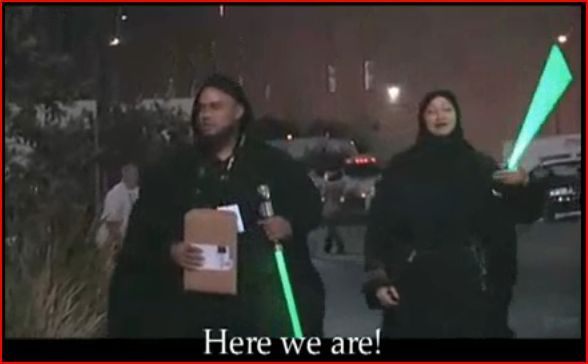
Muslim JediWhen you are Muslim, every day is Halaloween!

Women-in-Islamic-dress-we-001-1

Beekeepers take their light sabers for a walk.

image courtesy of tundra tabloids

Jedi religion founder accuses Tesco of discrimination over rules on hoods. The Guardian UK

Daniel Jones says he was humiliated and victimised for his beliefs following incident at store in Wales

Tesco has been accused of religious discrimination after the company ordered the founder of a Jedi religion to remove his hood or leave a branch of the supermarket in north Wales.

Daniel Jones, founder of the religion inspired by the Star Wars films, says he was humiliated and victimised for his beliefs following the incident at a Tesco store in Bangor.

The 23-year-old, who founded the International Church of Jediism, which has 500,000 followers worldwide, was told the hood flouted store rules.

But the grocery empire struck back, claiming that the three best known Jedi Knights in the Star Wars movies – Yoda, Obi-Wan Kenobi and Luke Skywalker – all appeared in public without their hoods. Jones, from Holyhead, who is known by the Jedi name Morda Hehol, said his religion dictated that he should wear the hood in public places and is considering legal action against the chain.

“It states in our Jedi doctrination that I can wear headwear. It just covers the back of my head,” he said.

“You have a choice of wearing headwear in your home or at work but you have to wear a cover for your head when you are in public.” Continue Reading →

Vladtepesblog violates it’s own policy of non partisanship for this video

What can I say, given who is saying this stuff and it’s implications and consequences right or wrong, it should not be ignored. Some components of the left view Islam as it’s ‘Hayekian’ strong man, a tool to destroy the current system of capitalism, rationalism, and Greek and Roman intellectual heritage that has withstood all attacks on it so far. Islam is the best bet a failed economic and social system has to do its dirty work. So when David Horowitz suggests Obama really does have a radical agenda and actually means it when he says he will “fundamentally transform America” we should pay attention.

Here is the whole show. In this, Glenn Beck deals with the issue of ‘Tzars’, something I find needs clarification.

Link: GlennBeckFriday2009 09 04