What is ‘desecration’ of a Koran exactly

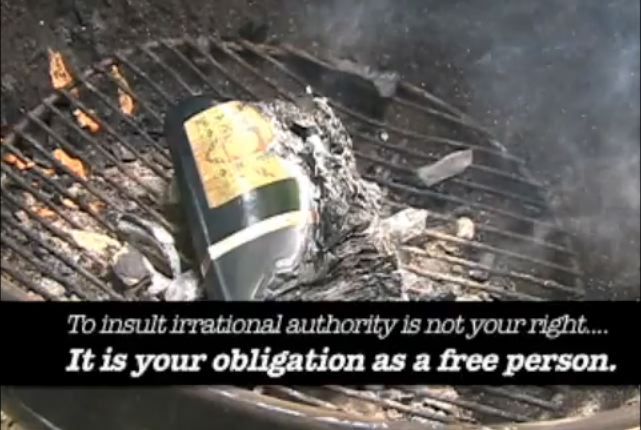
Koran burn insultLet’s see, we had riots in Greece when rumors circulated about a policeman ‘mistreating’ a koran, so I guess that is desecration, fair enough…

We had several Christians killed, their houses burned, and many families dislocated when Mosques trumpeted that one Christian family had torn a page from a Koran in Pakistan, so I guess that is desecration even when it was utterly untrue and again… well fair enough… sort of….

Then, we had some Muslims smuggling Heroin into Europe in a hollowed out Koran and no riots killings burnings or even condemnations at all so, I suppose, that is not a ‘desecration’. I suppose Mohamed must have been an apothecary…

And today, we have a koran hollowed out and bombs placed inside them in order to kill as many of the unwitting as possible in Iraq.

So, granted this is a small sample, but it gives us a place to start.

Desecration of Koran, therefore, must be when anyone not Muslim handles the holy book of Islam in any manner whatsoever that can be construed as disrespectful, and reported truly or falsely in that manner. Desecration of a koran is a tactic for political gain using the politically correct who think that a book is important merely because a non westerner says it is.

Desecration of a koran is not when that book is destroyed,mutilated or carved out for the purpose of advancing Islam in such ways as smuggling dangerous drugs to harm the infidel and raise money for jihad. It is not desecration when it is filled with explosives to kill other Muslims so long as those Muslims are of some other flavour than the bomber, as technically it’s still jihad to advance Islam.

Glad we cleared that up.

Eeyore
Iraq- the worst place for homosexuals on earth

From The Guardian U.K.

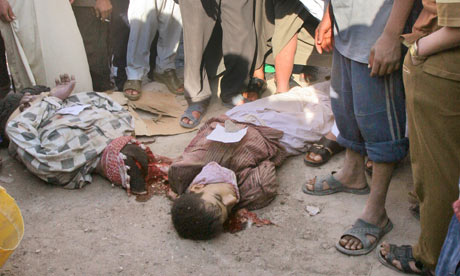
In an attempt to preserve the honour of Islam, gays are being sought out and brutally murdered by Islamist gangs. Their bodies are found lying in the streets bloodied, broken and ripped to pieces often with their genitals removed. Hardline groups spend hours trolling the internet hunting for gay Iraqi men to attack and murder in the latest spate of deliberate cruelty and surging violence aimed against homosexuals in Iraq.

” It is the easiest way to find those people who are destroying Islam and who want to dirty the reputation we took centuries to build up” Abu Hamizi, terror gang member.

How Islamist gangs use internet to track, torture and kill Iraqi gays

Iraqi militias infiltrate internet gay chatrooms to hunt their quarry – and hundreds are feared to be victims

Afif Sarhan and Jason Burke
The Observer, Sunday 13 September 2009
The bodies of gays on the streets of IraqThe bodies of gays on the streets of Iraq. Photograph: Bilal Hussein/AP

Sitting on the floor, wearing traditional Islamic clothes and holding an old notebook, Abu Hamizi, 22, spends at least six hours a day searching internet chatrooms linked to gay websites. He is not looking for new friends, but for victims.

“It is the easiest way to find those people who are destroying Islam and who want to dirty the reputation we took centuries to build up,” he said. When he finds them, Hamizi arranges for them to be attacked and sometimes killed.

Hamizi, a computer science graduate, is at the cutting edge of a new wave of violence against gay men in Iraq. Made up of hardline extremists, Hamizi’s group and others like it are believed to be responsible for the deaths of more than 130 gay Iraqi men since the beginning of the year alone.

The deputy leader of the group, which is based in Baghdad, explained its campaign using a stream of homophobic invective. “Animals deserve more pity than the dirty people who practise such sexual depraved acts,” he told the Observer. “We make sure they know why they are being held and give them the chance to ask God’s forgiveness before they are killed.” Continue Reading →

Naked in Iraq

From The Telegraph.co.uk.

''The Naked Woman'' by Picasso

”The Naked Woman” by Picasso Photo: AP

Stolen Picasso painting ‘The Naked Woman’ found in Iraq

A Picasso painting stolen from Kuwait during Saddam Hussein’s 1990 invasion has been discovered in southern Iraq.

Iraqi police arrested a man who was planning to sell “The Naked Woman” during a raid on his house in southern Iraq, officials said on Wednesday.

The painting was apparently among the artwork looted from Kuwait by Iraqi forces, said police spokesman Maj. Muthana Khalid.

It was seized on Tuesday during a raid near the mainly Shia city of Hillah, about 60 miles south of Baghdad.

Mr Khalid said the man was trying to sell the painting for $450,000 (£275,000), but some Iraqi experts who saw the painting said it was worth as much as $10 million.

The painting, which was signed by Pablo Picasso and bore inscriptions from “The Museum of Kuwait”, was being held as evidence while the suspected was interrogated, Mr Khalid said.

Goods and artwork from the neighbouring country’s wealthy homes and its national museum were hauled back to Iraq after the invasion, which led to the 1991 Gulf War.

Kirkuk: a businessman killed, a doctor kidnapped. Fear returns to haunt Christians

Yesterday in northern Iraq two violent episodes took place against the Christian community. A man was murdered because he tried to prevent the abduction of a Muslim child. A doctor kidnapped for money; a passer-by killed during the abduction. Local sources confirm a climate of “concern” that could cause “another mass exodus.” 

War on ChristiansKirkuk (AsiaNews) – More murders and kidnappings targeting the Christian community in Kirkuk, northern Iraq. Yesterday evening Sabah Daowd Askar, 55 years old, married and father of three children, was killed in front of his home in the district of Almas. Also yesterday, in another episode, a 50 year old doctor was abducted on his way home. AsiaNews sources in the city speak of a “climate of fear” and are afraid of a “new mass exodus” of Christians.

Sabah Daowd Askar was killed because “he tried to prevent a kidnapping.” The man, Christian, saw four people “kidnap a Muslim child.” He tried to save him, but the “criminals opened fire”. “He was a businessman – said the source, who knew the victim well – very kind and generous”.  Because of his generosity he had tried to prevent the abduction of the child, “irrespective of his faith or the community he belonged to”.

Samir Gorgia, 50, married with two children, a boy and a girl, was abducted around 9 last night, on his way home. During the course of the abduction a passer-by was killed, also of the Christian faith. “Even in this case – the source tells AsiaNews – this is a well known person. He is a medical specialist, known and appreciated by all” for his dedication to his work.

Once again “a climate of concern and fear” reigns upon the Christian community in Kirkuk, a victim of fundamentalist and criminal violence in the past.  The source says that “for some time the city has been living in a situation of instability” and a new mass exodus is feared. “Despite some attacks – the source concludes – few faithful have left the city, on the contrary, many families have recently returned. These latest episodes of violence, however, have generated a real concern for the future”.

95 killed on Iraq’s deadliest day since U.S. handover

These terror attacks are nothing to do with trying to grab power in Iraq. They are only to punish those who do not hold the same views as the attackers. To think that al-Qaeda members can justify and celebrate the mass slaughter of  fellow Muslims shows their evil knows no limit.

baghdad_giBAGHDAD, Iraq (CNN) — A series of bombings rocked Iraq’s capital within one hour Wednesday, killing at least 95 people and wounding 563 others, an Iraqi Interior Ministry official said.

The six explosions marked the country’s deadliest day since the United States pulled its combat troops from Iraqi cities and towns nearly two months ago and left security in the hands of the Iraqis.

In one attack, a truck bomb exploded outside the Ministry of Foreign Affairs — a blast that blew through the front of the building, sending some vehicles flying and leaving others in mangled twists of metal.

Nearby, Iraqi security forces stood with shocked expressions as ambulances screamed past.

Another truck bomb went off outside the Ministry of Finance building.

In central Baghdad, a roadside bomb exploded on Kifa Street, and another bomb exploded in the Salhiya neighborhood, where on Tuesday security forces had avoided injuries by successfully defusing a truck bomb. Wednesday’s other two bombs exploded in eastern Baghdad’s Beirut Square, officials said.

“The terrorism attacks that took place today require, without a doubt, the re-evaluation of our plans and our security mechanisms to face the challenges of terrorism,” Iraqi Prime Minister Nuri al-Maliki said in a written statement.

U.S. Ambassador to Iraq Chris Hill and Gen. Ray Odierno, the top U.S. commander in Iraq, issued a joint statement condemning the bombings.

“The horrific injuries and loss of life witnessed in Baghdad today are terrorist attacks that serve no legitimate purpose,” they said.

The attacks “will not deter Iraqis from continuing their efforts to build a peaceful and prosperous society and engage the international community, nor will they weaken our resolve to help them in their efforts,” they added.

Two people believed to be connected to the bombings have been arrested, an official with the Iraqi army told CNN. Continue Reading →

Iraq says Iran-made rockets found from attacked US base

Times of India

BAGHDAD: Police say Iraqi forces seized a launcher loaded with 13 Iranian-made rockets after an attack against the US base outside the southern city of Basra.

Col. Karim al-Zaidi says the missiles were found Tuesday in an eastern section of the mainly Shiite city.

He says Iraqi forces raided the area after five rockets were fired at the US base late Monday.

The oil-rich area of Basra has been a Shiite militia stronghold but violence has declined sharply following a US-backed government offensive that led to a ceasefire last year.

Still, attacks continue. Three American soldiers were killed in a rocket attack against the base in mid-July.

The US military says Iran is continuing to support violence in Iraq. Tehran denies the allegation.

Iraqi gays rounded up, tortured and mutilated

Militias in Iraq are rounding up gays, slitting and removing pieces of their throats, cutting off their genitals and gluing their anuses shut. Signs are then attached to their displayed, mutilated bodies reading ‘pervert’ in Arabic and their bodies then dumped into garbage cans. “Fears that Iraqi men’s masculinity is under threat” is the motivation for violent action taken against gays in Iraq. Victims families are also to blame for carrying out honour killings because ‘unmanly’ behaviour shames the family/tribe.

From The National Post.

Rights activists say Iraqi gays targeted for death by militias

Aseel Kami and Mohammed Abbas, Reuters Published: Monday, August 17, 2009

BAGHDAD – Iraqi militias are conducting a campaign of torture and murder against men suspected of homosexual activity, a leading rights group said on Monday, adding that government security forces may be involved.

New York-based Human Rights Watch (HRW) said the killings began earlier this year in the poor Sadr City district of Baghdad, once ruled by Shi’ite Muslim militias, and had since spread to many cities across Iraq.

“The killers invade homes and pick people up in the street, witnesses and survivors said, interrogating them before murdering them to extract the names of other potential victims,” the rights group said in a statement. Continue Reading →

Iraqi women’s wrestling team irks clerics–tribesman calls for their slaughter

Some young women in Iraq are wrestling– with each other–in the gym. Clad in Nike and Adidas they put the learned moves into practice and defy the rigid theological pressure by clerics who demand their subservience. Despite a call for their slaughter, these Iraqis are willing to move beyond the threats and embrace greater democracy and equality.

From The New York Times.

Diwaniya Journal

Female Iraqis Take on Tradition in Wrestling Ring

Joseph Sywenkyj for The New York Times

Samah Hamid, 24, right, squared off against her 22-year-old sister Masar during wrestling practice at the sports club in Diwaniya.

By SAM DAGHER
Published: August 4, 2009

DIWANIYA, Iraq — It doesn’t happen much in the Arab world, but a coach here decided in January to start an all-female wrestling team, the first ever in Iraq. The wrestlers love it and already dream of competing in the Olympics.

Skip to next paragraph

Joseph Sywenkyj for The New York Times

After a practice last month, Farah Shakir, 17, put on a traditional abaya over her wrestling clothes.

But there are many in this town south of Baghdad, which like much of Iraq is religious, conservative and governed largely by tribal tradition, who want the dozen girls and young women on the team to stop wrestling immediately. One tribesman has said they should be “slaughtered” if they continue. A Shiite cleric says the team should be banned because wrestling can lead to promiscuity and “transgressions” against Islam.

As a result of the pressure, four wrestlers have quit. But the rest, for the moment empowered by the post-invasion promise of greater democracy and equality, are defying the threats.

“They think we are loose girls just because we play sports,” said Ikram Hamid, 25, one team member.

Farah Shakir, 17, said, “It really is something different for Iraq, but I love the challenge.”

In fairness, it is not just female wrestling that troubles the traditionalists.

“I have information that male wrestling is problematic, too, because of all the friction that goes on,” said Sheik Hussein al-Khalidi, a turbaned cleric who sits on the provincial council.

But it is the women who have touched a nerve, perhaps partly because of their ambitions. Three other teams were set up in Iraq after Diwaniya’s was formed with the backing of Iraq’s wrestling federation. In June, all the teams took part in a championship, which the Diwaniya team won, qualifying for an Asian tournament in September in freestyle wrestling.

Some local people have become captivated by the female wrestlers and feel they are a fitting challenge to Iraq’s entrenched tribal and religious establishment, whose hold on society and people’s lives paradoxically became much tighter after the 2003 invasion. One supporter, Haidar Walid, 20, called the team a “sign of evolution and freedom.”

The controversy in Diwaniya underscores a fundamental struggle under way in Iraqi society as a whole. The grip of Sunni and Shiite armed groups that had compelled Iraqis to abide by what they considered moral behavior has loosened, and many people now feel free to express themselves in various ways. This was reflected during provincial elections in January, in which secular and relatively liberal parties did well.

On a recent scorching hot morning, the wrestlers, some veiled and others not, and dressed in shorts and soccer jerseys, filed into the wrestling gym at the Diwaniya sports club. They are allowed to use it only when male wrestlers have no practice.

A battered and dusty wrestling mat filled most of the room. The walls were adorned with framed photographs of male wrestlers, colorful posters of Shiite saints and the portrait of a local hero, Abbas Fadhel Jouda, an Iraqi wrestling champion killed two years ago by militiamen in Diwaniya because he was a police officer.

After a warm-up, Ms. Shakir and her teammates paired off and started practicing grapples and takedowns under the instruction of their coach and team founder, Hamid al-Hamdani, and his two assistants, all professional wrestlers.

Unlike Greco-Roman wrestling, freestyle wrestling allows holds below the waist and legs to be used for a takedown. It is an internationally recognized sport, but women’s wrestling made its Olympic debut only five years ago at the Athens Games. Two other Arab countries, Egypt and Morocco, have female wrestling teams.

But Diwaniya’s team may face more than the usual obstacles on the road to gold. Iraq’s wrestling federation endorsed the team, but an official from that body refused to come to Diwaniya for the competition in June, fearing he would be killed, according to Mr. Hamdani.

In May angry tribal leaders petitioned the provincial council to ban the team after a television station showed one of the wrestlers practicing with her coach.

Since then the team has kept a low profile, abiding by local customs. During practice the girls are chaperoned by Ms. Shakir’s mother, Nawal Kadhim, and when they leave the club they are covered in head-to-toe black veils.

Still, many are taunted and cursed whenever they venture to the market. They are ostracized at school and constantly hectored by their teachers.

Mrs. Kadhim, who has five daughters on the team, was recently advised by relatives to leave Diwaniya and received threatening messages on her cellphone.

“Women will lose their femininity,” said a resident, Faris Abbas, 42, who like most opposes the female team.

A tribal leader, Gaith al-Kassir, 53, says the sport is against Islam and tribal traditions. “Women can do sports at home,” he said.

As with many other issues, Shiite religious leaders are divided on female wrestling. Some say there is no harm as long as the women are properly covered, while others say it is “absolutely forbidden,” according to one of the team’s coaches, who consulted the religious authorities in the city of Najaf.

Sheik Khalidi says he will continue to rally public opinion until the wrestling club is closed down. He is a member of the Islamic Supreme Council of Iraq, which is a religious party close to Iran and ruled the province until January’s elections, when it lost to Prime Minister Nuri Kamal al-Maliki’s party throughout the south. Although Mr. Maliki is an Islamist, his party has favored persuasion over coercion when it comes to shaping society’s values.

Despite the setback at the polls, Sheik Khalidi said his party was still convinced that Iraqis were becoming more conservative and attached to Islamic rituals and values.

Batoul al-Attiyah, a local physician, said she disagreed with Sheik Khalidi’s assessment of where Iraq was heading, even if she opposed female wrestling.

“Religion has become more about appearances than substance,” she said.

Terrorists kidnap, torture boy to bully Iraqi policeman

Khidir and Abdul QaderFALLUJA, Iraq (CNN) — Like many young boys, Khidir loves playing with toy cars and wants to be a policeman like his father when he grows up. But it was his father’s very job that caused the tiny child to suffer the unimaginable.

Khidir was just 6 years old when he was savagely ripped away from his family, kidnapped by al Qaeda operatives in Iraq.

“They beat me with a shovel, they pulled my teeth out with pliers, they would go like this and pull it,” said Khidir, now 8, demonstrating with his hands. “And they would make me work on the farm gathering carrots.”

What followed was even more horrific, an ordeal that would last for two years in captivity. Khidir and his father spoke to CNN recently, more than half a year after his rescue by Iraqi police.

“This is where they hammered a nail into my leg and then they pulled it out,” he says, lifting up his pant leg to show a tiny wound.

He says his captors also pulled out each of his tiny fingernails, broke both his arms, and beat him repeatedly on the side of the head with a shovel. He still suffers chronic headaches. He remembers them laughing as they inflicted the pain.

“I would think about my mommy and daddy,” he replies, when asked how he managed to get through the agony.

His father, Abdul Qader, struggles for words. “When he tells me about how they would torture him, I can’t tolerate it. I start crying,” he says. “What hurts me the most is when they hammered a nail into his leg.”

The father, a police officer, was sleeping at the police station in Falluja when his son was kidnapped. It was too dangerous to go home regularly. Although Falluja was no longer controlled by insurgents, assassinations against police were common.

“I woke up to the sound of a huge explosion … and then I heard my name on the radio. I ran outside and they came to me saying your house was blown up,” he says.

“When the police patrol came back, they all started kissing and comforting me,” he continues. “I was asking, ‘What’s going on? Where is my family?’ They told me that they took my son. This was a disaster. I went mad that day, I wasn’t normal, I was hysterical.”

Khidir’s grandmother was at home with the family at the time.

“The kidnappers climbed the fence and kicked in the door,” she says.”They were screaming for Abdul Qader. I told them he’s not here. They called me a liar and said we want his son. His son was hiding behind me, clutching my clothes. I said this is not his son. They hit me on the back with a rifle and ripped him out of my arms.”

The last thing she remembers were his screams of “Granny, Granny!” Continue Reading →

CNN 4 killed, 32 wounded as 6 Baghdad churches bombed

BAGHDAD, Iraq (CNN) — At least four people were killed and 32 wounded as six Baghdad-area churches were bombed within 24 hours, officials told CNN.

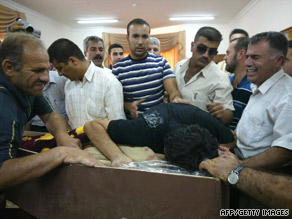
Family members of Rizko Aziz Nissan grieve before his funeral in Kirkuk, Iraq, on Sunday.

Family members of Rizko Aziz Nissan grieve before his funeral in Kirkuk, Iraq, on Sunday.

The first bombing took place Saturday night at St. Joseph’s church in western Baghdad, according to an Interior Ministry official. Two bombs placed inside the church exploded at about 10 p.m. No one was in the church at the time of the attack.

Sunday afternoon, three bombs exploded outside churches, wounding eight civilians, the official said. The bombs detonated within a 15-minute span, between 4:30 and 4:45 p.m. Two of the churches are in central Baghdad’s al-Karrada district, and the third is in al-Ghadeer in eastern Baghdad.

Sunday evening, a car bomb exploded outside a church on Palestine Street in eastern Baghdad just after 7 p.m., the official said. Four people died, and 21 were wounded.

One Christian Iraqi, interviewed outside Sacred Heart Church — one of the two in al-Karrada — said the bomb went off shortly before 5 p.m., as members were arriving for Sunday evening mass. No one was hurt, Sabhan George told CNN, but the bomb damaged the church building and some cars outside.

George said he is concerned about the church bombings. If this continues, he said, “there will be no Christians left in Iraq.”

St. Joseph’s was one of six churches hit by coordinated bombings of Christian houses of worship in Baghdad and Mosul in 2004. The church is in the al-Jamiaa neighborhood of Baghdad, a former stronghold of al Qaeda in Iraq. There have been recent reports of an increase in targeted attacks in the area.

Many of Iraq‘s estimated 1 million Christians have fled the country after targeted attacks by extremists. In October, more than a thousand Iraqi families fled the northern city of Mosul after they were reportedly frightened by a series of killings and threats by Muslim extremists, who apparently ordered them to convert to Islam or face possible death. At least 14 Christians were killed in Mosul in the first two weeks of October.

Separately, gunmen shot and killed an official in the Iraqi city of Kirkuk on Sunday morning, a local police official told CNN.

Using guns with silencers, the assailants opened fire on Rizko Aziz Nissan outside his home in central Kirkuk at 8:15 a.m.

Nissan was an Iraqi Christian, but the motives behind his killing were not immediately clear. Kirkuk is 150 miles (240 kilometers) north of Baghdad.

And in southern Baghdad’s Dora district, a bomb outside a church wounded three other civilians.

Most of the churches were damaged in the bombings, according to video footage.