I couldn’t really think of what to say the interview was about in a couple of words. Mr. Johnson is a great communicator and we had a very enjoyable and informative interview.
“The secret of all victory lies in the organization of the non-obvious.” -Marcus Aurelius

I couldn’t really think of what to say the interview was about in a couple of words. Mr. Johnson is a great communicator and we had a very enjoyable and informative interview.
Thank you Ava Lon for the translation of this refreshing and important video
Poland still retains two important customs and traditions which need to be known by the rest of the West. Thanks to our tireless translator, Ava Lon, we can show you them with explanations.
The Bugler of St. Mary’s.
Video of the actual performance:
In the same town, Cracow, there is another tradition to make the same point. Or perhaps more accurately the point of what happens when you fail to hear the bugle’s call to arms.
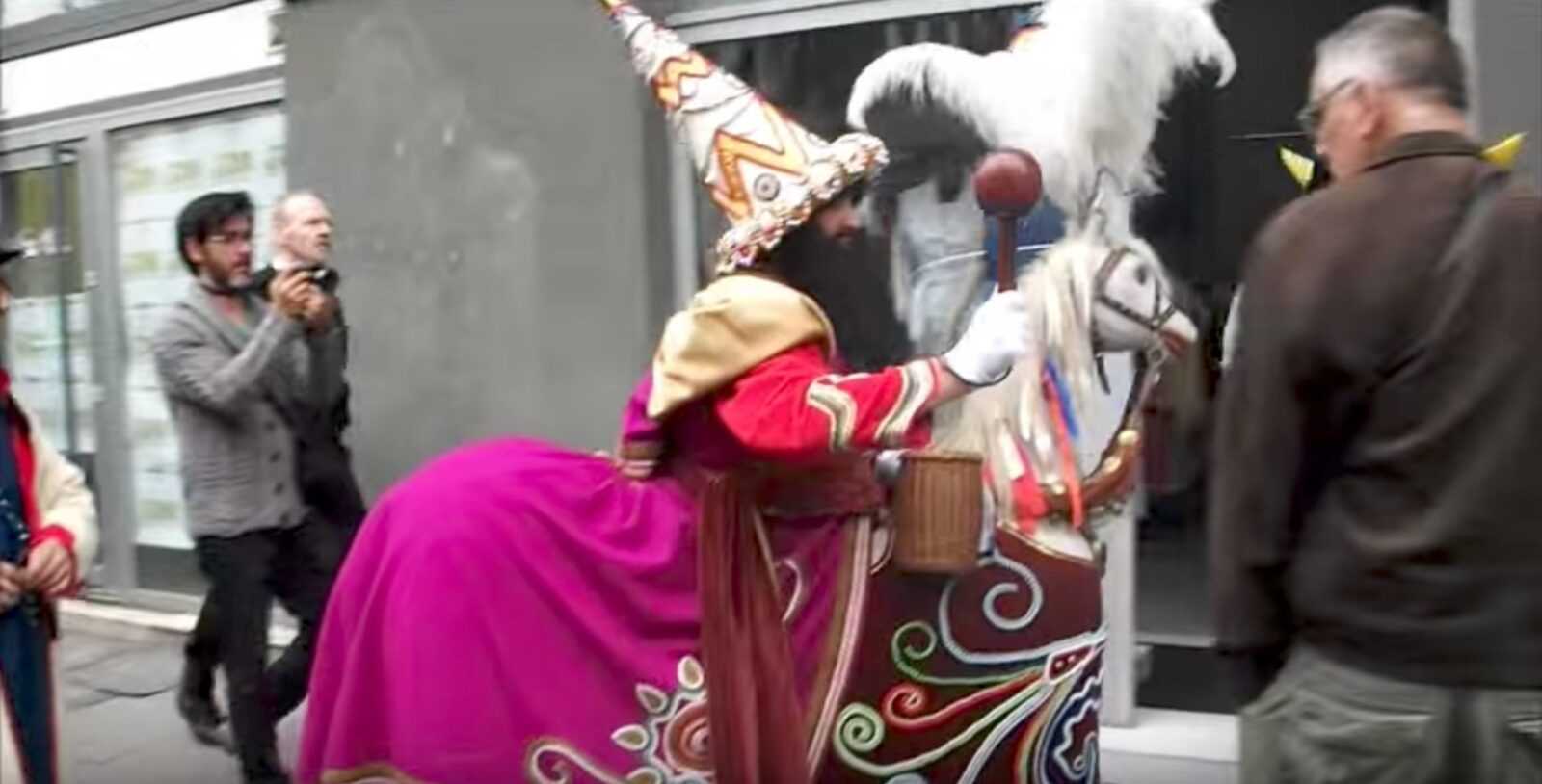
In this tradition during the procession of Corpus Christi, a man dressed as a Muslim invader, complete with a pointy hat with the Ottoman, or is it Tartar, crescent on top, rides atop a ‘horse’ tapping people with a rod, symbolic of forcing them to pay the “jizya” or tribute the non-Muslims were forced to pay to their islamic overlords after being conquered. As the Koran puts it:
Fight against those who (1) believe not in Allah, (2) nor in the Last Day, (3) nor forbid that which has been forbidden by Allah and His Messenger (4) and those who acknowledge not the religion of truth (i.e. Islam) among the people of the Scripture (Jews and Christians), until they pay the Jizyah with willing submission, and feel themselves subdued.
Tapping people with the staff symbolizes beating the locals into a state of submission, although today people believe it brings them luck. The horseman is known locally as Lajkonika, where Konic means little horse.
Some people actually give money symbolizing paying the jizya, but really to help keep this tradition alive.
This used to be an annual event without interruption for 700 years. But it is more common now for tourists, and hopefully of increased importance to the locals. Here is a Wiki on the festival you can see in the video above.
Many thanks again to Ava Lon for making me aware of this beautiful remembrance and explaining it so well for us all.
The truth about slavery.
SHARE: https://t.co/VVgj8GvzmH pic.twitter.com/8jN4V0syiB
— Paul Joseph Watson (@PrisonPlanet) May 5, 2017
Real education, Greek thought, civilizational continuity must now be done by the private sector and volunteers. While we are still forced to pay for professional educators and institutions determined to use our resources to deconstruct everything that matters to us.
H/T Richard.
This man is very intelligent speaks with some subtlety. It requires a bit of focus to get the nuance of his speech. For example, he appears to be making the distinction between Islam and ” Islamism” when in fact he is mocking that very distinction.
Thank you Ava Lon for doing this one. Anyone watching it can tell it must have been a lot of work.
A good friend of the Counter-Jihad had spent some time as a fine arts major in a German University.
She informed me that there is, it seems, a curious tradition in German classical art that many of us may find quite intriguing,
The term for it is “Mondsichelmadonna” which means “sickle moon Madonna.”
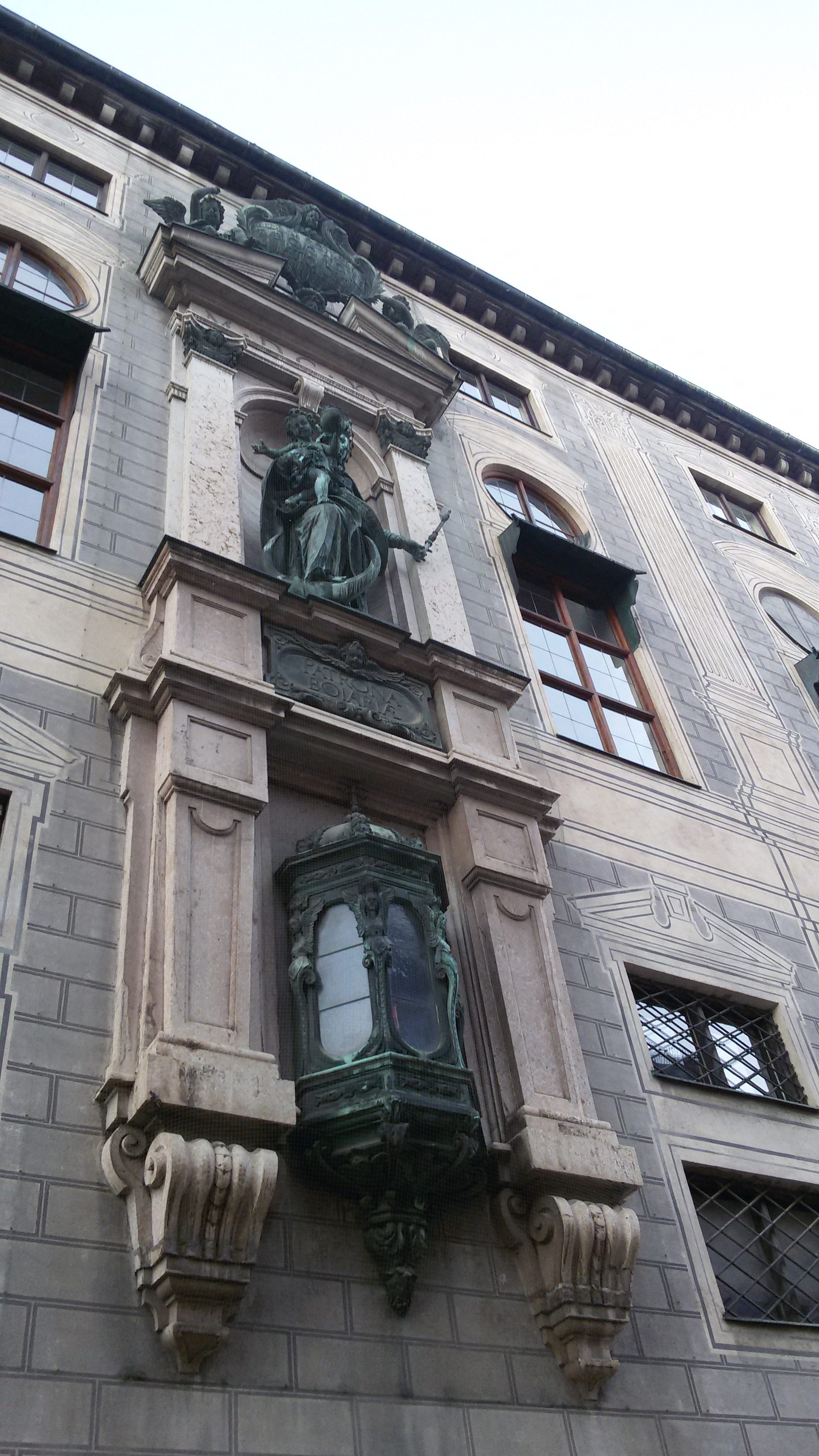
The images are of the Virgin Mary, usually holding something like a scepter, and standing on a crescent moon.
The moon, I am told, must also have a specific feature.
The moon must have a face, and that face must look unhappy.

OLYMPUS DIGITAL CAMERA
The icons can be seen all over Germany, although they are not so common as perhaps once, they might have been.
Many date back to the late 1600s like this one, which is right at the center of München.
(Munich)
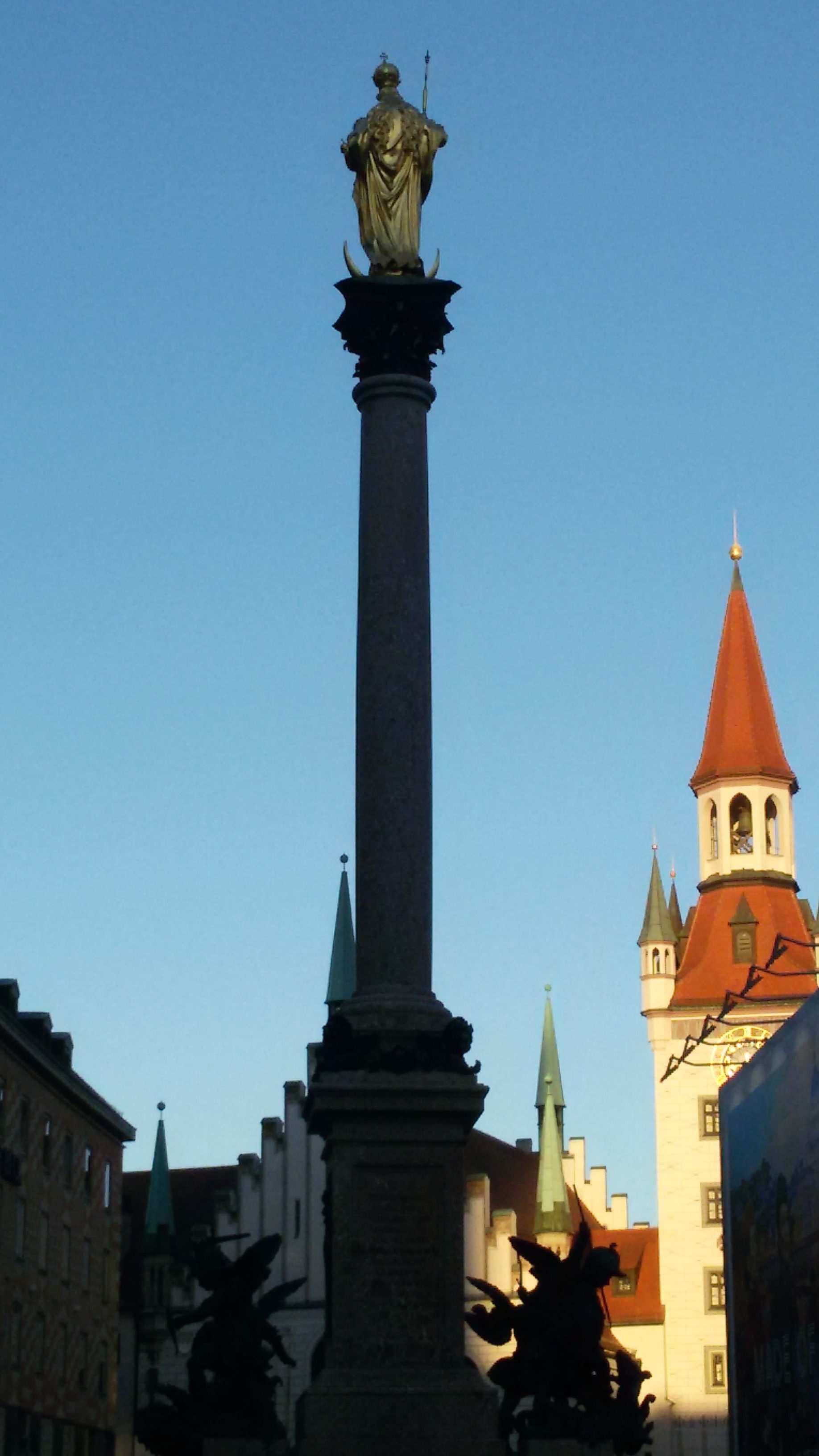
If you zoom in on the statue, you get a better idea. This one is said to be at the geographical center of München and all roads lead away from this point.

Axis of symmetry was reversed in this enlargement
An interesting set of features. The Virgin Mary, a baby Jesus, a scepter of some kind and standing on an unhappy crescent moon.
Our friend tells us that no one knows what any of this means anywhere. not in the usual literature and certainly no university prof. or purveyor of the narrative has any idea what these things means.
I suppose that means they will be removed soon, despite having been there since the 1500s.
I suppose in a way, this can be thought of as the German equivalent of the classical tradition of iconic art known as The Pietà, except with the added element of the scepter and the unhappy crescent moon.
They must have a crescent moon. It must have a face, And it must be unhappy.
One wonders why a solidly iconic figure would be portrayed as standing on an unhappy crescent moon’s face in and around the 1500s and 1600s in Germany.
It may be impossible to figure that out. There is, as German art profs insist, “there is simply no way to know.”
And yet there it is all over German art in that period, and represented in magnificent statuary all over Germany.
The moon face on the top image seems to be wearing a cap of some kind.
But that cannot possibly have anything to do with the meaning of the imagery.

No doubt just an ancient teutonic custom from the renaissance with no actual meaning whatsoever to be discarded ad abandoned with last week’s milk. The cost of making these must have been the ransom of a Sultan though, if Europeans where the sort of folks who took Sultans hostage and ransomed them. So it must have meant something to them at the time.
Perhaps if enough grant money is found, and all arts schools can be funded enough to destroy all the research, its possible that the meaning of the unhappy crescent moon with a sad face and a sort of cap on can be forgotten forever in case the facts of history may offend those people currently in the process of rewriting it all.

The entire speech and Q&A will be edited and uploaded at some point over the next few days but for the moment I wanted to post a bit of a teaser.
One man asked a question which contained nearly every canard about Islamic history we are spoon fed by the useful idiots on a near daily basis from the ‘golden age of Al-Andaluz’ to the bringing of the Enlightenment to we “savages in Europe” by Islamic scholars.
Robert deals with them all in on succinct answer.
The rest of Robert’s superb presentation and the Q&A, which was of unusually high calibre, will be available over the weekend.
This is very good. Try and make it right to the end. It really is worth the time. I was going to make it a sticky post but intend I think I will refer to it and link back to it here and there throughout the day.
It has been quite a day already for both events, and people speaking frankly about Islam and those events.
The Pat Condell clip in the post below is excellent. Superb. Important even. As is this John Robson clip, Prof. Robson himself a professor of History at Ottawa University, comes out and speaks the obvious and well documented truth about Islamic history and its aggressions.
Moroccan troops known as Goumiers formed part of the Free French army that fought with the Allies in Italy during World War Two. After the victory at Monte Cassino — in which the Goumiers had played a crucial role — bands of Moroccans rampaged through mountain villages in the area, raping all the women and girls they could lay their hands on, and sometimes men and boys as well.
Here’s an excerpt from the Wikipedia article on the atrocities committed by the Moroccans:
On vlad, and on some other sites recently there has been discussion about using the dhimmi term, ‘The Prophet Mohamed’ when referring to the founder of islam.
This is of course, pure submission. Its not like you hear the same journalists or fellow travelers at the coffee shop etc. referring to, ‘Our Lord and Saviour Jesus Christ’ etc. unless they are devout believers. And even then only some of them.
So what do we call him?
Well I think we should go with historical and even mythological truth as, at least once upon a time in Canada, truth was an absolute defense. So let’s have a look at a couple of basic and easily verifiable truths about Islam’s founder.
1. Mohamed dyed his beard red. According to this site it was for a few reasons. He dyed it to look other than Christian or Jewish, and dyed it red to signify being at war.
2. Mohamed funded his nascent army by raiding desert caravans, stealing the contents and doing what he would with the staff. I won’t provide a link. Do google searches. This is too important for a single link I pick. Mohamed funded his gang and its rules and its take-over of vast territories by raiding other people’s wealth achieved by civilized cooperation and hard work. He paid his army by offering them a percentage of whatever they could steal from unbelievers providing that they kicked up the requisite amount to him and eventually his generals and then those who represent him in the hierarchy, typically called ‘Caliphs’.
(I believe the MAFIA has a more exact term for paying up a percentage of stolen goods to a leader than ‘kick up’ but its been a while since I watched the Sopranos)
So how do we refer to the founder of Islam without being deliberately vulgar and relying 100% on truth as presented not just by accepted history but by muslims themselves in their most holy and authoritative scripture?
I would suggest…