
You need to install or upgrade Flash Player to view this content, install or upgrade by clicking here.
Category Archives: War on women’s rights
Video promo for womens rights revolution in the Muslim world.
In this case, it is never too little, and too is never too late. I am thrilled to see this well made appeal for women to fight for equal rights, although any rights at all would be welcome I’m sure, in the Muslim world.
Phyllis Chesler: Sexual harrasment and rape in the Islamic world
This is an audio interview Ms. Chesler did with Israel National News. Please click here to go to her page and hear the interview.
Hundreds Of Muslim Women In Sweden Run From Being Murdered By Their Own Families RTV
Turkish femicides up 1400%
The irony of PressTV knows no bounds. They report on abuse of women in turkey, of course without mentioning the role Islam plays, and ignore crushing of womens rights in Iran thanks to Islam’s rules applied at home.
More on the attack on the teacher for teaching Muslims religion other than Islam
Egypt’s harassed women need their own revolution
By Mary Rogers, CNN
February 16, 2011 — Updated 1804 GMT (0204 HKT)
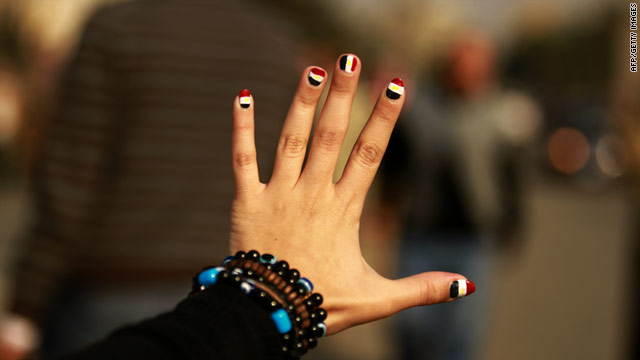
An Egyptian girl flashes her nails painted with the colors of her national flag in Cairo’s Tahrir Square.STORY HIGHLIGHTS
- If you are a woman living in Cairo, chances are you have been sexually harassed
- In 1994, shortly after I arrived in the city, a man walked up to me and casually grabbed my breast
- Behavior of men includes groping, stalking, lascivious looks and indecent exposure
- The only real protection women can have is when the attitudes of men change
Editor’s note: CNN producer and camerawoman Mary Rogers has lived and worked in Egypt since 1994. She joined CNN in 1981 and has covered conflicts in Somalia, Sierra Leone, the Congo, Iraq, Chechnya, Israel, Gaza, the West Bank, Lebanon and Afghanistan. Recently she filmed the uprising in Tunisia.
Cairo, Egypt (CNN) — Several months before the revolution, I wrote a piece for CNN.com on the sexual harassment of women in Cairo.
News of the chilling attack on CBS reporter Lara Logan, as well as other sexual assaults against women during Egypt’s uprising, show that attacks against women have not gone away.
I speak from experience. While most of my days covering Tahrir Square during the last few weeks were free from harassment, there was one day when I was groped. Another colleague almost had her pants ripped off by a gang of thugs.
If you are a woman living in Cairo, chances are you have been sexually harassed. It happens on the streets, on crowded buses, in the workplace, in schools, and even in a doctor’s office.
According to a 2008 survey of 1,010 women conducted by the Egyptian Center for Women’s rights, 98 percent of foreign women and 83 percent of Egyptian women have been sexually harassed.
It happens on the streets, on crowded buses, in the workplace, in schools, and even in a doctor’s office.
–Mary Rogers
I was walking home from dinner recently when a carload of young men raced by me and screamed out “Sharmouta” (whore in Arabic.)
Before I could respond, they were gone, but I noticed policemen nearby bursting with laughter. I am old enough to be those boys’ mother, I thought.
This incident was minor compared to what happened in 1994, shortly after I moved here. It was winter, and I was walking home from the office, dressed in a big, baggy sweater, and jacket. A man walked up to me, reached out, and casually grabbed my breast.
In a flash, I understood what the expression to “see red” meant. I grabbed him by the collar and punched him hard in the face. I held on to him, and let out a stream of expletives. His face grew pale, and he started to shake. “I’m sorry. I’m sorry,” he whispered.
But the satisfaction of striking back quickly dissipated. By the time I walked away, I was feeling dirty and humiliated. After a couple of years enduring this kind harassment, I pretty much stopped walking to and from work. Continue Reading →
Bangladesh girl bled to death after lashing say doctors
From The BBC:
Bangladesh girl bled to death after lashing say doctors
 Hena Begum took six days to die
Related Stories
A Bangladeshi girl who was publicly whipped for an alleged affair with a married man bled to death, according to a fresh post-mortem examination.
Doctors in Dhaka found multiple injuries on the body of Hena Begum, the deputy attorney general told the BBC.
The High Court ordered her body to be exhumed and taken to the capital after a local autopsy recorded no injuries.
Miss Begum died in hospital six days after last month’s beating, which has caused shock in Bangladesh and abroad.
Police have opened a murder investigation.
The doctors who carried out the initial investigation have been summoned to explain their findings in the High Court on Thursday.
The second post-mortem examination was carried out by a team of doctors at Dhaka Medical College Hospital.
“Multiple injuries were found. The girl died because of bleeding,” deputy attorney general Altaf Hossain told the BBC Bengali service. Continue Reading →
Girl molested over headscarf
From this Dutch news site:
Translation: Sagunto
The sixteen-year-old girl who was beaten up at school last Tuesday, was molested because she wasn’t wearing a headscarf. That is what the head of Scala College high school told to the AD [Dutch newspaper, Algemeen Dagblad]
The girl from the Dutch city of Alphen was attacked by a group of girls, all wearing headscarves themselves. The cause of the molestation was a message spread through social media by the victim.
The teenager suffered a concussion and injuries to her lip. The incident happened on Tuesday afternoon at Scala College, location Diamantstraat. The high school student has been harassed by her fellow students. The girl that hit the victim will be suspended by the school, the director of the school board told the AD.
Dutch girl sent to hospital by Muslims for “slutty photo”
English translation of article from Dutch News. URL
Girl (13) violated over Twitter photo
A thirteen-year-old girl was beaten up and sent to the hospital last Friday, after a conflict about a Twitter photo.
The victim is a student at Huygens College, a VMBO high school in the Amsterdam West area. A classmate put a somewhat juicy picture on Twitter.
According to a police spokesman, the school subsequently witnessed a “tense atmosphere” between two opposing groups. Meanwhile, on Twitter the verbal abuse went on as well. The police paid two visits to the Huygens College, together with the community-coordinator [PC lingo for: local agent] in order to calm things down.
At first this seemed to work, but later that day things turned ugly nevertheless. The girl had been sent home as a precaution, but later on she went back to school to voice her displeasure. At the Overtoom [street in Amsterdam], the girl suffered a bruised vertebra during a violent confrontation that took place between the two groups. She received treatment in hospital and has returned home.
In a comment to AT5 [Amsterdam local news channel] she says she’s terrified of returning back to school.
The other girl in the picture is a student from a school in the Amsterdam-Noord area. There are reports that she also has been threatened.
Cory Bernardi: Defending Freedom of Speech
This article was written by the Australian senator, Cory Bernardi on his own website linked here
Sergio Redegalli is an artist who has become an eloquent spokesman for freedom of speech. He has also become a friend – as much as you can be friends with someone you have never met.
Unfortunately, he has been subject to a most appalling campaign of hate and violence, legal threats and personal attacks that now has him living in fear for his life.
His crime? Mr Redegalli is the artist responsible for the “Say no to burqas” mural in Sydney’s Newtown.
To suggest that the six foot high mural has caused controversy would be an understatement but the campaign against Mr Redegalli has highlighted the growing threat of extremism that lurks in Australia.
Artists pushing the boundaries of community acceptance is nothing new. Personally, the quasi pornographic Bill Henson images of naked pre-pubescent teens masquerading as art appalled me.
I am also offended by the ritual humiliation of Christian belief in the name of art but I accept that my taste is not shared by everyone. To me, artistic expression is a small price to pay for living in a free country.
In fact, any suggestion that an artist has gone ‘too far’ in their craft for mainstream sensibilities is usually met with a vigorous defence by those claiming we need to be more tolerant of freedom of expression. Continue Reading →
CNN: Girls sold into sexual slavery, then jailed or punished for dishonour.
BBC: Stoning in Afganistan today and sharia law
I wonder how this got by the BBC censors. It actually shows Islam for what it is instead of the party line of, ‘UnIslamic activities’ which is how the English government and the BBC usually soft soap this sort of story.
Forbidden Love. Taboos and Fear among Muslim Girls
A couple of articles that deal with the issue of Turkish girls in Germany who wish to live a free Western life.
The first is this video below which is quite interesting and then an article from Der Spiegel:
Forbidden Love
Taboos and Fear among Muslim Girls
By Güner Balci

Kathrin Harms / Zeitenspiegel / DER SPIEGEL
Gülay has heard it from her mother so many times: An unmarried woman who has lost her virginity might as well be a whore.
Gülay, 22, lives in Berlin’s Neukölln, a district that is home to a high number of Muslim immigrants, and has little in common with the cliché of the “girl with the headscarf.” She wears tight jeans, low-cut blouses and has long hair that she doesn’t keep covered. She is self-confident and looks people in the eye. Gülay plans to begin a training program to work as an airport ground hostess next year. At first glance, she comes across as a poster child for successful integration.
Nevertheless, she is adamantly opposed to seeing her name in print, just as she would never meet a journalist for an interview in one of the hookah bars in her neighborhood that are so popular among Arab and Turkish immigrants. She is worried that someone could overhear her talking about her family’s strict morals, and about the rigid code of honor in her social environment that prevents girls from having sex before marriage and forbids them from having boyfriends.
Gülay is thinking about how best to sum up her dilemma. She nervously stirs her tea before launching into a litany of complaints. “The boys can screw around as much as they want, but if a girl does it she can expect to be shot,” she says. “That’s just sick.” She first had sex five years ago, and it completely changed her life. Since then, she has been deathly afraid of being branded by her family as a dishonorable girl — or, worst yet, punished and cast out.
A Constant Tug-of-War
Hardly any other issue is as fraught with prohibition and fear among Germany’s Muslim immigrants as sex. Many Muslim families adhere to moral values from a pre-modern era, and the separation of the sexes affects almost all aspects of daily life. At the same time, young female immigrants are faced with the temptations of a free life unrestrained by religious and cultural traditions. Their daily lives are a constant tug-of-war between two value systems.
Many of them suffer from this contradiction, and some crack under the strain. Doctors and social workers report on desperate young women coming to them with requests to reconstruct the hymen or perform late-term abortions. The elevated risk of suicide among young immigrant women even prompted Berlin’s Charité Hospital to establish a suicide prevention initiative for women from Turkish immigrant families. In a multi-year study, the group hopes to discover why the suicide rate within this population is apparently twice as high as it is among ethnic German women of the same age.
The consequences of living this double life have been poorly studied. Almost no governmental and non-governmental organizations, from family and education ministries to immigration authorities and self-help groups, can offer reliable figures or well-founded conclusions on the issue.
“The problems these women face are caused by the patriarchal and traditional structures in families,” says Berlin’s commissioner for integration and migration, Günter Piening. According to Piening, youth welfare agencies, government offices and schools have been educated on the issue for years, “but a lot remains to be done.”
Being Home by 8 p.m.
Of course, these problems do not exclusively affect Muslim groups. Young women in other social groups also suffer as a result of strict moral codes and domestic violence. And there are also Muslim families in which the daughters lead a modern, self-determined life, a fact that Piening and other politicians are quick to point out.
But doctors, social workers and the operators of crisis hotlines and youth clubs often experience a different reality. They note that, like in Turkey, equal rights are usually only experienced in families in academic or artistic circles. Otherwise, strict traditions dictate that fathers and brothers control the lives of their sisters and daughters.
This helps to explain why many girls with Turkish and Arab origins are so candid about their double lives, but only as long as they are not named.
One of the places where they are more likely to speak their minds is a Berlin youth club for girls from devout families, which is strictly off-limits to boys — the perfect place for Gülay and her girlfriends to meet. Otherwise, they are not permitted to go out. Going to a party is tantamount to turning tricks, and girls who are not home by 8 p.m., when shops close, need a good excuse to explain their tardiness.
The only freedom these girls enjoy is at school, while shopping or in youth clubs. “When I go home I hide my mobile phone in my underwear,” says Sibel, giggling as she extracts a mobile phone from her bra. “I’m not allowed to have a mobile phone or talk to boys. What else should I do?”
Twenty Minutes in a Public Bathroom
A small group of teenagers has congregated in the youth club kitchen. The girls are talking about sex, and almost all of them have something to say, something about their families that upset them. “The first thing our parents think is that we’re up to no good,” says one of the girls. Nevertheless, most have boyfriends, and even a visit to a gynecologist would be unthinkable for many of these girls, for fear of being spotted by relatives who would automatically conclude that they are there to get the pill — and are therefore sluts. “There are girls who would rather die from the pain,” says Gülay.
Sex education in school is also taboo for many young Muslim girls, says Gülay, who was the only one of 15 Muslim girls in her grade who attended the classes. Her fellow female students from the most devout families, says Gülay, “asked me all kinds of questions about how to use a condom and how to get the pill. Some of them didn’t know anything at all.” And some, according to Gülay, believed that all they had to do after having sex was to rinse themselves thoroughly with water. Others, especially “headscarf girls,” only engage in anal sex with their boyfriends, believing that in this way they can protect their “honor,” says Gülay.
Taking a boy home would almost be suicidal, say the girls at the youth club. The thought alone is so unheard-of that it triggers hysterical laughter. They rattle off the places where they have their rendezvous: hallways, park benches or the public restroom on Boddin Square in Neukölln, where person can get 20 minutes of privacy for 50 cents. Some girls are lucky enough to have a boyfriend with his own car or who can at least afford to pay €20 ($27) for a hotel room.
Connecting with a Hotline
And what happens then?
Papatya, a Berlin crisis center and shelter for girls of Turkish origin, provides neither an address nor a telephone number on his website. For more than 20 years, Papatya has been offering protection and shelter to young immigrant girls and women fleeing domestic violence. The organization is careful to keep its identity and whereabouts a secret. When it comes to injured family honor, anyone who so much as helps the girls can quickly get into danger.
Those who want to contact Papatya are asked to leave a number on an emergency hotline. A short time later, a social worker or a psychologist calls the girls.
One of the staff members at the center is a woman named Leila. In the eight years she has been working at Papatya, she has heard the same complaints again and again. Her list runs the gamut from girls being kept at home and barred from going to school to forced marriage and acts of violence committed on behalf of parents. In her counseling sessions, the girls repeatedly talk about their virginity, and about the fact that their happiness, or lack thereof, can depend solely on a few millimeters of skin.
For page 2 please click here:
Losing your head over love
Women in Somalia given choice. Marry, or be beheaded.
Fleeing Somali women recount tales of terror
BBC
By Hugh Macleod and Annasofie Flamand BBC News, Kharaz, south Yemen
 The parents of Somali Halim Ibrahim, 22, paid for her to travel alone, hoping she could earn them money in Yemen
Amina Ahmed’s letter, typed out in English by a fellow refugee, tells of a little known horror she and others endure in the tragedy that is Somalia’s ongoing civil war: The rape, forced marriage and even beheading of women at the hands of the Islamist militiamen who have overrun much of their country.
“I was living with my aunt in Afgooye district of the lower Shabelle region when [a] warlord assaulted our home as a reason to marry me by force.”
Her aunt tried to protect her from the man but he shot her dead.
Ms Ahmed fled next door to her neighbour’s, but the man followed and shot them all. Then Ms Ahmed fled, braving the perilous trip across the Gulf of Aden to reach Yemen.
“This year we have been hearing a lot about forced marriages and rapes,” says a member of an aid agency working on the ground with newly arrived Somali refugees in Yemen.
Like most who spoke about the actions of the hardline Islamist al-Shabab and other militias in Somalia, he refused to have his name published, fearing reprisals against his family still living in Somalia.
The head office of the aid agency also requested their name not be published for fear of attacks on their staff members in the country.
‘Beheaded’
“Women cannot move or sit outside. They can’t even walk with their brother,” says the aid worker.
“Unmarried women are forced to marry and if she refuses they say she’s a non-Muslim. Many parents choose to send their girls away with relatives and friends so as not to be forced into marriage or raped.
“If a woman refuses a forced marriage, we have reports of them being beheaded and their head sent to their father.” Continue Reading →