Speeches from Rifka Barry Rally

A rally for Rifqa Bary held in Dorrian Commons Park in Columbus, Ohio, on November 16, 2009. Speakers included Pamela Geller, Simon Deng, Nonie Darwish, James Lafferty, Robert Spencer, and Jamal Jivanjee.

Some excellent speeches here by some people who the western world needs to pay a lot more attention to than they are. Simon Deng, Nonnie Darwish and others are amongst this illustrious group of speakers who deal with very important issues of apostasy in Islam and Islam and Western Civilization.

Personally I do not have an opinion on the Rifka Barry case, other than of course she has the absolute right to change her belief howsoever she likes and should be safe from the state, her family and community. There is much I do not understand however about the details. But I do know the people who have chosen to rally behind her and offer her massive support in many ways are far wiser and more experienced than I on these matters so I post this also for that reason. These speakers are excellent. The community represented here in this video is significant so in solidarity also I post this video, even if I have not been a strident voice on this particular individual and issue. One hopes that she turns 18 soon, and becomes a free agent within the US to live her life with the same rights and responsibilities as all Americans. If she is one.

Eeyore for Vlad.

Multiculturalism. Islam in the Sudan, and UN solutions

Warning: This is not family viewing. But it is Islam in the Sudan and elsewhere.

But no need to worry about any of the above, the UN is here to address and solve these issues right?


Sudan, slavery, starvation and Islam.

So hold on a second…. “We shouldn’t fight Islam because Islam is just where Christianity was a few hundred years ago so since ‘we’ did it, we really should allow ‘them’ to do it and someday ‘they’ will be ‘us’.”

I have heard variants on this preposterous bit of pseudo-reasoning for years now. There is so much wrong with it I do not have the time or patience to type it all out. I will offer two things though, 1. if it was wrong for Christians to do (whatever aspect of Islamic horror we are discussing which most likely Christians NEVER did, and certainly not in accordance with dogma) then, it is wrong for Muslims to do it now. 2. Thanks very much to KitmanTV, we see a contemporary example of Islam in Africa which frankly, any attempt to rationalize away or justify with the intellectual slight of hand of  the kind of historical relativism I illustrated above, is simply repugnant and borderline criminal. Watch this please. And send this link to anyone who gives that obscene argument or any variant of it.

Link: Slavery sudan

It wasn’t all that long ago, that Britian sent its gunboats up various African rivers and shelled the palaces of kings and leaders who would not abandon the slave trade. England has changed quite a bit since then I would say.

Who wears the pants in Sudan? Muhammed, of course.

This coming Tuesday, Sudanese born Lubna Hussein, a former journalist, could receive forty lashes if found guilty of breaching Article 152 of  Sudanese criminal law. The Article prohibits dressing indecently in public. Ms. Hussein and thirteen other women, one as young as fourteen, were all charged under the law for wearing--trousers. Most of the accused pleaded guilty and paid a fine to avoid the brutal punishment, but Hussein standing alone and resolved, has chosen to challenge those willing to impart the radical sharia law that has been imposed upon her. Journalist James Copnall covers Lubna Hussein’s story in The Guardian/Observer, U.K.

” I’m not afraid of being flogged. It doesn’t hurt. But it is insulting” Hussein defiantly states.

She goes on to say, ” Islam does not say whether a woman can wear trousers or not. The clothing I was wearing when the police caught me- I pray in them. I pray to my God in them. And neither does Islam flog women because of what they wear. If any Muslim in the world says Islamic law or sharia law flogs women for their clothes, then let them show me what the Qur’an or Prophet Muhammed said on that issue. There is nothing. It is not about religion. It is about men treating women badly”.

Predictably, the Sudanese embassy in London has tried to avert media and international attention away from Ms. Hussein’s very public case focusing on a landmark ruling involving the Sudanese region of Abyei. Rather unsuccessful in this attempt, and desperate to shift media focus, they have resorted to the predictable accusation of Islamophobia and racism, issued here in an official statement. It reads:

“The floodgates of expert and non-expert comments on Sudan opened suddenly on 29 July in the wake of an indecency and antisocial behaviour case in Khartoum involving journalist Lubna A Hussein,” the statement read. “The case is still ongoing and it wouldn’t be appropriate to comment on it. The real question, which is relevant to the deep-rooted Islamophobic and anti-Arab prejudice, is th selective spotlight on Ms Lubna Ahmed Hussein and determined neglect of Abyei dispute’s result for eight long days.”

With all due respect to Ms. Hussein, I do not agree with her stance that this indecency/antisocial behaviour law has nothing to do with religion. Of course it does, at least by way of those who on insist that sharia has legal legitimacy through divine authority. I do agree with her though, that at this basis, it is a conduit for absolute misogyny and gender apartheid. One thing we must all agree upon is that her sheer defiance in the face of such brutality is a sign of a deep respect for herself, of her bravery and her willingness to help bring human dignity to all Muslim women.

———————————-

Lubna Hussein: ‘I’m not afraid of being flogged. It doesn’t hurt. But it is insulting’

Lubna Hussein could receive 40 lashes if found guilty on Tuesday of being indecently dressed – by wearing trousers. In her first major interview, she tells James Copnall in Khartoum why she is determined to fight on, whatever danger she faces.

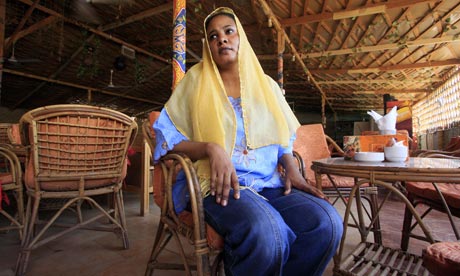
Lubna HusseinLubna Hussein pictured in the Khartoum cafe where she was arrested. Photograph: Observer

Sitting in the restaurant where her ordeal began, Lubna Hussein looks at the offending item of clothing that caused all the trouble and laughs softly. “In Sudan, women who wear trousers must be flogged!” she says, her eyes widening at the thought. The former journalist faces up to 40 lashes and an unlimited fine if she is convicted of breaching Article 152 of Sudanese criminal law, which prohibits dressing indecently in public.

What exactly constitutes “indecent” is not clear. Last month Lubna was among a crowd listening to an Egyptian singer in a restaurant in a swish area of Khartoum when policemen surged in. They ordered Lubna and other women to stand up to check what they were wearing, and arrested all those who had trousers on. Lubna, who was wearing loose green slacks and a floral headscarf, was taken to the police station.

“There were 13 of us, and the only thing we had in common was that we were wearing trousers,” Lubna says. “Ten of the 13 women said they were guilty, and they got 10 lashes and a fine of 250 Sudanese pounds (about £65). One girl was only 13 or 14. She was so scared she urinated on herself.”

Lubna asked for a lawyer, so her case was delayed. Despite the risks, she is determined that her trial should go ahead. Before her initial hearing last Wednesday, she had 500 invitation cards printed, and sent out emails with the subject line: “Sudanese journalist Lubna invites you again to her flogging tomorrow.”

The court was flooded with women’s rights activists, politicians, diplomats and journalists, as well as well-wishers. During the hearing, Lubna announced that she would resign from her job as a public information officer with the United Nations, which would have provided her with immunity, to fight the case. The judge agreed, and adjourned the trial until Tuesday.

Lubna says she has no fear of the punishment she might face. “Afraid of what? No, I am not afraid, really,” she insists. “I think that flogging does not hurt, but it is an insult. Not for me, but for women, for human beings, and also for the government of Sudan. How can you tell the world that the government flogs the people? How can you do that?”

She is determined to face prosecution in order to change the law. “It is not for me. It is my chance to defend the women of Sudan. Women are often arrested and flogged because of what they wear. This has been happening for 20 years. Afterwards some of them don’t continue at high school or university, sometimes they don’t return to their family, and sometimes if the girls have a future husband, perhaps the relationship comes to an end.”

Lubna, a widow in her 30s, says women have faced similar punishments, mainly in silence, ever since President Omar el-Bashir seized power in 1989. For much of the time since then, Sudan has been at loggerheads with the west. It provided shelter for Osama bin Laden in the 1990s, and is still on an American list of countries that sponsor terrorism, although a senior US official said recently that there was no justification for this.

But Lubna says her concerns are not political. Her frustration stems from what she believes is an erroneous interpretation of her religion.

“Islam does not say whether a woman can wear trousers or not. The clothes I was wearing when the police caught me – I pray in them. I pray to my God in them. And neither does Islam flog women because of what they wear. If any Muslim in the world says Islamic law or sharia law flogs women for their clothes, let them show me what the Qur’an or Prophet Muhammad said on that issue. There is nothing. It is not about religion, it is about men treating women badly.”

Since news of the case broke, Lubna has been celebrated in the western press. She is bemused by the thought of being seen as a heroine, and even more by the idea – suggested by some British newspapers – that she was targeted because she is a Christian. “I am a Muslim, and a good Muslim,” she says.

In response to the articles about her case, the Sudanese embassy in London pointed out there had been next to no coverage of a recent landmark arbitration ruling on the region of Abyei, which is contested by the north and the south following two decades of civil war. Despite fears that it might spark renewed conflict, both sides announced they would respect the ruling.

“The floodgates of expert and non-expert comments on Sudan opened suddenly on 29 July in the wake of an indecency and antisocial behaviour case in Khartoum involving journalist Lubna A Hussein,” the statement read. “The case is still ongoing and it wouldn’t be appropriate to comment on it. The real question, which is relevant to the deep-rooted Islamophobic and anti-Arab prejudice, is th selective spotlight on Ms Lubna Ahmed Hussein and determined neglect of Abyei dispute’s result for eight long days.”

Sitting in the Khartoum restaurant as the fierce late-afternoon sun intrudes through the windows, Lubna dismisses the notion that western praise might be a drawback in a country like Sudan. “In Sudan, we like the west,” she exclaims, apparently agitated by the idea that people might not realise this. “For many Sudanese, our dream is to go to the west.” But the government doesn’t always give that impression. “The government thinks differently to the people. The government hopes to be friends with the west, but sometimes they try to look tough, that’s all.”

Nevertheless, she is worried that the foreign attention on her case could lead to further cultural misunderstandings. “The west really doesn’t understand Islam,” she says. “Because as Muslims we know that, if the police catch girls and arrest and flog them, we know this is not Islam. But when the government of Bashir does that, the west says: ‘Oh, that is Islam.’ It presents a bad face of Islam.”

Since her initial hearing, Lubna has been bombarded with messages and phone calls from all over the world. Her family has been supportive, she says, perhaps in part because they are used to it: she was first arrested 15 years ago as a campaigning university student, and has been called in by the police on many subsequent occasions, often after writing satirical articles for the newspaper her husband set up, Sahafa

But one phone call from within the country touched her most. “I talked to my colleagues in the court, the 10 who have already been flogged. At the beginning they were very sad, and one of them was in a bad psychological state. But when she saw me on TV and in the newspaper, she called me to say that this was good. In the beginning, her neighbours and her family didn’t believe she was flogged just for the clothes she was wearing. So she called me to say thank you.”

The issue is rapidly becoming politicised. The Sudan People’s Liberation Movement, which represents the mainly non-Muslim south in a coalition government, has called for the law to be changed. Under a 2005 peace deal, sharia law is not supposed to apply to non-Muslims, and not the least controversial among Lubna’s statements is that several of the 10 women she says were flogged were non-Muslims.

But, for Lubna, the heart of the case goes beyond the north-south divide and its ramifications. She says nothing in Islam justifies flogging a woman for wearing trousers. “I am not a hero, I just don’t have a choice,” she says, fiddling with her pale gold headscarf.

When she spoke to the Observer, Lubna was wearing trousers again, this time blue jeans. Will her experience change the way she dresses? “I have trousers, I have dresses, I have traditional Sudanese clothes – I wear what I like. I won’t change.”

And what will happen if the judge decides, as is still possible, that she was indecently dressed, and sentences her to 40 lashes?

“I will take my case to the upper court, even to the constitutional court,” she insists, measuring her words. “And if they find me guilty, I am ready to receive not only 40 lashes, I am ready for 40,000 lashes. If all women must be flogged for what they wear, I am ready to be flogged 40,000 times.”

————–

Sudanese woman wears pants to indecency trial

We used to call Western feminists brave when they wore pants in the 60s challenging the orthodoxy of cultural norms. None of those women faced 40 lashes and an unlimited fine. 40 lashes by the way, is painful beyond imagining. There are videos here on vlad of men being torn apart mentally by far fewer than 40.

Here is a woman who is a hero by real standards. I hope the world is paying attention. Had this been in the 60s when liberalism was actually liberalism, she would certainly have achieved the desired effect. International outrage would most certainly bring about change, and if not, at least massive international attention and embarrassment on this government.

I doubt modern ‘liberals’ will be so caring. After all, woman’s rights, the fight against sharia law and justice and equality for minorities have somehow become positions of ‘the far right wing’

Eeyore for Vlad:

From Canada’s National Post, h/t Grace

Sudanese journalist Lubna Hussein in Khartoum on Jun. 13, 2009. Ashraf Shazly/AFP/Getty Images Sudanese journalist Lubna Hussein in Khartoum on Jun. 13, 2009.

KHARTOUM – A Sudanese woman facing 40 lashes for wearing pants in public made her first appearance in a court packed with supporters Wednesday, in what her lawyer described as a test case of Sudan’s decency laws.

There were chaotic scenes as Lubna Hussein, a former journalist who works for the United Nations, attended the hearing wearing the same green slacks that got her arrested for immodest dress.

Indecency cases are not uncommon in Sudan, where there is a large cultural gap between the mostly Muslim and Arab-oriented north and the mainly black and Christian south.

But Ms. Hussein has attracted attention by publicizing her case, inviting journalists to hearings and using it to campaign against dress codes sporadically imposed in the capital

The case was adjourned Wednesday as lawyers discussed whether her status as a UN employee gave her legal immunity.

After the hearing, defense lawyer Nabil Adib Abdalla said Hussein had agreed to resign from the United Nations in time for the next court session Aug. 4 to make sure the case continued.

“First of all she wants to show she is totally innocent, and using her immunity will not prove that,” Mr. Abdalla told reporters. “Second she wants to fight the law. The law is too wide. It needs to be reformed … This is turning into a test case. Human rights groups will be watching this closely.”

He said Ms. Hussein was ready to face the maximum penalty for the criminal offense of wearing indecent dress in public — 40 lashes and an unlimited fine.

Before the hearing, Ms. Hussein told Reuters she was arrested in early July when police raided a party at a restaurant in Khartoum’s Riyadh district.

“Thousands of women are punished with lashes in Sudan but they stay silent,” she said. “The law is being used to harass women and I want to expose this.” Continue Reading →