January 27, 2011 STRATFOR SITREP
Egyptian protesters are attempting to set fire to a police station in Suez, and shooting has been heard in the al Arbaein area of the city, Al Arabiya reported Jan. 27.
Category Archives: Egypt
The events in Egypt. How close are they to Iran’s revolution?
Egypt: Protestors set fire to government buildings
January 26, 2011
Protesters in Suez set a government building on fire and tried to burn down an office of the National Democratic Party on Jan. 26, Reuters reported, citing unnamed security sources and witnesses. Police used tear gas to push back protesters, and the party’s office failed to set fire, the sources said. Shops were ordered closed by city officials after incidents of looting, and clashes with police left about 55 people injured, witnesses said.
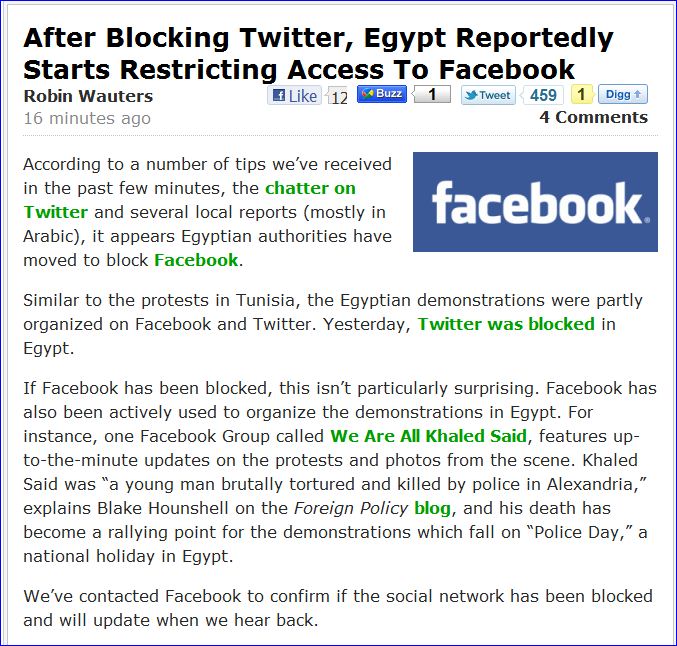
EGYPTIAN GOVERNMENT REPORTEDLY BLOCKING FACEBOOK
From TechCrunch:
RELATED:
Egypt activists call (on Facebook) for second day of protests
IBTimes: […] Opposition group Sixth of April Youth movement called on its Facebook page for protests to continue on Wednesday “and after tomorrow, until Mubarak’s departure”.
Security forces said protesters would not be permitted to reassemble. A Reuters witness saw at least 10 riot trucks leaving a Cairo army base in mid-morning.
Some of the videos on the possible revolution in Egypt taking place.
Thank you Shirl
ABC news, 20,000 people in Cairo & 20,000 people in Alexandria, seperate protests all over the country, twitter blocked, Mubarak shuts down network connections to prevent videos been uploaded.
Protestors refuse to go home, demonstrator makes two announcements , 1) has flown out of the country 2) Gamal Mubarak (Hosni’s son) has taken his wife and fled the country.
police running for their lives.
tourists take video from hotel
Speeches during protests:
Defiance:
police firing at protesters
More police firing at protesters:
There is much more, I will continue to update. We do indeed live under the Chinese curse of interesting times.
Egypt protests: Eyewitness accounts
Thousands of people took part in rare anti-government protests in Egypt after an internet campaign inspired by the uprising in Tunisia.
In Cairo, where the biggest rallies were held, police used tear gas and water cannons in an attempt to disperse the crowds. At least three people have been killed, reports say.
Here, eyewitnesses describe the atmosphere during the day’s events
Abd-Allah, Cairo resident
I saw the riot with my own eyes. We were out in the morning, we didn’t intend to protest, but we were caught up in it. I saw the police arresting everybody in a restaurant. Shortly afterwards we went home as it was too dangerous to stay out.
Now we are watching from the window what is happening outside. I hear people chanting: “Down with the president.” I’ve seen the police using tear gas against protesters, though I haven’t seen any violence. People are behaving as if they are ready to die. They keep pushing forwards.
Some people say that they won’t stop until Mubarak is gone. The noise from the street is increasing not decreasing even though it is 2230 (2030 GMT). There are more people now than during the day. There are people gathered downtown where the parliament building is located. I have friends among the crowd and they tell me what is happening.
The atmosphere is very tense, it feels like a revolution. I see people who are determined, people who have nothing to lose, people who want a better future.
This protest is different. Previous protests would last about an hour, this seems to be much larger, much longer. I think this could bring only violence. Mubarak is so power hungry, he would do anything to hang on to power. If people keep on pushing, many will end up in jail
Hussein, protester, Cairo
I participated in the protests today. I have to say I was surprised by the number of people who attended. These high numbers are unusual in Egypt.
People are afraid to speak out, but it seems that what happened in Tunisia encouraged many to protest in Egypt.
On the streets it seemed that the police were trying to avoid confrontation with the protesters, at least at the beginning of the day. Many of the senior officers were ordering the soldiers not to make any contact. They were only trying to form a cordon around the demonstrators, that was in Shobra.
But when our protest broke the cordon and joined with the major protest in El Tahrir, we found that it was more violent there. Although it was a peaceful protest, the police threw tear gas and fired/sprayed water canons.
Some protesters threw rocks at the police, which the police threw back. Most protesters however were trying not to be violent and many people were discouraging any acts of violence against the police.
I got the feeling in the end that the police were trying to make the protest go violent – that would give them an excuse to beat and arrest the protesters
Courtney Graves, American living in Giza
I went alone to Tahrir square today – my Egyptian friends seemed to think that the demonstration wouldn’t live up to the hype.
But news of the incredible turnout had reached my friend Gehad and she was fervently trying to find someone to accompany her into the city. She never made it to the demonstration but she at least let me know what to expect.
I surfaced from the Metro station into a scene of happy panic. Riot police were lined up along every street and it was almost impossible to move at first. From afar, I could hear a roar of human voices coming from one side of the square.
I managed to find higher ground to stand on and I saw an immense mass of people making their way towards where I was standing. I saw as they managed to get past the authorities restraining them and they were finally able to express the anger so evident in their faces.
As the group passed me I joined them. Emotions were so high and passions so great it was almost tangible. I’ve never seen men so angry, yet so happy to be expressing their anger.
I walked next to girls in hijabs (Islamic headscarves) screaming for the downfall of Hosni Mubarak. I walked behind men begging God for freedom.
In the middle of the tumult, I spotted two Muslim men praying in the middle of the sidewalk.
I soon heard screams from behind me and realised that the police had sent tear gas canisters flying into the air. Everyone began to run away from the source.
Fortunately, I avoided the full force of the gas but my fellow protesters were not so lucky. Screams for water filled the air as men dropped to their knees, covering their faces. I saw one little girl furiously rubbing her eyes as tears streamed down her face.
I stayed for another hour, on the sidelines. I felt different about Egypt as I walked away, like the political stagnancy had finally come to an end. As I walked across a bridge to Zamalek I could still hear chants coming from Tahrir, “Horreyya, Horreyya, Horreyya!” – “Freedom, freedom, freedom!”Assad Elepty
Egypt: Protesters Seize, Beat Security Personnel
January 25, 2011
Egyptian protesters in Cairo’s central Tahrir Square broke through a police cordon, seizing and beating 50 police sergeants before releasing the security officials, according to eyewitnesses, Al-Masry Al-Youm reported Jan. 25. Protesters attacked security vehicles and a fire truck that was dispatched to disperse the crowds with water cannons. Protesters plan to continue their sit-in overnight. All streets leading to Egypt’s Ministry of Interior building were cordoned off.
For better or for worse…
Egypt: Muslim Brotherhood Sparked Violence – Report
STRATFOR:
January 25, 2011
The Muslim Brotherhood has caused demonstrations in Egypt to become violent , Egypt’s state-owned Nile News reported Jan. 25, citing an Egyptian security source. The source named the Muslim Brotherhood, 6 April movement, National Association for Change and Kifaya as the organizers of protests mainly in Cairo, Jiza, Gharbiya and Alexandria. The source said the Muslim Brotherhood forced large numbers of its members into the protests, which then turned violent as demonstrators vandalized buildings and threw stones at security personnel. Egypt’s Interior Ministry said ending the protests is important to national security.
Honourable David Clarke: “Justice Will Come to The Copts of Egypt”
Egyptian Government blames Palestinian group for Copt NYE church bombing
STRATFOR: January 23, 2011
Egyptian Interior Minister Habib al-Adli said he believes the Army of Islam, a Palestinian militant group linked to al Qaeda, is responsible for the New Year’s Day bombing at a Coptic Christian church that killed 20 people and wounded about 100 others, VOA reported Jan. 23. Though the Army of Islam has praised the attack, it has denied being involved in the incident.
‘This Is a Historical Moment for Egypt’
In this interview, a Nobel Peace prize winning Egyptian suggests that Egypt follow tunisia’s example and form a new government with the Islamic brotherhood.
From Der Spiegel:
By Erich Follath and Dieter Bednarz
SPIEGEL: Mr. ElBaradei, some six months ago, you announced in an interview with us that you wanted to retreat from public life. After 12 years as the chief of the United Nations nuclear weapons inspectors in Vienna, you only wanted to give lectures. Now you are challenging President Hosni Mubarak. What happened?
ElBaradei: The decisive moment was my return to Cairo in February. I really only wanted to visit my country again and spend a few weeks at my house here near the pyramids. But then, 1,500 people were standing there at the airport. It was a cross-section of our society: students, business people, workers and surprisingly many women, including Egyptian women with head scarves and veiled faces. Some called out: “This country must be changed, please help us make that happen!” Others held signs reading: “ElBaradei for President!” It electrified me.
SPIEGEL: And that’s why you changed plans? According to the constitution, you can’t even become a candidate for the presidency without your own party.
ElBaradei: I have traveled through the cities and through the villages. I was shaken by the backwardness of my country, deeply moved by the people’s palpable desire for change, overpowered by the sympathy and enthusiasm I was met with. And then it was the regime itself that gave me no other choice than to become politically active. With the help of the state-controlled media, they launched an unprecedented smear campaign against me, denounced me as a foreign agent.
SPIEGEL: You know what happens to challengers of Mubarak. The last man to contest Mubarak for the presidency landed in jail.
ElBaradei: I was in Alexandria a short time ago with Ayman Nour at a protest event dedicated to the victims of the regime’s torture. I’m privileged in that I can rely somewhat on the fact that my international recognition protects me. Of course my wife and my children are afraid of violent attempts against me. But my family knows that I have no choice: We live in a special time of awakening. This is a historical moment for Egypt …
SPIEGEL: … in which many see you as a kind of messiah.
ElBaradei: I neither can nor want to be a savior. This mentality of sitting back and waiting for a savior is exactly what I am fighting against. The people have to effectuate change themselves and they have to dedicate themselves to it — that is the only way to achieve decisive progress. And that is exactly what is happening these days, with a breathtaking mobilization in completely new ways.
SPIEGEL: How so?
ElBaradei: Volunteers from all over the country, from every level of society are joining us. They ask: What can I do? There are already a good 15,000 supporters who are fanning out in the cities and villages to inform people about the “National Movement for Reform.” Many are joining us in our signature-gathering campaign and are saying with their names and passport numbers: We have had enough, we want change! And because our state of emergency laws prevent more than five people from assembling for a demonstration, we are creating a virtual town hall through the media.
SPIEGEL: You’ve become a blogger?
ElBaradei: A short time ago, I didn’t even know what Twitter and Facebook were. Now I use the new media and we have almost 30,000 permanent users on our website and two Facebook groups with 250,000 users each. Things are starting to move in my country.
SPIEGEL: Why is this only starting now?
ElBaradei: The country has been governed under state of emergency laws for the past 30 years. The security services are omnipotent, the police act arbitrarily. This has created a culture of fear. Should a figure be needed to represent this awakening, I will do everything I can to be a catalyst for this change.
SPIEGEL: For a long time though, as director general of the International Atomic Energy Agency and as the Nobel Peace Prize winner in 2005, you were something for the regime to be proud of.
ElBaradei: Oh yes. Just four years ago, President Mubarak awarded me this country’s highest medal and gushingly praised me as an outstanding son of Egypt to the point that it was embarrassing for me. Since I have become actively involved in the Egyptian political opposition, the state authorities have, in a subtle way controlled my public exposure, such as appearances on television. Some of my supporters were detained, and hoteliers who offered me a meeting room were pressured to cancel the booking.
SPIEGEL: Many Egyptians refer to Mubarak as the “Pharaoh” because he has been ruling the country from his palace for almost 30 years now. How do you see him?
ElBaradei: Mubarak is a one-man show without checks and balances, with no real contact with the people, who has allowed Egypt to become a police state. The regent of a country that has fallen deeply, dramatically lost stature and forfeited influence.
SPIEGEL: Iran and Turkey appear to dominate in the Middle East. Has Egypt now been relegated to playing second fiddle?
ElBaradei: Cairo was once the undisputed cultural and economic center of this region. Today close to one-third of the 80 million Egyptians are illiterate, more than one out of every five people is forced to survive on less than $1 a day. But, according to Transparency International, we have a leading position in the list of the world’s most corrupt states. Egypt is even on a list of countries threatened to become failed states — that just shows how far things have gone with us.
SPIEGEL: That is a Herculean task for the next president.
ElBaradei: Yes, because foreign policy and domestic policy can no longer be separated. A state that wants to have international clout must have a lively and open civil society — only then will it be attractive elsewhere.
SPIEGEL: Nonetheless, the West still sees Mubarak as a partner. Despite his deficits when it comes to democracy, he is seen as a guarantee for a certain amount of stability. No other country outside of Israel receives as much American aid.
ElBaradei: You are touching on a dilemma for the West: Mubarak has convinced the United States and Europe that they only have a choice between two options — either they accept this authoritarian regime, or Egypt will fall into the hands of the likes of bin Laden’s al-Qaida. Of course that is not exactly true. Mubarak uses the specter of Islamist terror to prevent a third way: the country’s democratization. But Washington needs to know that the support of a repressive leadership only creates the appearance of stability. In truth, it promotes the radicalization of the people.
For the rest of this critically important article please click here:
Egyptian Policeman Shouted ‘Allahu Akbar’ Before Shooting Six Christians
(AINA) — Six Copts were shot by an off-duty policeman on a train between Assiut and Cairo on Tuesday. One Copt was killed and five remain in critical condition. The gunman, identified as Amer Ashour Abdel-Zaher, was on his way to work in Beni Mazar police station when he boarded the train at approximately 17.00 hours in the town of Samalout in Egypt’s Minya province, roughly 260 km south of Cairo. He shot the six Copts after chanting “Allahu Akbar” (Allah is Great) then attempted to flee but was apprehended by passengers.
Fathy Ghattas, a 71-year-old Coptic Christian, died immediately. His wife Emily Hanna underwent an operation to remove her left kidney and spleen. She is in intensive care. Another Coptic woman, Sabah Saniod, 54, underwent an operation on her liver. Three of the injured Copts, Marianne, Maggie and Ashraf, were flown by helicopter to Kasr-el-Aina teaching hospital in Cairo for further treatment.
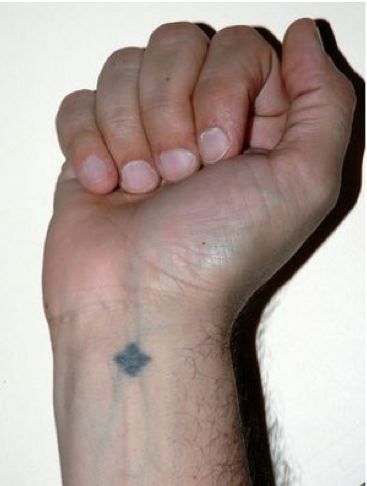
The communique issued by the Egyptian interior Mministry said the gunman shot randomly at the train passengers, while according to the Egyptian newspaper al-Masry al-Youm the assailant had checked passengers for the green cross traditionally tattooed on the wrists of Coptic Christians in Egypt. After identifying several Copts, the gunman shot at them.
The Ministry of Interior later said that the assailant was “mentally unstable” and had been undergoing medical treatment for some time. The Governor of Minya denied any sectarian motives behind the incident and said that the assailant is unstable and shot indiscriminately at passengers.
The Coptic Diocese of Minya said that the perpetrator went up and down the train compartment before shooting at the Copts while chanting Islamic chants.
Dr.Naguib Ghabrial, head of the Egyptian Union of Human Rights Organizations, described the incident as a premeditated “sectarian” attack, aimed at the Copts, since they sat together and sang Christian hymns, and the assailant shouted Allahu Akbar three times before shooting.
Ghabrial criticized the Interior Ministry for downplaying the shooting as usual. “The gunman did not shoot at random, otherwise Muslims would have been wounded as well,” Ghabrial told BBC Arabic TV. “This is one in the series of attacks aimed at Copts, before this there was the Alexandria Massacre.”
“I am sorry that the Ministry hastily issued a statement that the assailant was mentally unstable.” Said Ghabrial. ” Would someone who is mentally unstable be issued with a weapon and ammunition, would he be able to differentiate between Copts and Muslims?” he said. “I am telling the Interior Minister do not under-estimate Coptic intelligence and do not undervalue Coptic blood, for Coptic blood is not cheap.” He called once again for the minister to resign after all these Coptic Massacres. Continue Reading →
Egyptian Muslim police throw rocks at hospital where Christians are being treated
The video quality is bad, and the description is inadequate. I am hoping someone who speaks Egyptian Arabic can translate what is being screamed here accurately. The impression I am getting, is that police are throwing rocks at the hospital where the Christians who were shot up on the train by the off duty police officer in a Christian district in Egypt, are being treated. I hope to get more and better intel on this soon.
The description under the video is:
Egyptian Muslim Police Stoned the Good Shepherd’s Hospital in Coptic Orthodox Diocese-Samalut-Egypt 11-1-2011
The video lives on thecopticmartyrs youtube channel with a H/T to FOOMF
EGYPT:CHURCH MASSACRE;IMAM AL AZHAR:NO EXTERNAL MEDDLING
(ANSAmed) – CAIRO, JANUARY 11 – No to any interference from the outside in the internal affairs of the Muslim countries ”under any pretext”. So said the Imam of Al Azhar, Ahmed al-Tayyeb, according to the spokesperson for one of the largest centres of Sunni theology, Mohammed Refaa al-Tahtawi. The comments follow the speech made by Pope Benedict XVI to the accredited diplomatic corps within Vatican City, in which he urged Middle Eastern governments to protect their Christian minorities. ”Every country has the right to approve laws to protect national and civil security” the Imam stated. ”With all due respect for the statements made by Benedict XVI, we affirm that the protection of Christians is in internal matter to be guaranteed by the state as each citizen has the same rights as any other”. (ANSAmed).
Christians in Egypt shot on train:
January 11, 2011
A gunman who opened fire on a train Jan. 11 in southern Egypt, killing one and wounding five, was an off-duty policeman, the Egyptian Interior Ministry stated, AP reported. A 71-year-old man was killed, and the man’s wife and three other women were among the wounded; all of the victims are Christian. The shooter was identified as Amer Ashour Abdel-Zaher, and the motive for the attack is not yet known. Abdel-Zaher, a Muslim, was on his way to work when he boarded the train in Samalout, Minya province, and opened fire with a handgun. He was arrested nearby at his home after fleeing the scene and is being questioned, the ministry said.
One Egyptian Christian shot dead on train MSNBC
Violence comes less than two weeks after a church was bombed
CAIRO — One Egyptian Christian was shot dead on a train on Tuesday and at least three others were injured, medical and security sources said, less than two weeks after a church was bombed in Egypt’s deadliest sectarian attack in years.
It was not immediately clear if the shooting incident was religiously motivated.
Mariam Salah, a doctor at a hospital in southern Egypt, said the institute was treating five injured Christians. She said one of them told her a sixth Christian was shot dead.
A security source confirmed one had been shot dead but said three were wounded.
The latest violence comes as Egypt dismissed Pope Benedict’s call for more protection of Christian minorities as “unacceptable interference” on Tuesday. In response, Egypt summoned its Vatican ambassador back to Cairo for consultation.
The head of the Roman Catholic Church on Monday condemned attacks on churches that killed dozens of people in Egypt, Iraq and Nigeria, saying they showed the need to adopt effective measures to protect religious minorities.
“Egypt asked its ambassador in the Vatican to come to Cairo for consultation after the Vatican’s new statements that touch on Egyptian affairs and which Egypt considers an unacceptable interference in its internal affairs,” Foreign Ministry spokesman Hossam Zaki said in a statement sent to Reuters.
“Cairo is keen to communicate with the Vatican after its statements following the terrorist incident in Alexandria that took place earlier this month”.
A New Year bombing outside a church in the Egyptian city of Alexandria left 23 people dead and dozens injured and prompted demonstrations by both Christians and Muslims.
Egyptian officials insist they are capable of protecting all citizens and said there are indications that “foreign elements” were behind the Jan. 1 blast. An Iraqi group linked to al Qaeda threatened in November to attack Egyptian Christians.
STRATFOR: Why Egypt matters, and the recent attack on the Copts
Egypt and the Destruction of Churches: Strategic Implications
January 4, 2011 STRATFOR.COM

By George Friedman
Over the past few days, Christian churches have been attacked in at least two countries — Nigeria and Egypt — while small packages containing improvised explosive devices were placed on the doorsteps of Christian families in Iraq. Attacks against Christians are not uncommon in the Islamic world, driven by local issues and groups, and it is unclear whether these latest attacks were simply coincidental and do not raise the threat to a new level or whether they indicate the existence of a new, coordinated, international initiative. There is a strong case to be made for the idea that there is nothing new in all of this.
Yet I am struck by the close timing of events in three distant and dispersed countries. Certainly, Egyptian intelligence services are looking for any regional connections (e.g., whether Iraqi operatives recruited the Egyptian bomber). While there have been previous bombings in Egypt, they have focused on tourists, not churches. What is important is this: If the recent attacks are not coincidental, then a coordinated campaign is being conducted against Christian churches that spans at least these countries. And it is a network that has evaded detection by intelligence services.
Obviously, this is speculative. What is clear, however, is that the attack on a church in one country — Egypt — is far from common and was particularly destructive. Egypt has been relatively quiet in terms of terrorism, and there have been few recent attacks on the large Coptic Christian population. The Egyptian government has been effective in ruthlessly suppressing Islamist extremists and has been active in sharing intelligence on terrorism with American, Israeli and other Muslim governments. Its intelligence apparatus has been one of the mainstays of global efforts to limit terrorism as well as keep Egypt’s domestic opposition in check. Continue Reading →
CNN Does best MSM report on attack on Copts in Alexandria yet.
It seems that the regular media is starting not to have any ore lies to retreat into, and are beginning to expose the actual facts about Islam and it’s actions. Click here for Hot Air blog’s story on it.