
February 9, 2011 Stratfor
An Egyptian Foreign Ministry spokesman accused Hezbollah Secretary-General Sheikh Hassan Nasrallah and Iranian Supreme Leader Ayatollah Ali Khamenei of meddling in Egyptian affairs and destabilizing the region, NOW Lebanon reported Feb. 9. Nasrallah has no right to accuse Egypt of submitting to Israel or the United States when he is dividing united fronts in the Palestinian territories in line with Iranian agendas, the spokesman said.
Category Archives: Egypt
Violence in Egypt
I absolutely guarantee any and all readers, this is the future for Canada if we allow unchecked immigration and multiculturalism as policies. We nearly saw it with the Tamils in Ottawa and we will see it with Muslims as the reason Canada and as a rule, the US does not see this kind of political violence is one reason only. Our democratic culture and traditions.
Muslims Attack Two Christian Families in Egypt, 11 Killed
AINA.ORG
Posted GMT 2-3-2011 2:57:58
(AINA) — News of a massacre of two Christian Coptic families by Islamists just emerged from Upper Egypt with the return of the Internet connections after a week of Internet blackout by the Egyptian regime. The massacre took place on Sunday, January 30 at 3 PM in the village of Sharona near Maghagha, Minya province. Two Islamists groups, aided by the Muslim neighbors, descended on the roof of houses owned by Copts, killing eleven Copts, including children, and seriously injuring four others.
Anba Agathon, Bishop of Maghagha, told Coptic activist Dr. Mona Roman in a televised interview on Al-Karma TV that the killers are their neighbors, who seized the opportunity of the mayhem prevailing in Egypt and the absence of police protection to slaughter the Copts. He said that he visited today the four injured Copts, who escaped death despite being shot, at Maghagha General Hospital and they told him that they recognized the main attackers as they come from the same village of Sharona. They gave the Bishop details of what happened.
“The two families were staying in their homes with their doors locked when suddenly the Islamists descended on them,” said Bishop Agathon, “killing eleven and leaving for dead four other family members. In addition, they looted everything that was in the two Coptic houses, including money, furniture and electrical equipment. They also looted livestock and grain.”
According to the Bishop the first group was led by Islamist Ibrahim Hamdy Ibrahim, who was joined by a gang of masked assailants. They accessed the roof of the house of Copt Joseph Waheeb Massoud through the roof of his Muslim neighbor Mahgoub el Khawaled. The armed men killed Joseph, his wife Samah, his 15-year old daughter Christine and 8-year-old son Fady Youssef
Another Islamist group led by Yasser Essam Khaled and several masked men simultaneously accessed the house of Copt Saleeb Ayad Mayez through the roof of his Muslim neighbor Mohamad Hussein el Khawaed. The Islamist shot dead Saleeb, his wife Zakia, his 4-year-old son Joseph, 3-year-old daughter Justina, his 23-year-old sister Amgad, mother Zakia and Ms. Saniora Fahim.
The police in Minya were called and they transferred the bodies in ambulances to Maghagha Hospital.
The Bishop denied any vendetta between the Copts and the Muslims. He called on the police to arrest the Islamist perpetrators immediately, as everyone knows they are the neighbors of the victims. He said “The massacre has nothing to do with the mayhem in Egypt, but the murderers took advantage of the lack of police protection and thought they could commit their crime and no one would notice.”
Coptic activist Dr. Hanna Hanna views the Mubarak era with its policy of impunity to be the cause of why Copts are targeted. “Why have those Islamists chosen those two Coptic families and not Muslim ones to slaughter and rob? I believe it is because they know that with Copts they can literally get away with murder.”
By Mary Abdelmassih
BREAKING: GAS LINE FROM EGYPT TO ISRAEL SABOTAGED

Natural gas supply to Israel cut off after blast at Egyptian terminal
JERUSALEM — Egypt temporarily suspended its natural gas supply to Israel as a security precaution after an explosion at a terminal in the northern Sinai Peninsula, Israel radio said Saturday.
The Egyptian regional governor told Nile News TV that he suspected “sabotage” at the el-Arish gas terminal but did not elaborate, the Associated Press reported. The blast set off a fire that could be seen for dozens of miles.
Gov. Abdel Wahab Mabrouk said the fire was brought under control by mid-morning, the AP reported. Technicians had to shut off valves controlling the flow of gas from the terminal into pipelines transporting gas to Israel, Syria and Jordan.
Israeli radio said the explosion damaged a pipeline to Jordan, not to Israel, but the supply to Israel was cut off as a temporary precaution.
In recent days, Israelis have worried about the possibility of a cutoff of natural gas shipments from Egypt as a result of the turmoil and political uncertainty there.
“Following the pipeline explosion in [Egypt], the security establishment has taken steps to beef up security at all installations related to the supply of gas to Israel,” Israeli Defense Minister Ehud Barak’s office said in a statement Saturday.
Israel’s main electricity company said service to homes would not be interrupted.
Egypt sells Israel 60 billion cubic feet a year under a 15-year deal that started in February 2008, according to the AP
BREAKING: ASSASSINATION ATTEMPT ON NEW EGYPTIAN VP OMAR SULEIMAN
‘Two bodyguards killed in assassination attempt on new Egyptian vice president’
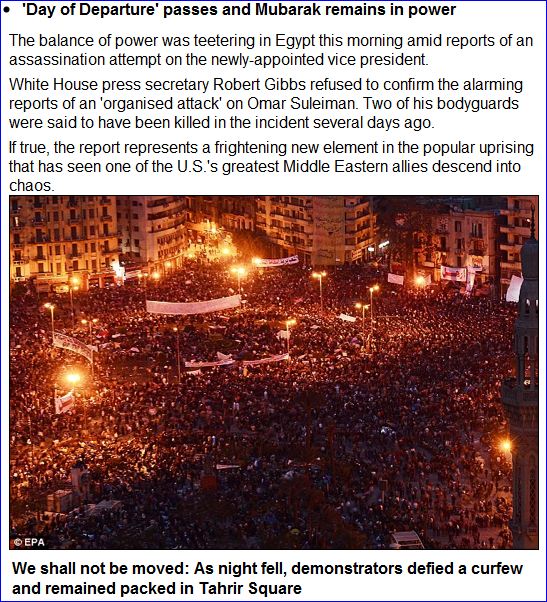
Opportunists could be taking advantage of the revolution, which has not yet succeeded in toppling President Hosni Mubarak from power, to push their own unknown agendas.
Fox News quoted sources on the assassination attempt last night.
Mr Gibbs was visibly flustered when asked about the incident at a press conference. ‘Uh… I’m not going to get in to that question,’ he said.
Mr Suleiman was appointed by Mr Mubarak as he tried to stem criticism over his 30-year rule. So far, the move has failed to bring calm to Egypt.
EGYPT’S COPTIC CHRISTIANS FEARFUL OF FUNDAMUSLIM BROTHERHOOD TAKEOVER
Watch out for the jizya to be extracted from the dhimma, the Copts have every right to be worried. KGS
NOTE: It would help a great deal if these same Copts were not anti-Semitic, but there are some groups in the US that are not anti-Jew, like the Voice of the Copts, which offers some modicum of hope.
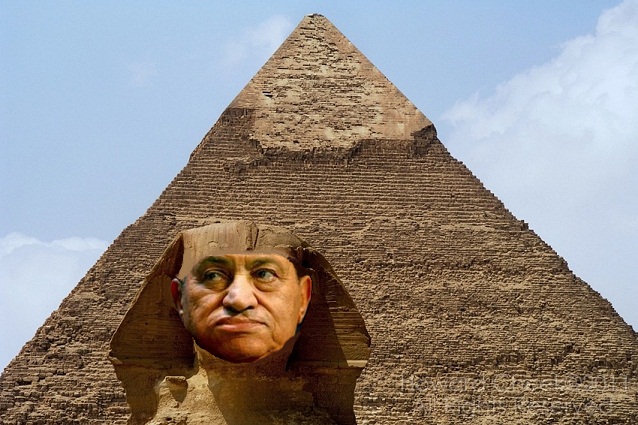
A Copt: Mubarak: “He’s the best of the worst,”
Egypt’s Coptic Christians fear life without Mubarak
The Copts have protested the harassment directed at them under the Egyptian president’s rule, but worry that things would be far worse if Islamist extremists gained power.
Reporting from Alexandria, Egypt — The morning bells of All Saints Church beckon worshipers a little later these days, and Mass is celebrated more frequently.
The schedule shift for the early service has come in response to the government-imposed overnight curfew. The extra services? Coptic Christians in Egypt’s second-largest city say they have a lot of reasons to pray amid the nation’s ongoing turmoil.
But in a surprise even to them, many Copts say they now find themselves praying for President Hosni Mubarak’s government to last as long as possible.
It’s not that the Copts — who make up about 10% of Egypt’s population of more than 80 million — see the autocratic three-decade president as a great friend. Far from it, they say. As recently as last month, Christian youths in this coastal city protested what they called the government’s failure to root out growing anti-Copt harassment, which culminated in a New Year’s Day bombing that killed 24 worshipers outside All Saints.
Weeks before anti-Mubarak demonstrators in Cairo began their occupation of Tahrir Square, Copt protesters in Alexandria were choking on tear gas as they faced down government police.
But now, many say they’re rethinking their opposition to Mubarak’s government, fearing its collapse might spur an anti-Christian backlash if the Muslim Brotherhood or other Islamist groups gain a foothold.
“He’s the best of the worst,” said Sameh Joseph, a church worker at the Patriarch of the Orthodox Christians Church in Alexandria. “Whoever comes after him might want to destroy us.”
H/T: Frank Kitman
Egyptian police run over people in Cairo
This is harsh.
Poll shows Egyptians favour democracy and stoning for adultery
The Globe and Mail.

Popular opinion
Poll shows Egyptians favour democracy and stoning for adultery
Reuters
Published Wednesday, Feb. 02, 2011 7:54PM EST
Last updated Wednesday, Feb. 02, 2011 9:20PM EST
Egyptians reject radical Islamists, but want Islam to play a large role in politics and think democracy is the best political system, according to poll data collected in Muslim countries last year. The sample group of 1,000 was surveyed in face-to-face interviews in April and May of last year for the U.S.-based Pew Research Center. These results give an idea of Egyptian public opinion before the current protests there broke out.-
Democracy
59%: Say democracy is preferable to any other form of government.
22%: Say a non-democratic system can be preferable in certain circumstances
Islam in politics
95%: Say it’s good that Islam plays a large role in politics
85%: Say Islam’s influence on politics is good
48%: Say Islam currently play a large role in Egyptian politics
Islamist extremism
80%: Think suicide bombings are never or rarely justified.
20%: Think suicide bombings are sometimes or often justified
70%: Are concerned or very concerned about Islamist extremism in the world
61%: Are concerned or very concerned about Islamist extremism in the Egypt
Traditional Muslim practices
54%: Believe men and women should be segregated in the workplace
82%: Believe adulterers should be stoned
84%: Believe apostates from Islam should face the death penalty
77%: Believe thieves should be flogged or have their hands cut off
Vladtepesblog proposes solution to the Egyptian crisis.
By the way this is our first Public Service Announcement.
My Nobel Peace Prize is in the mail I can assume.
STRATFOR: Canadian journalists arrested in Egypt
Egypt: Army Arrests Foreign Journalists In Cairo STRATFOR SITREP
February 3, 2011
Egypt’s military detained about two dozen foreign journalists Feb. 3, possibly to protect them from supporters of Egyptian President Hosni Mubarak, AP and CP reported. Two Canadian journalists for The Globe and Mail had their vehicle commandeered by Egyptian troops just before 3 p.m. Cairo time, but they were released three hours later. An AP reporter said he saw eight foreign journalists seized by soldiers near the prime minister’s office near Tahrir Square, and the Washington Post cited numerous witnesses as saying Cairo bureau chief Leila Fadel and photographer Linda Davidson were arrested by Egypt’s Interior Ministry.
Anjem Chaudery: Egypt, sharia and Islam
Get Ready for the Muslim Brotherhood
By AYAAN HIRSI ALI The New York Times:
Published: February 3, 2011
WASHINGTON — In 1985, as a teenager in Kenya, I was an adamant member of the Muslim Brotherhood. Seventeen years later, in 2002, I took part in a political campaign to win votes for the conservative party in the Netherlands.
Those two experiences gave me some insights that I think are relevant to the current crisis in Egypt. They lead me to believe it is highly likely but not inevitable that the Muslim Brotherhood will win the elections to be held in Egypt this coming September.
As a participant in an election campaign, I learned a few basic lessons:
• The party must have a political program all members commit to with a vision of how to govern the country until the next election. Dissent within the party is a sure way of losing elections.
• Candidates must articulate not only what they will do for the country but also why the other party’s program will be catastrophic for the nation.
• The party has to be embedded in as many communities as possible, regardless of social class, religion or even political views.
• Candidates must constantly remind potential voters of their party’s successes and the opponent’s failures.
The secular democratic and human-rights groups in Egypt and in the rest of the Arab world show little sign of understanding these facts of political life. The Muslim Brotherhood, on the other hand, gets at least three out of four.
True, they have never been in office. But they have a political program and a vision not only until the next elections, but, in their view, until the Hereafter. And they are very good at reminding Egyptians of why the other party’s policies will be ungodly and therefore catastrophic for Egypt. Above all, they have succeeded in embedding themselves in Egyptian society in ways that could prove crucial.
When I was 15 and considered myself a member of the Muslim Brotherhood movement, there were secular political groups in the diasporas of Pakistanis, Yemenis and Somalis, who lived in exile in Nairobi like my family. These loosely organized groups had vague plans for building their countries into peaceful, prosperous nations. These were dreams they never realized.
The Muslim Brotherhood did more than dream. With the help of money from Saudi Arabia and other oil-rich countries, they established cells in my school and functioning institutions in my neighborhood. There were extracurricular activities for all age groups. There were prayer and chant hours, as well as communal Koran readings. We were encouraged to become volunteers, to help the indigent, to spread Allah’s message. They established charities to which we could tithe, which then provided health and educational centers.
The Brotherhood also provided the only functioning banking networks, based on trust. They rescued teenagers from lives of drug addiction and excited them about a purposeful future for justice. Each of us was expected to recruit more people. Most importantly, their message transcended ethnicity, social class and even educational levels.
It is true that the movement was violent, but we tend to underestimate in the West the Brotherhood’s ability to adapt to reality and implement lessons learned. One such adaptation is the ongoing debate within the network on the use of violence. There are two schools of thought within the network, and both of them invoke the Prophet Mohammed.
Those who want instant jihad hark back to the time when the Prophet had small armies that defeated massive ones, as in the battles of Badr and Uhud. The nonviolent branch of the Brotherhood emphasizes the Prophet’s perseverance and patience. They emphasize da’wa (persuasion through preaching and by example) and above all a gradual multi-generational process in coming to power and holding on to it. Above all, they argue for taqiyyah, a strategy to collaborate with your enemies until the time is ripe to defeat them or convert them to Islam.
Why are the secular democratic forces in Egypt so much weaker than the Muslim Brotherhood?
In light of recent events in Egypt, I think this has become a very important article.
Egypt as every schoolkid knows, is one of, if not the, most important archaeologically/historically rich nations on earth. What we learn about ourselves from Egyptian history matters a great deal to keeping us on the right course. I post this article because it needs to be understood what the cost is to history itself if Ikhwan, the Muslim Brotherhood ever gets power in Egypt the way the Muslims did in Iran and Saudi Arabia. This is no mere clash of ideologies. This is the destruction of the time line itself.
Eeyore.
August 31, 2009
Lebanonwire
Digging up the Saudi past: Some would rather not
Donna Abu-nasr, Associated Press
RIYADH, Saudi Arabia – Much of the world knows Petra, the ancient ruin in modern-day Jordan that is celebrated in poetry as “the rose-red city, ‘half as old as time,'” and which provided the climactic backdrop for “Indiana Jones and the Last Crusade.”
But far fewer know Madain Saleh, a similarly spectacular treasure built by the same civilization, the Nabateans.
That’s because it’s in Saudi Arabia, where conservatives are deeply hostile to pagan, Jewish and Christian sites that predate the founding of Islam in the 7th century.
But now, in a quiet but notable change of course, the kingdom has opened up an archaeology boom by allowing Saudi and foreign archaeologists to explore cities and trade routes long lost in the desert.
The sensitivities run deep. Archaeologists are cautioned not to talk about pre-Islamic finds outside scholarly literature. Few ancient treasures are on display, and no Christian or Jewish relics. A 4th or 5th century church in eastern Saudi Arabia has been fenced off ever since its accidental discovery 20 years ago and its exact whereabouts kept secret. Continue Reading →
Egypt: Israeli Embassy In Cairo Attacked
STRATFOR: Egypt: Israeli Embassy In Cairo Attacked
February 1, 2011
Iranian state-owned news agency IRNA reported the Israeli embassy in Cairo was attacked by armed men in the morning of Feb. 1. According to eyewitnesses cited by IRNA, an Egyptian officer who was guarding the embassy was killed. The attackers reportedly withdrew from the embassy following clashes with the Egyptian forces around the embassy.