(AINA) —
The Egyptian Emergency State Security Court in Qena acquitted today two of the three suspects in the Christmas Eve Massacre in Nag Hammadi in January, 2010, where six Coptics, between the ages of 16 to 23, were shot and killed by Muslims in a drive-by shooting. The Copts were killed as they filed out of Church after celebrating the Coptic Christmas Eve midnight mass in Nag Hammadi, 600km south of Cairo A Muslim bystander was also killed and nine Copts were seriously injured (AINA 1-7-2010).
The three Muslims accused of the shootings were Mohamed Ahmed Hussein, more commonly known as Hamam el-Kamouny, Qurshi Abul Haggag and Hendawi Sayyed. Mohamed Ahmed Hussein, 39, was sentenced to death by the court on January 16 and the other two were acquitted today. The defendants were charged with using force to disrupt public order and intimidate citizens, with the premeditated murder of seven people, illegal possession of fire arms, the attempted murder of nine others, and voluntarily damaging fixed and liquid assets.
Bishop Cyril, the Coptic Orthodox bishop of Nag Hammadi, said “The court imposed one death sentence because one Muslim was killed, and the Egyptian judiciary wasted the blood of the six murdered Copts, who are of no value to the society. This verdict saddened all Christians worldwide because it means that the State is applying Islamic Sharia on all Christians in Egypt.” He explained that according to Sharia the blood of one Muslim, victim Ayman Hisham, is paid for by the blood of one Muslim, Al-Kamouny; since one Muslim died, one Muslim got the death penalty. Continue Reading →


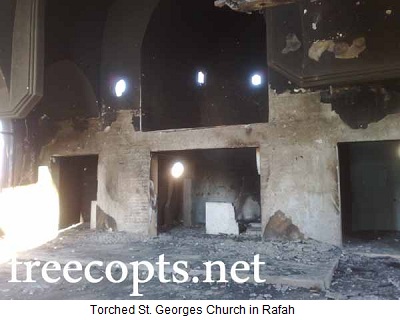 On September 15, 2010, an Islamic Jihadist Forum called Islamic Atahadi (Challenge) Network, which is said to be an affiliate of Al-Qaida, published on its website under the title “Images of the Church under construction in the Pyramids and how to demolish it.” The Forum showed photos of St. Mary and St. Michael church in Talbiya, which was still under construction, gave its members instructions on how to demolish the church by using sugar; “An easy and affordable way for the demolition of the church before its completion, no need for demonstrations, no need for the use of weapons or explosives, you only need to introduce certain quantities of sugar, yes normal sugar.” They went on to explain how to introduce reasonable quantities of sugar inside the forms prepared for pouring the columns, “because sugar affects concrete and cancels the chemical reaction which makes the sand and gravel hold together with the cement.” They advised in their step by step instructions that timing was very important in the process; the best time being immediately before pouring the roof.