FJORDMAN: A BRIEF HISTORY OF PASTA

A Vlad Tepes exclusive. KGS

Fjordman: A Brief History of Pasta

In recent weeks I’ve been on two major travels, one to Beijing, China, and another to northern Italy. I couldn’t really afford to go, but then I got some money from the CIA and the Mossad for my Islamophobic essays. I also remembered that I had not cashed in on my annual white privilege bonus for a few years. Once I had done that, I could go for a holiday, anyway.

I will describe my impressions from these travels in later essays, but will start with reflecting on the history of pasta. I talked to one Italian man who believed that pasta was invented by the Arabs, whereas another frequent claim is that it was invented by the Chinese. I am personally skeptical of both these claims. To quote food historian Linda Civitello in Cuisine and Culture:

“For hundreds of years, it was accepted ‘fact’ that Marco Polo discovered noodles in China and brought them back to Europe. Now, in his masterwork, A Mediterranean Feast, food historian Clifford Wright states flatly that there is no truth to the story of Polo and pasta. Wright unravels the tangled strands of the origin of pasta and takes it down to its basic ingredient: hard semolina or durum (Latin for ‘hard’) wheat. This makes pasta different from bread, which is made from soft wheat. The Chinese did not have durum wheat. Wright places the origins of ‘true macaroni’ – pasta made from durum wheat and dried, which gives it a long shelf life – ‘at the juncture of medieval Sicilian, Italian and Arab cultures.’”

Marco Polo (1254-1324) was the son of a merchant from Venice in northern Italy who had good contacts in the East. The book Il Milione (“The Million”), describing his alleged travels in Asia in the late thirteenth century, became hugely popular in the Renaissance period and inspired other European travelers in their search for Asia, among them Christopher Columbus. Polo supposedly spent years in Mongol-ruled China but never mentions tea, nor the Great Wall or the practice of foot binding, which crippled millions of Chinese women well into the twentieth century. It is quite possible that he was a well-traveled man for his time, but scholars are still arguing about whether he really did all of the things he claimed to have done.

Noodles or noodle-like foods made of wheat, buckwheat, rice or soya have been enjoyed in China, Korea and Japan for a very long time and we have no indications that pasta existed in the Roman Empire, but these foods do not taste alike and are made from different materials and methods. Besides, pasta is a lot more than spaghetti, and many varieties do not resemble noodles even superficially. There is no strong historical or logical reason to assume that the inventions of East Asian noodles and Italian pasta were directly connected. Pasta from durum wheat was an innovation of the European Middle Ages. Middle Easterners before and after the rise of Islam used durum wheat, but Muslims apparently never invented pasta-like foods.
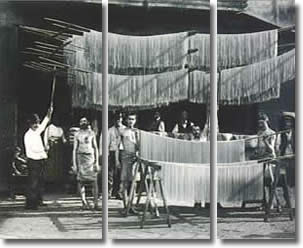
Historian Toussaint-Samat, too, questions the myth that it was imported to Italy with Polo. Anything resembling modern pasta cannot be traced with certainty much further back than to southern Italy in the thirteenth or fourteenth centuries AD. If you believe A History of Food, “the first production of pasta on any kind of industrial scale was indeed in Naples in the early fifteenth century. However, this pasta did not keep well, and it was not until 1800 that the process which would make it really asciutta (dry) was discovered. It involved natural drying alternately in hot and cold temperatures. Perfect conditions were found at Torre Annunziata, some kilometres south of Naples itself, where the climate changes four times a day, to a regular pattern. The macaroni of Torre Annunziata is the ne plus ultra of Italian pasta.”

The great merit of pasta, and one of the secrets behind its tremendous international success in recent years, is that it is very easy to make and also takes up little storage space, but swells when cooked. Cooking it is simple, too, since it only requires a large pot filled with water.

Another food myth is that Marco Polo introduced ice cream to Italy and Europe from China. Frozen desserts made from fruits or berries combined with ice and snow brought down from nearby mountaintops were served in several ancient civilizations, including ancient Rome. Whether this constituted ice cream as we think of it is debatable, however. A more recognizable version appeared in Renaissance banquets, with modern European ice cream dating back to the 1500s and 1600s. And yes, Italians did play a major role in this story.
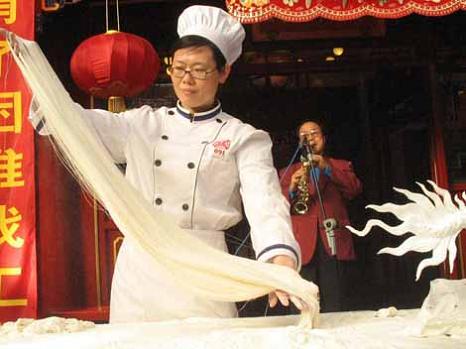
I am personally a fan of Chinese cuisine, as are millions of other non-Chinese around the world judged by the popularity of Chinese restaurants, but I have to say that their dinners and warm dishes are a lot better than their sweets and desserts. I brought back some alleged Chinese sweets and candies to Europe and literally couldn’t give them away for free to my youngest relatives. It is the first time I have experienced children saying no to candy. There is nothing made in China, at least not today, that can be remotely confused with Italian gelato.

Gelato is Italy’s unique version of ice cream, but with significantly less butterfat and higher sugar content than regular ice cream. It is less solidly frozen, melts in the mouth faster, has a richer, creamier taste and is denser because not as much air is whipped into the mixture. It is extremely delicious, and to Western tastes easily beats anything similar produced in China.
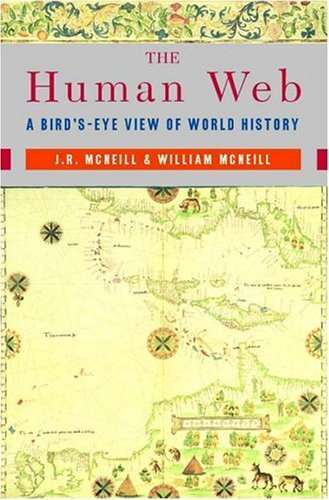
BOOK REVIEW BY FJORDMAN:THE HUMAN WEB: A BIRD’S-EYE VIEW OF WORLD HISTORY

Fjordman files the following book review with the Tundra Tabloids. KGS

The Human Web: A Bird’s-Eye View of World History from 2003 is an attempt by Robert McNeill and William H. McNeill, a father-and-son team of historians, to outline the major trends of human societies from Paleolithic times until the dawn of the twenty-first century.

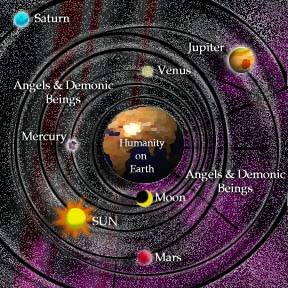
The authors state that the Scientific Revolution was to have great consequences for all of mankind. Its emphasis on observation, experiment and unfettered reason – potentially subversive ideas that were often resisted by the political and religious establishment – has continued to flourish until the present day. While they agree that the creation of a network of universities was a uniquely European achievement, they also claim that “Ibn al-Shatir (died 1375) and others had challenged Ptolemy in much the same ways that Copernicus did later.”

This is not quite true. Yes, Ibn al-Shatir, working in Damascus, Syria and possibly the most gifted member of the Maragha school of astronomy, challenged certain aspects of Ptolemy’s models, especially his complex system of epicycles on top of circular orbits to account for apparent variations in the speed and direction of the motion of the planets. It has been speculated whether his ideas may indirectly have influenced Copernicus as a student in Italy.

Be that as it may, while a handful of the most talented astronomers in the Islamic-ruled world might question some of the technical details of Ptolemy’s models, none of them ever seriously questioned the notion that the Earth is the center of the universe. This was far more than a minor mathematical detail; it related to man’s place in the cosmos in very fundamental ways.

The Mongols under the leadership of Hulegu Khan (ca. 1217-1265), a grandson of the powerful Mongol conqueror Genghis Khan (ca. 1162-1227), sacked Baghdad in 1258 and ended the Abbasid Caliphate. Hulegu believed that many of his military successes were due to the advice of astronomers who were also astrologers (astrology was very important in Mongol culture) and was persuaded to found the Maragha observatory in present-day Iran by the Persian mathematician Nasir al-Din al-Tusi (1201-1274). His brother Kublai Khan (1215-1294) constructed an astronomical observatory in Yuan Dynasty (Mongol-ruled) China.

Some have claimed that scientific advances in the Islamic world were halted by the Mongol conquests. This is historically inaccurate. The conquests affected Syria, Egypt, North Africa and the Arabian Peninsula rather little, yet these regions didn’t make any more progress than did the Islamic East. Besides, science had already stagnated in many fields prior to this. In astronomy, achievements peaked after the conquests, and partly with Mongol encouragement.

Continue Reading →

Fjordman: The Chinese and the Irrational

Fjordman files the following essay with Vlad Tepes blog.

The Chinese and the Irrational

By Fjordman

James Evans in The History and Practice of Ancient Astronomy has written an extremely thorough account of astronomy during historical times in the Middle East and Europe, up to and including Kepler just prior to the telescope. In his view, “The remarkable accuracy of the Babylonian observers is a silly fiction that one still frequently encounters in popular writing about early astronomy.” The important thing is that there was a tradition of making observations, recording them carefully and a social mechanism for preserving the records.

The gods were believed to speak through objects and events in the natural world, including animal entrails, dreams and celestial phenomena. Omens were important for every level of Mesopotamian society, yet astronomical observations did not become the major focus of divination until after 1500 BC. Mesopotamian bureaucrats and astronomers/astrologers gradually amassed detailed information about the movement of the planets after 800 BC.

By the fifth century BC, Babylonian celestial divination had expanded to embrace horoscopic astrology, which used planetary positions at the moment of the date of birth to predict individual fortunes. As explained by science historian James Evans, “While horoscopic astrology was certainly of Babylonian origin (as, indeed, the Greek and Roman writers always claimed), it was elaborated into a complex system by the Greeks. Thus, the familiar and fantastically complicated system of horoscopic astrology with dozens of conflicting rules does not descend from remote antiquity. Rather it is a product of Hellenistic and Roman times.”

An Egyptian astronomical interest can be detected in the alignment of their temples and pyramids, but rarely on the level of sophistication seen in Mesopotamia. The ceilings of royal tombs from the Middle Kingdom on, for instance in the Valley of the Kings in Luxor, contain drawings that could be described as simple celestial maps, yet with the partial exception of their solar calendar it does not seem to have occurred to them to seek for any deeper explanation of what they observed. The Egyptians “seem to have produced no systematic records of planetary movements, eclipses, or other phenomena of a plainly irregular sort.”

To the ancient Greeks, the planets were “wandering stars.” Our word planet comes from a Greek verb meaning to wander. The modern names for the five naked-eye planets are the names of Roman divinities which were more or less equivalent to a number of Greek gods. Most people today probably know this. What many of them don’t know is that some of the Greek names themselves may have been derived from Babylonian divinities in Mesopotamia.

Mars was often associated with war because of its reddish color, which can be spotted through naked-eye observations; the ancient Egyptians called it the Red One. However, there are other parallels that are unlikely to be accidental. In ancient Mesopotamia, Ishtar was the Babylonian and Assyrian counterpart of Inanna, the moody Sumerian goddess of love and fertility, identified with the planet Venus. To the Romans, Venus was the goddess of love and fertility, their equivalent of the Greek goddess Aphrodite, who was also a symbol of love and fertility.

In the eyes of Walter Burkert, a few similarities between the Epic of Gilgamesh and Homeric poetry can no longer be ignored. He is nevertheless careful to point out that natural and political philosophy in the true sense was a Greek invention as much as was deductive proof in mathematics. As Ibn Warraq puts it, “what emerges is something entirely distinctive: what we call Greek civilization. The very strength of this civilization lay in its ability to learn from and improve upon the ideas, art, and literature of the Near East, Persia, India, and Egypt.”

Continue Reading →

FJORDMAN: A GENETIC BASIS FOR NORTHERN EUROPEAN DRUNKENNESS……?

Fjordman files the following essay with the Tundra Tabloids. KGS

NOTE: As usual, Fjordman brings us a wonderful mix of historical facts with present day realities.

Is There A Genetic Basis For Northern European Drunkenness?

Alcoholic drinks made from wild fruits and berries or from honey (mead) may theoretically have existed prior to the Neolithic, but they became much more important with the rise of agriculture. Fermented beverages have many bad side effects, yet essentially all agricultural peoples regularly consumed some form of alcoholic brew. The consumption of beverages which contained modest amounts of alcohol could be beneficial to your health in ancient times as they might provide some level of protection against waterborne pathogens. For this reason, alleles that reduced the risk of alcoholism prevailed among agricultural populations. By contrast, peoples that did not have early food production, such as Eskimos, Aboriginal Australians or the Native Americans of North America, are more vulnerable to this problem.

Modern Europeans have easy access to chlorinated tap water, which may not always taste great but which they can usually drink without fear of getting sick. In the past, access to clean water was far from certain. Today, some of the common antiseptics are alcohols, used to disinfect the skin or surgical instruments. Alcohols for medical purposes have a much higher concentration of ethanol, typically 60-90%, than regular beer or wine, but even small amounts of ethanol has some effect. Because of its alcoholic content, wine was an excellent vehicle for dispensing various medical agents, too. Patrick E. McGovern writes in his book Ancient Wine:

“It was the most common ingredient in ancient Egyptian, Mesopotamian, and Syrian medicines, which was readily administered by drinking or external application. Most important, people who drank alcoholic beverages, as opposed to straight water, in antiquity were more likely to live longer and reproduce more. As Paul advised Timothy (I:5.23): ‘No longer drink only water, but take a little wine for the sake of your stomach and your frequent ailments.’ Ancient armies were ‘inoculated’ against disease by mixing wine with the uncertain water supplies that they came upon in their journeys. In addition to the alcohol, the polyphenolic aromatic compounds in wine have antiseptic properties.”

Continue Reading →

Fjordman: Metal and Early European Warfare

Thank you Fjordman for publishing this, as usual, excellent and informative essay.

Surprisingly early copper tools such as axes from around 5500 BC have been found at Plocnik, near Prokuplje south of Belgrade in Serbia. Archaeologist Julka Kuzmanovic-Cvetkovic comments that “These people were not wild,” pointing to fine statuettes recovered from the site. “They had finely combed hair and adorned themselves with necklaces.”

Before 5000 BC the inhabitants of the Lower Danube Valley and the Balkan foothills farmed, built sizable towns and mastered large-scale copper smelting. At its peak by 4500 BC, says Professor David W. Anthony, “Old Europe was among the most sophisticated and technologically advanced places in the world.” Admiring their colorful ceramics, a specialist in Egyptian archaeology noted that during this early period “Egyptians were certainly not making pottery like this.” The Spondylus shell from the Aegean was a special item of trade.

Long-distance trade of certain materials existed in prehistoric times. Amber (fossilized tree resin) has been used for jewelry for many thousands of years and was exported from the shores of the Baltic Sea to other European regions quite far back into the Stone Age. During the Copper Age and Bronze Age in Europe and Near East, metals initially served prestige and decorative purposes, but gradually became employed for practical tools and weapons as well.

Bronze is an alloy of copper, usually in combination with tin. It had been made before 3000 BC but didn’t become widespread until somewhat later. The period prior to this is sometimes called the Copper Age or Chalcolithic (Copper-Stone) Age, referring to the limited initial use of pure copper along with stone tools. Bronze is harder than copper and easier to cast. Its eventual replacement by iron for tools or weapons before and primarily after 1000 BC happened mainly because iron is much more abundant in the Earth’s crust than copper and tin. Continue Reading →

Fjordman Report: War and Human Accomplishment

War and Human Accomplishment.

Charles Murray’s book Human Accomplishment from 2003 has already achieved a well-deserved status as a modern classic. In this work, Murray not only ranks individual achievements and contributions in the arts and sciences; he also attempts to analyze some of the variables involved in rates of accomplishment, such as religion, political system and wars.

There is no doubt that the chaos, death and disruption caused by major wars can potentially limit human accomplishment. Among the most extreme cases in point would be the two great wars in Europe from 1914 to 1945, which caused an orgy of bloodletting and ideological radicalization and disrupted the very fabric of European civilization. Yet this does not imply that wars always have to have a similarly negative impact.

The conflicts between Catholics and Protestants during of the Thirty Years’ War ended with the Peace of Westphalia in 1648, which established the modern, sovereign European state. This fighting caused great devastation within the Holy Roman Empire, particularly in the mini-states of what we now call Germany. Yet from the late 1600s on, Johann Sebastian Bach spent his life in Germany between Weimar and Leipzig, and the eighteenth century in German-speaking Central Europe eventually turned out to be one of the most impressive periods in the history of music.

The first Persian invasion of mainland Greece ended with Athenian victory in a battle fought on the Marathon plain of northeastern Attica in 490 BC. According to legend, a soldier ran from the battlefield to Athens to announce the victory, a distance of roughly 42 kilometers. This consequently became the length of the long-distance footrace we now call marathon. Continue Reading →

Fjordman: Why Islam Must Be Expelled From The West

Winds of Jihad 19 December 2010
By Fjordman

On the 11th of December 2010, the first-ever suicide bombing in Scandinavia occurred when Taimour Abdulwahab, an Iraqi-born Muslim and Swedish citizen with a wife and children in Luton, Britain, was carrying explosives and mistakenly set off an explosion near a busy Christmas shopping street in Stockholm just before he could murder dozens of people.

Foreign Minister Carl Bildt, who is a passionate promoter of having Turkey as a full member of the European Union and Islam as an established part of European culture, stated that “We were extremely lucky… I mean minutes and just a couple of hundred metres from where it would have been very catastrophic.” Sweden’s intelligence agency and a news agency received an email with audio files in which a man called on “all hidden mujahedeen [Islamic holy warriors] in Europe, and especially in Sweden, it is now the time to fight back.” He criticized Sweden for its military presence in Afghanistan and its acceptance of the artist Lars Vilks, who had made some cartoons mocking Muhammad. The message warned that “now your children, daughters and sisters die like our brothers’ and sisters’ children die.”

We’ve been told for years that suicide bombers who blow themselves up in civilian areas in Israel are “freedom fighters struggling against Israeli occupation.” Does that mean that this Muslim blew himself up to protest against the Swedish occupation of Stockholm?

Sweden has no colonial history, at least not outside of northern Europe. It is a self-appointed champion of Third World countries and has virtually surrendered its third-largest city to immigrant mobs and substantial chunks of other cities, too. Swedish authorities are using the most extreme methods imaginable to suppress any dissent among the native people, who are being ethnically cleansed from their own land. The authorities always side with immigrants against the natives in the case of conflict. Muslims in Sweden can harass the natives as much as they want to and have access to all kinds of welfare goodies and a much higher standard of living than they would have in their own countries. In short, they have no imaginable, rational reason to complain, yet they still blow themselves up.

In Sweden, all the traditional excuses employed by Multiculturalists and Leftists throughout the Western world, fail. This leaves just one possible explanation, the only one never mentioned in Western mainstream media: That Muslims and their culture are fundamentally incompatible with our values and societies. Continue Reading →

Turkey uses chem weapons against Kurds?

Another reason, as if one was needed, not to let them into the EU.

From Der Spiegel with a H/T to Fjordman

Shocking Images of Dead Kurdish Fighters

Turkey Accused of Using Chemical Weapons against PKK

By Daniel Steinvorth and Yassin Musharbash

Turkish soldiers on patrol in a Kurdish area of southeastern Turkey: Did the Turkish military use chemical weapons against the PKK?

Zoom
REUTERS

Turkish soldiers on patrol in a Kurdish area of southeastern Turkey: Did the Turkish military use chemical weapons against the PKK?

German experts have confirmed the authenticity of photographs that purport to show PKK fighters killed by chemical weapons. The evidence puts increasing pressure on the Turkish government, which has long been suspected of using such weapons against Kurdish rebels. German politicians are demanding an investigation.

It would be difficult to exceed the horror shown in the photos, which feature burned, maimed and scorched body parts. The victims are scarcely even recognizable as human beings. Turkish-Kurdish human rights activists believe the people in the photos are eight members of the Kurdistan Workers’ Party (PKK) underground movement, who are thought to have been killed in September 2009.

In March, the activists gave the photos to a German human rights delegation comprised of Turkey experts, journalists and politicians from the far-left Left Party, as SPIEGEL reported at the end of July. Now Hans Baumann, a German expert on photo forgeries has confirmed the authenticity of the photos, and a forensics report released by the Hamburg University Hospital has backed the initial suspicion, saying that it is highly probable that the eight Kurds died “due to the use of chemical substances.”

Did the Turkish army in fact use chemical weapons and, by doing so, violate the Chemical Weapons Convention it had ratified?

Repeated ‘Mysterious Incidents’ Continue Reading →

When it comes to taking cultural Marxism and “gender neutrality” to its logical conclusion, you just can’t beat the Swedes:

H/T Fjordman

http://www.thelocal.se/28042/

Transgendered people need more protection, the Liberal Party has announced, adding it proposes that the hate crime law be clarified so that it is clear that it also applies to this group.

http://gatesofvienna.blogspot.com/2009/06/concentrating-on-essentials.html

Meet Pop, a two-and-a-half-year-old Swedish child whose parents are refusing to say whether the apple of their eye is a boy or a girl. Pop’s parents, both 24, made a decision when their baby was born to keep Pop’s sex a secret. Aside from a select few — those who have changed the child’s diaper — nobody knows Pop’s gender; if anyone enquires, Pop’s parents simply say they don’t disclose this information. In an interview with newspaper Svenska Dagbladet in March, the parents were quoted saying their decision was rooted in the feminist philosophy that gender is a social construction.

http://www.brusselsjournal.com/node/3582

The Swedish Green Party state explicitly that the concepts male and female are “socially constructed” and forced upon all human beings. In order to reach the new world order, it is paramount that all such artificial identities are broken down. This should be facilitated by the education system and specially trained teachers. They believe that “all human beings” should be free to choose whatever name they desire. By this they appear to mean “gender” as well. They want everything to be “gender neutral,” not only marriage ceremonies but identity cards.

Fjordman: History of Astrophysics Part V

Once again, Fjordman has honoured Vlad Tepes with a segment of one of his original essays, and a subject close to my heart, History of Astrophysics. Part IV can be read here: Tundra Tablids Fjordman Cosmology Part IV

Even after the introduction of the telescope it took centuries for Western astronomers to work out the true scale of the universe. The English astronomer and architect Thomas Wright (1711-1786) suggested around 1750 that the Milky Way was a disk-like system of stars and that there were other star systems similar to it, only very far away from us. Soon after, Immanuel Kant in 1755 hypothesized that the Solar System is part of a huge, lens-shaped collection of stars and that similar such “island universes” exist elsewhere, too. Kant’s thoughts about the universe, however, were philosophical and had little observational content.

Johann Heinrich Lambert (1728-1777), a Swiss-born mathematician, astronomer and philosopher, “provided the first rigorous proof that ? (the ratio of a circle’s circumference to its diameter) is irrational, meaning that it cannot be expressed as the quotient of two integers.” Lambert, the son of a tailor, was largely self-educated and early in his life began astronomical investigations with instruments he built for himself. He made a number of innovations in the study of heat and light and corresponded with Kant, with whom he shares the honor of being among the first to believe that certain nebulae are disk-shaped galaxies like the Milky Way.

William Herschel’s On the Construction of the Heavens from 1785 was the first quantitative analysis of the Milky Way’s shape based on careful telescopic observations. William Parsons in Ireland with the largest telescope of the nineteenth century, the Leviathan of Parsonstown, was after 1845 able to see the spiral structure of some nebulae, what we call spiral galaxies. Already in 1612 the German astronomer Simon Marius had published the first systematic description of the Andromeda Nebula (Galaxy) from the telescopic era, but he could not resolve it into individual stars. The decisive breakthrough came in the early twentieth century.

The Mount Wilson Observatory in California was founded by George Ellery Hale. He offered the young astronomer Harlow Shapley (1885-1972) a research post. Shapley had earned a Ph.D. at Princeton University in 1913 and in 1921 became director of the Harvard College Observatory. Before 1920 he had made his greatest single scientific discovery: That our galaxy was much bigger than earlier estimates by William Herschel made it out to be, and that the Sun was not close to its center. He didn’t get everything right, though. In the Great Debate with fellow American astronomer Heber Curtis (1872-1942) he argued that the mysterious spiral nebulae were merely gas clouds that were a part of the Milky Way and that everything consisted of one large galaxy: our own. Curtis, on the other hand, claimed that the universe consisted of many galaxies comparable to our own. Shapley was reasonably correct regarding the size of our galaxy, but Curtis was right that our universe is composed of multiple galaxies. Continue Reading →

Who will protect us from NATO? Fjordman

From the brand new Brietbart website, Big Peace. Check it every day

From Europe: Who Will Protect Us from NATO?

Posted by Ned May Jul 5th 2010 at 6:54 am in Islamic extremism | Comments (1)

Despite the initiative being spearheaded by France to create a “Mediterranean Union” composed of the EU and the Muslim countries of North Africa and the Middle East, tensions between Europe and the Islamic states bordering the Mediterranean have been growing steadily.

Within Morocco there have been recent calls to “liberate” the territories of Ceuta and Melilla from Spain, as the first step towards reclaiming al-Andalus from the infidels. Col. Muammar Gaddafi of Libya has been blackmailing Switzerland as well as the rest of Europe, and the Swiss have even resorted to paying ransom in order to secure the release of a businessman held hostage by Libya.

The most disturbing trend is, of course, the growing Islamic fundamentalism of the Turkish government. The attempt by Turkish radicals — with the thinnest of cover to disguise official government sponsorship — to run the Israeli blockade of Gaza is only the most recent example of growing Turkish hostility towards its erstwhile allies.

Official Islamic radicalism in Turkey is of great concern, due to the country’s membership in NATO. In the following essay, the Norwegian blogger Fjordman analyzes the plight in which NATO finds itself, and the possible danger that the alliance poses to Europe in its currently existing form.


Who Will Protect Us From NATO?
by Fjordman

The Western defensive alliance NATO was a product of the Cold War. While it may have been a useful tool back then, the organization has so far proven utterly incapable of dealing with the tidal wave of Islamic aggression and Third World invasion through mass immigration that is engulfing the Western world. It is likely that there will soon be a concerted push by Morocco to retake the Spanish-ruled enclaves of Ceuta and Melilla. How will NATO react to such a blatant attack on one of its member states? Will it respond in any meaningful way at all?

An attack on Ceuta would be highly symbolic since the European global expansion started in this exact place in the fifteenth century. After the Reconquista, the Portuguese occupied the strongholds because this region was used as a base for Jihadist Muslim attacks against Christians in the Iberian Peninsula. Ceuta was captured by the Portuguese in 1415. Only a few years later, Henry the Navigator arranged for organized explorations of the African coast. The rest is history, but that history is now being reversed by a declining Europe and a resurgent Islam.

It is becoming increasingly evident to intelligent observers that the experiment with secularism in Turkey is failing and that the country is reemerging as a hostile Islamic power, the way it has been for most of the past 1,000 years. There are clear parallels between how the USA currently acts toward the Turkish neo-Ottomans and how Western European powers acted vis-à-vis the original Ottomans in the late 1800s. For example, there is the unholy practice of using smaller nations as bargaining chips to appease Muslims. The difference is that the USA treats all of Europe the way the British and French used to treat the Balkan Christians, by consistently pushing for Turkish membership in the European Union. NATO has actively supported the Islamization of Europe through its military actions in Serbia and Kosovo.

For the rest please click on over to Big Peace.com

Fjordman: On US security policy.

From Diana West.net

From Fjordman, a story about the Obama administration’s new security strategy. Call it the rope the Obama adminstration is selling — sorry, making us buy — to hang ourselves.

From today’s Telegraph report

“We’ve seen an increasing number of individuals here in the United States become captivated by extremist activities or causes,” said John Brennan, deputy national security advisor for counter-terrorism and homeland security. “The president’s national security strategy explicitly recognises the threat to the United States posed by individuals radicalised here at home,” Mr Brennan said Wednesday at the Center for Strategic and International Studies.

Major Nidal Hasan, an American-born army psychiatrist who is the only suspect in the killing of 13 people at Fort Hood army base last year, was allegedly drawn to radical thought while serving in the armed forces.

For the rest please click on over to Diana’s site

Fjordman: History of Astrophysics — Part 3

Once again, vladtepesblog.com is delighted to present an original Fjordman essay, this time on one of my childhood passions, cosmology:

parts 1 and 2 are here: http://tundratabloid.blogspot.com/2010/05/fjordman-report-history-of-astrophysics.htmlhttp://www.brusselsjournal.com/node/4424

The process of combining light elements into heavier ones – nuclear fusion – happens in the central region of stars. In their extremely hot cores, instead of individual atoms you have a mix of nuclei and free electrons, what we call plasma. The term “plasma” was first applied to ionized gas by Irving Langmuir (1881-1957), a physical chemist from the USA, in 1923. It is the fourth and by far the most common state of matter in the universe in addition to the three we are familiar with from everyday life on Earth: solid, liquid and gas. Extreme temperatures and pressure is needed to overcome the mutual electrostatic repulsion of positively charged atomic nuclei (ions), often called the Coulomb barrier after the French natural philosopher Charles de Coulomb, who formulated the laws of electrostatic attraction and repulsion.

While their work represented a huge conceptual breakthrough, the initial theories of Weizsäcker and Bethe did not explain the creation of elements heavier than helium. Edwin Ernest Salpeter (1924-2008) was anastrophysicist who emigrated from Austria to Australia, studied at the University of Sydney and finally ended up at Cornell University in the USA, where he worked in the fields of quantum electrodynamics and nuclear physics with Hans Bethe. In 1951 he explained how with the “triple-alpha” reaction, carbon nuclei could be produced from helium nuclei in the nuclear reactions within certain large and hot stars.

The fusion of hydrogen to helium by the proton-proton chain or CNO cycle requires temperatures in the order of 10 million degrees Celsius or Kelvin. Only at those temperatures will there be enough hydrogen ions in the plasma with high enough velocities to tunnel through the Coulomb barrier at sufficient rates. There are no stable isotopes of any element with atomic masses 5 or 8; beryllium-8 (4 protons and 4 neutrons) is highly unstable and short-lived. Only at extremely high temperatures of around 100 million K can the sequence called the triple-alpha process take place. It is so called because the net effect is to combine 3 alpha particles, which means standard helium-4 nuclei of two protons and two neutrons, to form a carbon-12 nucleus (6 protons and 6 neutrons). In main sequence stars, the central temperatures are too low for this process to take place, but not in stars in the red giant phase.

More advances were made by the English astrophysicist Fred Hoyle (1915-2001). He was born in Yorkshire in northern England and educated in mathematics and theoretical physics at the University of Cambridge by some of the leading scientists of his day, among them Arthur Eddington and Paul Dirac. During World War II he contributed to the development of radar. With the German American astronomer Martin Schwarzschild (1912-1997), son of the astrophysicist Karl Schwarzschild and a pioneer in the use of electronic computers and high-altitude balloons to carry scientific instruments, he developed a theory of the evolution of red giant stars. Hoylestayed at Cambridge from 1945 to 1973. In addition to his career in physics he is known for his popular science works and wrote novels, plays and short stories. He attributed life on Earth to an infall of organic matter from space. He remained controversial throughout his life for his support of many highly unorthodox ideas, yet he made indisputable contributions to our understanding of stellar nucleosynthesis and together with a few others convincingly showed how heavy elements are created during supernova explosions.

The English astrophysicist Margaret Burbidge (born 1919) was educated at the University of London. She worked in the USA for a long time, but also served as director of the Royal Greenwich Observatory in her native Britain. She studied spectra of galaxies, determining their masses and chemical composition and married fellow Englishman Geoff Burbidge (1925-2010), who was educated at the University of Bristol and atUniversity College, London, where he earned a Ph.D. in theoretical physics. The American astrophysicist William Alfred Fowler (1911-1995) earned his B.S. in engineering physics at Ohio State University and his Ph.D. in nuclear physics at the California Institute of Technology. He and his colleagues at Caltech measured the rates of nuclear reactions of astrophysical interest. After 1964, Fowler worked on problems involving supernovae and the formation of light elements.

Building on the work of Hans Bethe, Hoyle in 1957 co-authored with Fowler and the husband-and-wife team of Geoffrey and Margaret Burbidge the paper Synthesis of the Elements in Stars. They demonstrated how the cosmic abundances of all heavier elements from carbon to uranium could be explained as the result of nuclear reactions in stars. Out of the four, William Fowler alone shared the Nobel Prize in Physics in 1983 with Subrahmanyan Chandrasekhar for work on the evolution of the stars. By then Fred Hoyle was known for, among other things, attributing influenza epidemics to viruses carried in meteor streams.

The Canadian scientist Alastair G. W. Cameron (1925-2005) further aided our understanding of these stellar processes. Astrophysicists spent the 1960s and 70s establishing detailed descriptions of the internal workings of stars. Chushiro Hayashi (1920-2010), educated at the University of Tokyo, together with his students made valuable contributions to stellar models. He found that pre-main-sequence stars follow what are now called “Hayashi tracks” downward on the Hertzprung-Russell diagram until they reach the main sequence. He was a leader in building astrophysics as a discipline in Japan. The Armenian scientist Victor Ambartsumian (1908-1996) was a pioneer in astrophysics in the Soviet Union, studied stellar evolution and hosted international conferences to search for extraterrestrial civilizations. Continue Reading →

Fjordman: Superstring Theory and Quantum Gravity

According to the models we currently operate with there are four basic forces at work in the universe: The strong and weak nuclear forces, electromagnetism and gravity. Of these, gravity is by far the weakest and is therefore more or less ignored when dealing with particles at the subatomic level, yet it is the most important force when dealing with the universe at large; both the strong and the weak nuclear forces act over extremely short ranges. As authors Neil F. Comins and William J. Kaufmann III state in Discovering the Universe, Eighth Edition:

“Their influences extend only over atomic nuclei, distances less than about 10?15 m. The strong nuclear force holds protons and neutrons together. Without this force, nuclei would disintegrate because of the electromagnetic repulsion of their positively charged protons. Thus, the strong nuclear force overpowers the electromagnetic force inside nuclei. The weak nuclear force is at work in certain kinds of radioactive decay, such as the transformation of a neutron into a proton. Protons and neutrons are composed of more basic particles, called quarks. A proton is composed of two ‘up’ quarks and one ‘down’ quark, whereas a neutron is made of two ‘down’ quarks and one ‘up’ quark. The weak nuclear force is at play whenever a quark changes from one variety to another….at extremely high temperatures the electromagnetic force, which works over all distances under ‘normal’ circumstances, and the weak force, which only works over very short distances under the same ‘normal’ circumstances, become identical. They are no longer separate forces, but become a single force called the electroweak force. The experiments verifying this were done at the CERN particle accelerator in Europe in the 1980s.”

The physicist Abdus Salam (1926-1996) from present-day Pakistan together with Sheldon Lee Glashow (born 1932) and Steven Weinberg (born 1933) from the United States shared the 1979 Nobel Prize in Physics for their work in this field.  Following this, the Dutch accelerator physicist Simon van der Meer (born 1925) was awarded the Nobel Prize in Physics in 1984 together with the Italian particle physicist Carlo Rubbia (born 1934) for work at CERN and for contributions to the discovery of the W and Z particles, short-lived subatomic particles.

Physicists have found that at sufficiently high temperatures, these various forces begin to behave in the same way. If you believe the current theoretical models, from the Big Bang until 10–43 seconds afterward, a moment which has been called Planck time, all the four forces are believed to have been united as one. Before the Planck time, the universe was so hot and dense that the known laws of physics do not describe the behavior of spacetime, matter and energy. At this point, matter as we think of it did not yet exist, but the temperature of the tiny and rapidly expanding universe may have been in the order of 1032 K. After this, gravity separated from the three other forces, which then separated from each other a little later. Continue Reading →

Fjordman on Astrobiology

For the second time, Vladtepesblog has been honoured with a new Fjordman essay. Read, enjoy, pass around. We may well be at the end of an era of free thinking rational science, unencumbered by the oversight of voodoo practitioners and other forms of religious and political censors. Fjordman is a refreshingly honest and courageous historian who has helped shape my world view like very few authors have been able to do. Thank you again Fjordman for this.

Eeyore for Vlad:

I touched briefly upon the subject of astrobiology in my history of geology, Earth science and planetary science, but I will expand upon this here. The best-explored planet next to our own is without doubt Mars, which has been visited by several orbiters as well as by a number of robotic probes on the surface. The most successful ones to date have been the twin Mars Exploration Rovers Spirit and Opportunity from the United States. Originally intended for just a 90-day mission, the rovers landed on opposite sides of the planet in January 2004, but were still exploring the Martian surface as of 2010. The Jet Propulsion Laboratory (JPL), a division of the California Institute of Technology in the USA, manages the rovers on behalf of NASA.

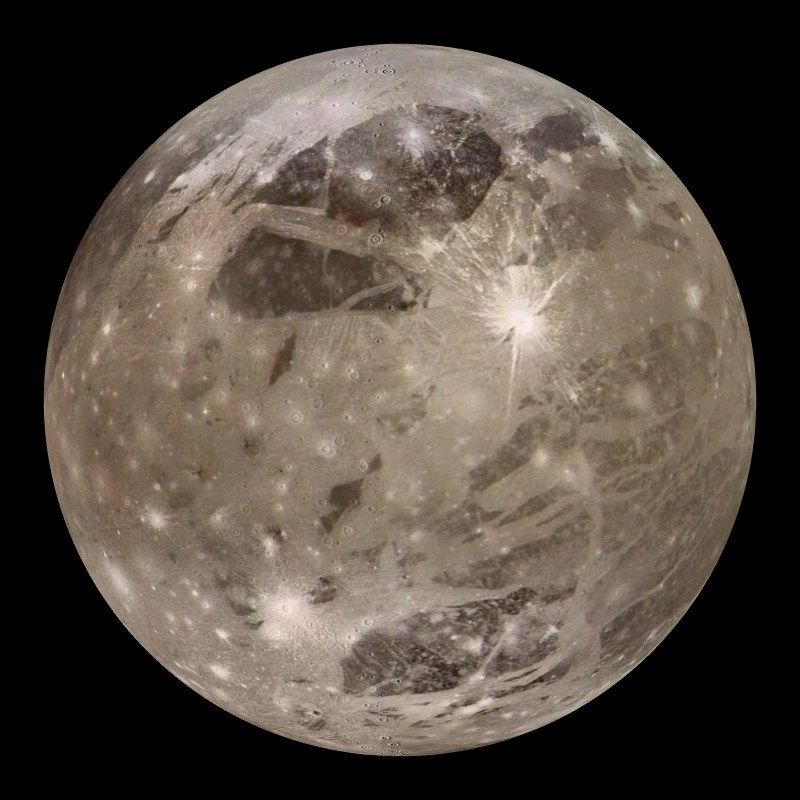
Next to Mars, the most promising candidates for primitive life in our immediate neighbourhood might not be the planets but rather some of their natural satellites. Jupiter’s huge moon Ganymede is the largest moon in our Solar System. Like Saturn’s moon Titan it is larger in diameter than the innermost planet Mercury but has less mass. Ganymede is the only natural satellite in the Solar System known to possess a magnetosphere, which is suspected to be generated through convections within a liquid, iron-rich core, not too different from the Earth.

Ganymede

While it is the least massive of Jupiter’s major Galilean moons, Europa is one of the most interesting bodies in the entire Solar System for astrobiologists and is strongly suspected to harbor a subsurface liquid water ocean. The same could be true of Ganymede and possibly Callisto, although this is considered less likely. If water contains a little bit of ammonia this has an antifreeze effect that could enable liquid water to exist at temperatures significantly below those of liquid freshwater or even seawater here on Earth. With a diameter of over 4,800 km, Callisto is almost the size of Mercury. Unlike Io, Europa and Ganymede, Callisto does not experience much tidal heating and orbits beyond Jupiter’s main radiation belts. “It is thought to be a long dead world, with a nearly complete absence of any geologic activity on its surface.” Any heat generated within it would have to come from radioactive decay alone.

In contrast, the gravitational influence of Jupiter squeezes Europa as it orbits from one side of the planet to the other. This “tidal flexing” should keep its core molten and result in volcanic activity, just like at its neighbor Io which is closer to Jupiter. The downside is that Europa orbits within the unfriendly radiation environment of its planet’s powerful magnetosphere.

Europa Close

Io, the innermost of the Galilean moons, is the most volcanically active body in the Solar System, with volcanoes spewing out sulfur and sulfur dioxide (SO2) to a height of hundreds of kilometers. The heat is caused by massive tidal forces generated by Jupiter and its moons. Volcanism exists on other bodies, too, but not necessarily in the form of molten rock (lava).

The American probes Pioneer 10 and Pioneer 11, launched in 1972 and 1973, were the first spacecraft to visit Jupiter and Saturn in the Outer Solar System. NASA’s Galileo spacecraft orbited Jupiter from 1995 to 2003, sent pictures and data back to the Earth and dropped a probe into the Jovian atmosphere to sample its composition. It also found evidence of what could be an ocean on Europa. New research suggests that there may be plenty of oxygen available there, possibly great enough to support not only microorganisms but perhaps also “macrofauna,” or more complex organisms like fishes. Maybe Europa has hydrothermal vents like the ones we know from the ocean floors of our planet, although this remains pure speculation. Some scientists think the origin of life on Earth occurred at such volcanic vents.

Continue Reading →