
Whatever one may say about religion, Christianity or the Coptic faith (the oldest Christian tradition on earth most certainly) there is no denying that this man led a group that has managed to preserve it’s own identity against an increasingly hostile, violent, even barbaric majority that considers all non-members to be without even the most basic imaginable rights. Rights such as not having your daughter forcibly abducted, ‘married’ to a member of the kidnappers family and forcibly have their official religion changed.
One can only wonder if the death of this man may mean more, or less restraint on behalf of the Coptic peoples of Egypt against their Muslim oppressors. I suspect we may not have to wait so long to know.
From CBS:
 Pope Shenouda III, in 2010 (KHALED DESOUKI/AFP/Getty Images)
CAIRO, Egypt – Pope Shenouda III, the patriarch of the Coptic Orthodox Church who led Egypt’s Christian minority for 40 years during a time of increasing tensions with Muslims, died Saturday. He was 88.
His death comes as the country’s estimated 10 million Christians are feeling more vulnerable than ever amid the rise of Islamic movements to political power after the toppling a year ago of President Hosni Mubarak. The months since have seen a string of attacks on the community, heightened anti-Christian rhetoric by ultraconservatives known as Salafis and fears that coming goverments will try to impose strict versions of Islamic law.
Tens of thousands of Christians packed into the main Coptic cathedral in Cairo on Saturday evening hoping to see his body. Women in black wept and screamed. Some, unable to get into the overcrowded building, massed outside, raising their hands in prayer.
“He left us in a very hard time. Look at the country and what’s happening now,” said Mahrous Munis, a Christian IT worker in his 30s who was among the crowds. “Copts are in a worse situation than before. God be with us.”
Munis’ friend, Sherif Sabry, interrupted. “He was our rock. God help us find someone who can fill his place.”

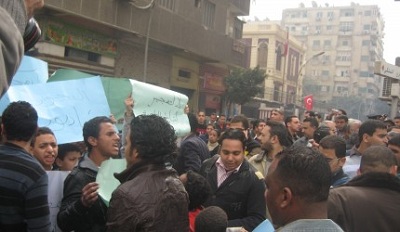






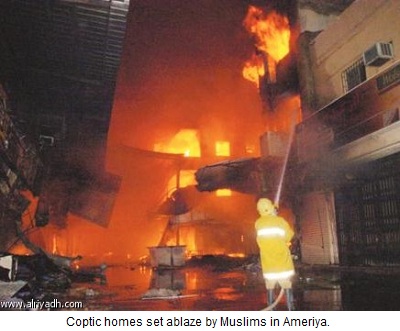 (AINA) — National and international rights groups have consistently criticized the recourse to the so-called “reconciliation meetings” — dubbed “Bedouin sittings” — that take place between Copts and Muslim assailant after every attack on Copts. The meetings are conducted under the auspices of state security. Last week a series of meetings were held by radical Muslims to decide on the fate of the Copts in a village in Alexandria, and Muslims insisted that the whole Coptic population of 62 families must be deported because of an unsubstantiated accusation levied against one Coptic man.
 Three week ago Coptic student Gamal Masood (17), from the village of Bahig and Adr in Assuit province, was assaulted by his fellow students after the school social worker had printed and hung on a wall a web page from Facebook with the photo of Gamal and a drawing which Muslims regarded as that of their prophet. Although he denied the charge, violence and protests broke out in three villages. Muslims from the surrounding villages protested for two days. They torched his home, together with four other homes of friends and relatives. To calm them down, the head of security promised them that Gamal and his family would be evicted. While Gamal’s investigations were still going on, a meeting was held on December 31 at the Assiut governor’s office, attended by representatives from Al-Azhar, Salafists from the area who won the last parliamentary elections, church representatives and the authorities, where it was decided that Gamal, also accused of causing sedition, would be handed over to prosecution, and he and his entire family would be expelled from the county. Moreover, it was decided that the priests in the area had to publish an official apology in all the media. The young student is still detained, and his trial is scheduled for February 7.

