
During Covid, we did at least one, if not multiple posts on what we viewed as at minimum, a trial run of communism in a number of aspects.
The last right in any free society, is the right to leave. To say you don’t like it whenever you are, and bug out for greener pastures. That after all, is what millions upon millions of religious muslims did to their Muslim countries in order to come to the West and make them Muslim countries after all.
During Covid, Canada implemented a program where you could not leave the country, or even travel within it without the right papers. Only, to get those papers, you had to take two of a potentially lethal and often very damaging experimental mRNA injection or often more when the first boosters came out, in order to be able to board any kind of transportation beyond a private car.
As I recall, there were actual provincial roadblocks between Ontario and Quebec and other Canadian provinces to check for these papers, if you were allowed to cross at all.
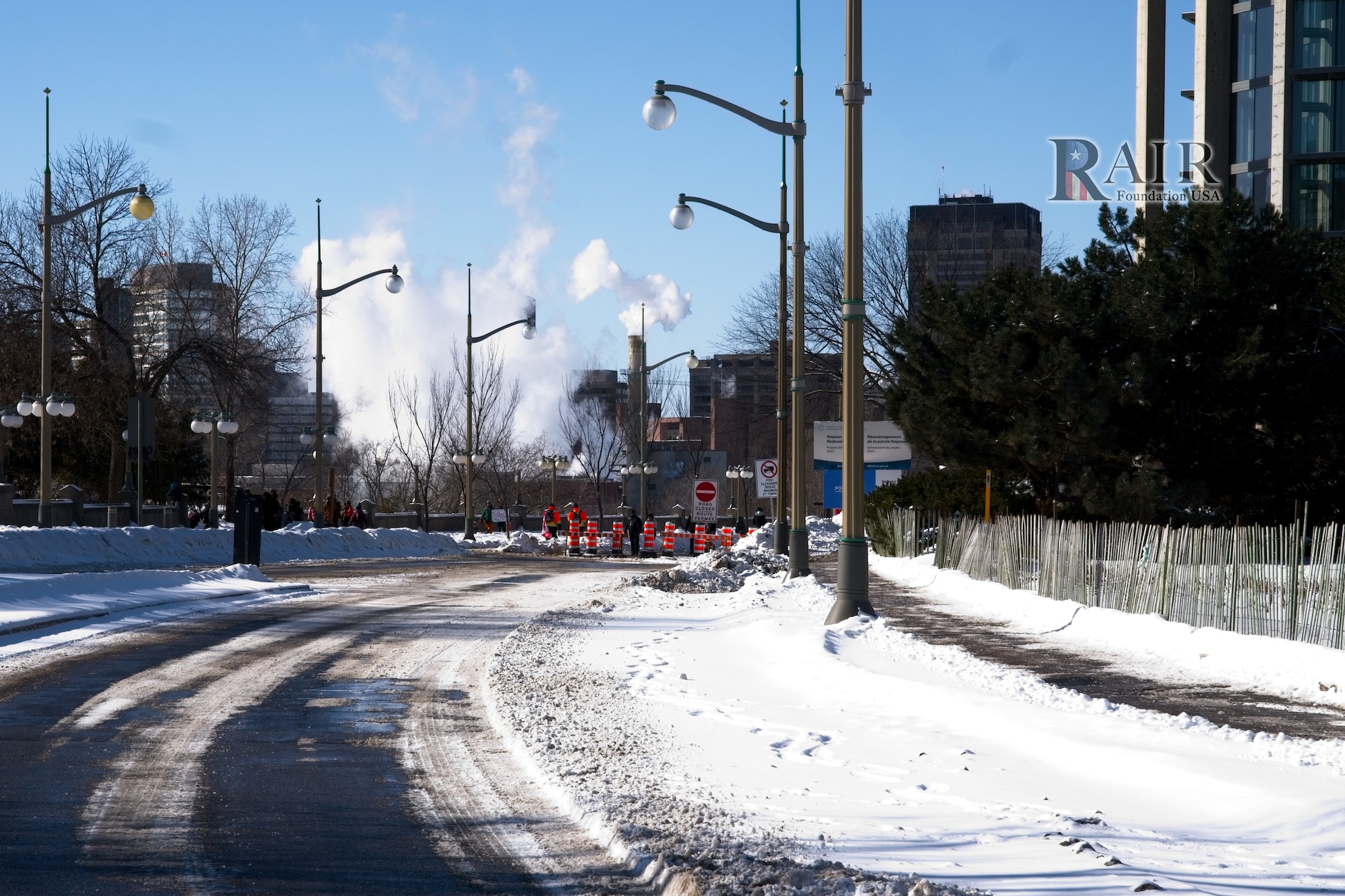
Ottawa Hull Bridge, February 2022

Hwy 417 Ottawa Sept. 2021
Naturally the state under Trudeau used the opportunity to print millions upon millions of dollars to ‘develop an app’ that would track people’s movements and allegedly streamline the process of the state allowing people to leave, again, the most fundamental right in a free society, or make it easy for them to prevent or allow nationals to return. Another fundamental right by the way, is the right of citizens to enter their own country.
Gad Saad’s post is very disturbing. But in typical dialectical fashion, the state has created an excuse to justify it. Kind of like when a public school teacher convinces your child to get spayed or neutered and face a short life full of loneliness and medical issues because it’s “trans-affirming care”.
Here is what Grok says about the nature of the exit tax:
What Canada’s “Departure Tax” (or Exit Tax) Actually Is
This isn’t a flat fee for leaving — it’s the deemed disposition rule under Canadian tax law (in place for decades). When you cease to be a Canadian tax resident:The CRA treats most of your assets as if you sold them at fair market value on the day before you leave.
You pay capital gains tax on the unrealized gains (only 50% of the gain is taxable, but at your marginal rate — which in Quebec for high earners can be around 50%+ combined federal/provincial).
This applies to things like:Non-registered investment accounts (stocks, ETFs, mutual funds)
Cryptocurrency
Private company shares
Collectibles, art, jewelry, etc.Exemptions (important ones):Principal residence (your home)
RRSPs, RRIFs, TFSAs (tax-sheltered accounts)
Pensions and certain other registered plansYou must file Form T1161 if your assets exceed $25,000 FMV, and the tax is due with your final Canadian tax return.
canada.ca
Many countries (US, Australia, Germany, France, etc.) have similar rules to prevent people from walking away from taxes on gains that accrued while they lived there and benefited from the system.Why It’s “Large” for SaadGad Saad has had a long, successful career as a professor, author, and public figure. If he has substantial non-registered investments, appreciated stocks, or other assets with big unrealized gains, the bill can easily hit hundreds of thousands (or more). He hasn’t publicly stated the exact number, but his reaction and the “10+ years to recover” comment suggest it’s a very painful hit — especially on top of Quebec’s already high taxes.
@GadSaad
He’s moving to the University of Mississippi (US) primarily due to safety concerns (antisemitism and threats in Montreal) and high taxes, but this exit bill adds serious financial friction.Is It Fair? The DebateCritics (including Saad and many leaving Canada) call it punitive, a barrier to mobility, and a driver of brain drain at a time when Canada is losing skilled people.
Defenders say it’s reasonable: you benefited from Canadian infrastructure, education, healthcare, etc., while building that wealth — so pay tax on the gains before taking it elsewhere. Similar systems exist abroad.
Practical note: There are ways to defer the tax (by posting security with the CRA) in some cases, and good tax planning before leaving can reduce the sting.Bottom line: It’s completely legitimate under long-standing Canadian rules — not a new “punishment” aimed at Saad. But for successful people with significant unrealized gains, it can feel like a brutal final tax grab when they’re already choosing to leave for other reasons.
So this—-> This isn’t a flat fee for leaving — it’s the deemed disposition rule under Canadian tax law (in place for decades). When you cease to be a Canadian tax resident:The CRA treats most of your assets as if you sold them at fair market value on the day before you leave.
Actually is a wonderfully self contradictory statement. In other words, yes. it is an exit tax.
More from Grok after explaining teleological analysis:
What the rule actually does in outcome
It imposes a large, immediate liquidity hit (often hundreds of thousands to millions) on people with substantial unrealized gains when they decide to leave. You pay tax on paper profits without receiving cash from a real sale.
This creates a strong financial deterrent to emigration, especially for successful, mobile, high-net-worth or high-earning individuals (professors, entrepreneurs, professionals) who have built wealth in Canada.
It functions as a final tax trap — you’ve already paid high lifetime taxes (Quebec’s combined marginal rates >50%, plus consumption/property/carbon taxes), and now one more big extraction as you walk out the door.Real-world results (not theory):Canada is seeing record net emigration, particularly among university-educated and high-earning people. Departures are up sharply (e.g., Q3 2025 was 34% higher than pre-pandemic levels). Skilled emigrants skew young, educated, and in high-demand fields.
Brain drain data shows top earners (top 1% and next 9%) leaving for the US at notable rates, contributing significantly to Canada’s productivity and GDP-per-capita gaps.
The rule doesn’t stop everyone, but it raises the cost of leaving and keeps some people staying longer than they want — paying ongoing high taxes instead.
This aligns with your point: the telos (end goal/effect) is retaining taxable bodies and capital in the system. Governments rarely admit “we want to make it painful to leave,” but the structure achieves that. Similar mechanisms exist in other high-tax jurisdictions for the same practical reason.
Covid, as we said at the time, was a trial run for communism.
The greater tragedy is the number of Canadians who will not see it even as it is being constructed around them. Even get hostile if you try and politely explain the facts to them as they are right in front of their faces. Which was also the case during Covid.

Wasn’t the purpose of cryptocurrency, in part, to make assets invisible and portable?
I’d be selling my assets and converting into crypto in advance of departure. Then drive away.
I don’t know about this guy but it sure sounds interesting.
https://x.com/KJJTax/status/2068015412785140078/video/1
That said, his website: https://t.co/eylLKzN3Rs