
And of course the brainless ombudsman for minorities applauds the decision.

My opinion: It’s a private company’s affair, they have a dress code, no one is forcing the man to be a bus driver for that company, he can chose a new work place or follow company rules. Following religious requirements are a duty of the believer, not of the non-believer. The Finnish bus company Veolia, are now subscribing to Sikh beliefs.
So what. It’s not creeping sikhria.
It doesn’t interfere with his job. It doesn’t cause endangerment. Have you ever heard of a car accident caused by a turban falling over a guys face? (It’s quite concievable – but I haven’t read a story to that effect).
It doesn’t interfere with hygene and won’t kill anyone like muslim medical staff in England not having to wash properly. If one of them tried to touch me I’d scream bloody murder and then sue everyone concievable.
It isn’t taking space from others like muslim prayer rooms or foot washing.
It doesn’t require private or public funds like the above.
It isn’t a way to weasle business for specific retailers – like forcing public institutions to provide halal meat.
It doesn’t give them special rights over others like when muslims weasled out time to pray at tehir factory job (a right not given in muslim countries btw), thereby forcing their co workers to work more compared to them.
It doesn’t interfere with the rights of others.
If there was a cabal of Sikhs that worked to prevent displays of other people’s religious affiliations, like muslims in England do, then that would be a reason to cry foul as well. But I don’t recall reading of them doing that.
It’s the same thing as a yermuke or wearing a cross.
And, I just realized, it doesn’t hide their faces and identities or violate the basic social fabric of society like the burka does.
(whew- almost walked right into that one)
It’s for them an essential part of their religion, similar to kippa for Jews unlike head bags are for muslims who in the west those that don’t wear them continually tell us “its cultural”. They have earn the right In the UK, many Sikhs died in the trenches in 2 world wars wearing those turbans and British uniforms. I respect that they have similar dress codes for both men and women. They respect others freedom of worship and will fiercely protect it.
Their loyalty to Queen and country is rarely questioned. I am a bit biased though having a few of them as good friends since childhood, including one of these lunatics http://www.youtube.com/watch?v=cWZK66c0NGk
So what? Just a bit of head gear.
It doesn’t bother me too much either. In fact, it’s quite good to show those Muzz that they are not the only ones to get their way. I’ve met a few Sikhs who have warned me against the dangers of Islam and said that their job is to protect the innocent. I believe that the Sikhs will be useful allies against creeping Sharia.
In Britain many years ago, motorcycling Sikhs demanded the right to wear turbans instead of the compulsory crash helmet. They won the case. It’s their own heads, they’re not risking anyone elses head.
As far as I am aware they have made no other demands since, unlike Muslims who make ever-increasing demands.
I have to agree with the other comments. I have yet to learn of any effort by Sikhs attempting to enforce their religion on anyone else. No passenger is required to wear the turban, just as no non-Jew is encouraged or forced to consume Kosher food….in contrast to Muslims enforcing halal on the general population, dress codes and accusing indigenous residents of racism when they object.
It doesn’t bother me. One, I have never been afraid of a Sikh for an reason. As Truthiocity said it doesn’t interfere with safety.
We could amiably debate dress code. In some instances not following the dress code would absolutely ruin the business model. I do know plenty of sikh who do not wear a turban nor do they carry knives. BTW the Sikhs only started carrying knives (kirpans) after their 10th Guru,Gobind Singh, said they had to in order to defend themselves from (yes you guessed it) Muslims who would attack them unprovoked (shocker). There was no Jewish state in Palestine and no Crusades at the time. Nor was their the Great Satan, the United States.
So what was the Muslims justification? The Muslim history in India needs to be publcized. It will shut the left and the Muslims up with their taqiyya.
There’s no death for apostasy laws in Sikhism either. I know a Sikh who gave up his religion and still remains on loving terms with his family.
I also know of a Sikh who celebrates Christmas, apparently the whole family do at the request of his grandfather. At Christmas they have a tree and buy each other presents.
The Muslims will be quick to capitalize. When they do so it will be a security nightmare. As Truthiocity already pointed out the veil prevents identification. The Muslims will surely sue. But a veil is different than a turban, when it comes to facial recognition. Maybe their guru needs to tell them to where the Turban all the time when not at work. They take into account current demands of the world such as Muslims attacking unprovoked.
I believe Sikhs revere great people of other religions. They might not or do not set up shrines for them or stuff like that but they admire them nonetheless.
They also don’t have this reversion theory and do not try to revert people and cut off their heads.
Muslim Leaders To Condemn Street Grooming
http://uk.news.yahoo.com/muslims-speak-against-street-grooming-011605676.html#unW37zh
These imams have known of the rapes of thousands of very young white girls for atleast 10 years, if not more. But only now, when it is has become a liability for Islam, do these Taqqiya merchants come out.
Trex
You are right. The Sikh religion was formed specifically to protect peaceful Hindus in India, who were totally subjugated by the slaughter that invading Muslims perpetrated in India.
To that end, the Sikhs too were mercilessly persecuted, but the Sikhs fought back.. Their military prowess was so good, that they eventually ended up ruling Afghanistan, from where most pf the Islamic invasions originated.
The specific moral principle applicable here, which no one appears yet to have identified, is the principle of property rights. If the owners of the bus company are not allowed, by threat of force, to determine what items of clothing its contracted drivers can and cannot wear on their buses, then they don’t fully own their buses or their bus company, do they? What is the definition of fascism, again?
Incidentally, since the man’s reason for wearing a turban is entirely arbitrary, this is yet another example of fantasy trumping reality.
@ George
You have a strong argument with property rights and very possibly a winning one. Not so much with the wearing of the turban as being arbitrary.
As long as they don’t try to force us to follow their religion let them wear the turban.
George
Your argument is very persuasive. Though allowing Sikhs to wear turbans has no primary significance, it does serve as a precedent for others who may have designs of different complexion.
And the argument of the bus company (@George) can be extended the a nation as a whole. In the end, it boils down to who has primary ownership, or “When in Rome..”
Red, what I meant by “the man’s reason for wearing a turban is entirely arbitrary” is that his reason is rooted in religious beliefs unsupported – as are all religious beliefs – by evidence. That which has no factual basis is arbitrary. Essentially, the Southern Finland Regional State Administrative Agency, by declaring in favour of the Sikh bus driver’s wearing of a turban while driving his employer’s buses, has subordinated objective property rights (reality) to arbitrary religious belief (fantasy).
DP111, if the Sikh owned the bus company, he would be entirely within his rights to wear whatever turban he chose to wear while driving his buses, so long as in doing so no one’s life was put in danger, which would, I think, be highly unlikely.
@ George
“Sikhs who have undergone the khan?e-k?-pahul, the Sikh initiation ceremony, can also be recognised by the Five Ks: uncut hair (Kesh); an iron/steel bracelet (kara); a Kirpan, a sword tucked in a gatra strap; Kachehra, a cotton undergarment; and a Kanga, a small wooden comb”
“Wearing a turban forms a distinct identity and also makes the Sikhs very easily recognisable”
http://en.wikipedia.org/wiki/Sikh
I am not a Sikh. That is out of the way. The turban et al is not arbitrary. It is a way of showing “communion” with a group. Is it necessary. I think not. One could have none of the outward trappings of a belief system and still be devout and lead a righteous life. These outward ‘material’ signs allow some to superficially show of communion and allow fakers to wear it on their sleeve. So while I appreciate it, IMHO it is not truly necessary. But it is not arbitrary.
There may not be a God, but there is a good psychological basis for such habits. It is a way of showing solidarity or reminding oneself of ones ethos that you have said you will follow voluntarily.
It can also be used by the unscrupulous. I have no doubt that Muslims have been given a cold shoulder because they were different. but lots of people get that and from member is of their own ethnicity. It is part of life and people should not overreact. My spouse started dating me and all the sudden people from their ethnicity started figuratively crapping on them. Point is that Muslims have faced some discrimination, but they should get over it. Instead since they put their finger up in the air and see liberalism denigrates Western culture and communism on the wane and have decided to use their dress as a weapon as way of showing number and keeping other Muslims in line and as a way to intimidate.
A turban does not bother me. I see a person from the subcontinent and I see that they are Sikh and I relax. No threat. Of course some Muslim sooner or later will do a false flag. But not yet anyway.
But like I said, your private property argument is strong.
Red, an arbitrary claim is a claim asserted in the complete absence of evidence, either perceptual or conceptual. It is a claim based neither on direct observation nor logical inference therefrom, a claim with no connection to reality. An example of an arbitrary claim is this: All cubic spheres are red. Since it is self-evident that a sphere cannot also be a cube at the same time and in the same respect, it follows that cubic spheres cannot exist in reality. The idea ‘cubic sphere’ is therefore arbitrary, and since the idea ‘cubic sphere’ is arbitrary, so too is the proposition ‘All cubic spheres are red’. Such a proposition lies outside the realm of epistemological assessment, and as such can neither be validated nor falsified. Once an idea or proposition has been correctly identified as being arbitrary there is simply nothing more that needs to be said about it.
You quoted this statement: Wearing a turban forms a distinct identity and also makes the Sikhs very easily recognisable.
In other words, the turban symbolises a man’s status as a Sikh, i.e., that he embraces the mystical beliefs that define Sikhism. I assert that the mystical beliefs underlying the wearing of the turban are arbitrary (in the same way that the idea ‘cubic sphere’ is) and therefore not open to formal validation or falsification by means of logic – the method of reason. If you still assert that the reason for the wearing of the turban is not arbitrary, then the onus is upon you to reduce logically the mystical beliefs defining Sikhism to observable facts of reality.
But you could extend the argument to all religious systems George. Then you end up in a mess. A mess of beliefs and of course we all have beliefs.
You seem to be an atheist. Now that is a belief. Religious people tend not to agree with that point of view. You can no more prove their is no God and hence invalidate the “fantasy” of religion that attaches to that point of view, than the religious can prove that there is a God and hence that there is no fantasy framework of belief attached to the claim of God ruling the universe.
Since your own belief is not proven it too falls into the realm of unproven fantasy and for you to force that on to the bus company by saying the belief system of our turban wearing theist is wrong, but, however, my atheist belief is correct, is not going to carry much water as your belief system is not a proven belief system, in much the same unproven way as the theists and their various systems of religion that attach to their understanding of God.
Observable facts of reality do not permit an atheist to deny God or a theist to say one exists. You are both in the same world and look at things differently but in essence you are both using limited senses and facts to come to the conclusion you think is the best.
Hence if the Bus company owner is an theist of a broad enough understanding to make fellowship with another theist, who may worship in a different way, than of course on the basis of his private ownership of a bus company, and the fact that he is a broad minded theist it is quite consistent with his property rights aligned as they are with his theistic understanding of reality, for him to facilitate the dress code of another believer; who will thank him for his compassionate understanding and hug him as a fellow spirit in the Love of the Lord.
Such is the way of the broad minded loving theist and his way of doing things aligned with HIS property rights. After all they are HIS property rights and it is HIS theistic understanding and they are both aligned in a way that causes happiness to the two theists, in question.
Identifying with a set of beliefs, a way of living and a group is important psychologically.
Of course this could all be perverted and has and will be again in the future. But nonetheless it is important.
We’ll have to agree to disagree. Now my particular brand of morality is such that I won’t declare a fatwa against you, go Che Gueverra against you or anything of the like. I guess I would not make a goof Muslim or Marxist.
Things that are important are measurable psychologically. Can I argue both via religion and science? Certainly. I picked that up from Jewish theology from confirmation class and from physics. I would like to copyright, patent or otherwise claim credit for that ideal but heh, probably millions of people have beat me to it. there was a cartoonist that showed a religious person and a scientist both reaching the peak of a mountain, the top of which represented the truth and everything, from opposite sides.
A cube sphere is of course is impossible. To claim that theism is as absurd as a cube sphere is in itself absurd. No one is trying to be irrational when claiming belief in God. One is simply looking at the available evidence and then being unable to prove what one believes come to a conclusion,nonetheless, that a God exists. One of course could say the same about the atheist. He too is not being irrational. He is as rational a man as is the theist and will, however, also be unable to prove that God does not exist. Coming to different conclusions, but remaining as rational truth seekers both come to the point of the mountain in your metaphor but of course there is no peak that they meet at. One never reaches the peak. One can never decisively prove things one way or the other. The commitment to truth and rationality is the thing that binds the sincere theist, whether, he wears a turban as symbol, or as an atheist wears a cap to keep out the cold.
When it comes to hats they are of all shapes and sizes. Here in the UK we have a lots of hunting. Every weekend in the countryside you see lots of men and women and children hunting foxes. One will notice the hunting hat and the other regalia of the English sporting huntsman. Nothing to do with either theism or atheism but just hunting and the hat is always on as symbol. One could go about other hats but a hat or head gear is nothing worth bothering about as long as the huntsmen does not want me to ride about the country of Britain killing foxes for sporting pleasure. And of course no one will. The very idea is absurd but when it comes to Islamic dress we are in another ball game completely. These people do want you to dress islamically/arabically and will punish women who do not put on the burka etc.
There are way too many demands on behalf of “religious beliefs”,………carnita mathews, a case in QLD where a sikh demanded he be allowed to wear his turban without a helmet on his pushy (granted), burkas allowed to be worn in banks but hoodies not, when will it all stop???
Two examples her Infidel. The first does not infringe on your rights but increases them. If you want to wear a turban instead of a helmet and claim it is your religious right you can now do so. So it does increase your rights to live dangerously, if you are an adrenalin junkie. Not a good idea and one I would not go for but it is there for you to claim now that this right has been granted.
The second one is an identity issue. A robber can now go into a place of business wearing a veil and rob the place and this has been done a few time to my knowledge. Someone coming into a place and robbing it is a whole lot different ball game from someone not wearing a crash helmet. The crash helmet not being worn increases your rights (to live dangerously if you choose to do so) but the veil diminishes them by allowing banks and other businesses to be robbed. You might own one of those banks or businesses. So the two are totally different. The first does not in any way effect, and in fact aids you right to live dangerously, and the second the second could very well relieve you of lots of money.
The state is always trying to enforce laws. The more laws the better as far as the state is concerned. A person should have the right to live dangerously if he chooses to do so. People go mountaineering, they go out into the wilds of Africa and into cannibal country. It is called life! Living dangerously is what gives life the excitement and zest that sitting on a computer and pontificating about the world lacks.
Infidel if you really want to live in safe world full of rules from the state then never ride a motor bike and campaign to get them banned completely. By doing so you go one step better than the rule bound state control of your life at present. You can follow your philosophy of not granting rights to religious folks to its full extent by using the safety argument to completely ride the world of unsafe things. Do the same for cars and of course planes. Then we end up in a world of insane safety.Life is dangerous. There is only so much we can do to be safe and boring. But then we pay a price in sitting on a computer and pontificating instead of going out there and living life to the full.
If you want to live dangerously go ahead. If you want to live in a safe way go ahead. In either case no one is in any way infringing on your rights by doing what they want to do when they ride a motor bike. It is entirely their choice and it is entirely your choice. Freedom.
hahaha “her infidel” thats a new one, (idiot)
Yeah live dangerous but abide by the laws also to protect us and not to end up on life support being a burden to society or to suddenly sue the council/govt because you feel like it and it supports your needs,
I write 4 lines you write an entire essay about………..nothing but YOUR impression on how one can live if they so wish.
I write 4 lines in about 1 minute,…..yours 20 minutes or so,…so who is sitting behind the keyboard pontificating instead of going out there and living life to the full????
Two issues here infidel firstly both of us are sitting behind a keyboard not living dangerously. I think we both need a rest from that and should do something more exciting.
Secondly, how one lives one’s life is up to the individual and if one stays in the law that is fine. However,staying in the law or out of the law is up to the individual. That is life. Consequences everywhere you turn.
No one is stopping you from doing whatever you want to do safely.So why should you want to limit other people from living dangerously. Should we ban car racing, boxing, kung fu, theme parks with amazing rides etc so that you can live in a safe society. Do what you want and be as safe and snug in your house as you want to be and let others live dangerously.The law allows for lots of dangerous and exciting things to let people burn of some of the excitement in their minds. Just because you do not want to do anything dangerous does not mean you can legislate away the dangerous things in society that are now lawful. Off the top of my head I can name hundreds of dangerous things that could be banned. Once you go down that route you end up in a society that would be safe to live in but utterly boring and weird.
Here you go again, i’m not stopping ANYBODY from living dangerously all i did was to make a factual statement and you go off your tits writing 2 essays babbling about shit and yes i did something dangerous today but i minimised it by wearing my bike helmet and watching out for idiots like you …..go and stick your arse in the air and face east……..End of.
Don, the proposition “All cubic spheres are red” is not falsifiable, but it is readily invalidated; falsification is merely one means of invalidating an idea. In order to falsify the proposition, I would first have to reduce it to the facts of reality – I would have to identify cubic spheres in reality and show that in addition to red ones there existed also ones of other colour, thus contradicting, and thereby falsifying, the proposition. I cannot do this, however, because there are no cubic spheres in reality for me to point to. The proposition is nonetheless invalidated, however, by means of self-evidence . The idea ‘cubic sphere’ is self-evidently self-contradictory, and since there can be no contradictions in realty, it is therefore self-evidently invalid.
All religious beliefs are arbitrary because all have no connection to reality, and none are falsifiable because all are arbitrary. All are, however, invalid because all entail self-contradiction, although usually (unlike in the case of the cubic sphere) this is not immediately self-evident. All religious beliefs are accepted on faith only, as though faith were a means to knowledge, which, of course, it is not. Reason is the only means to knowledge. The process of reason is a volitional process in which one looks at reality and then from one’s perceptions of it forms valid concepts and conclusions by means of the method of logic (the art of non-contradictory identification).
NB: Truth is the recognition or identification of fact, and all facts are facts of reality whether any consciousness recognises them or not. Thus truths are in minds and facts are in reality. When one makes a claim that is true, one is identifying, either directly or ultimately, a fact of reality (for example, the claim “Some sheep are white”). All truths, directly or ultimately, relate to reality. When one makes a claim that is false, one is making a claim that, although relating to reality, contradicts reality in some way (for example, the claim “All sheep are white”). When one makes an arbitrary claim, one is making a claim that has no relation to reality whatsoever, and is therefore neither true nor false (for example, the claim “All cubic spheres are red”, or “God is greatest”; such a claim does not contradict reality, it contradicts itself.
“God is greatest”; such a claim does not contradict reality, it contradicts itself.
The above statement is wrong. The claim does not contradict itself
How?
Since God is defined by common consensus (when we talk about God) as the greatest conceivable being, the statement God is the greatest is inherently non-contradictory as it follows from the normal accepted definition of God.
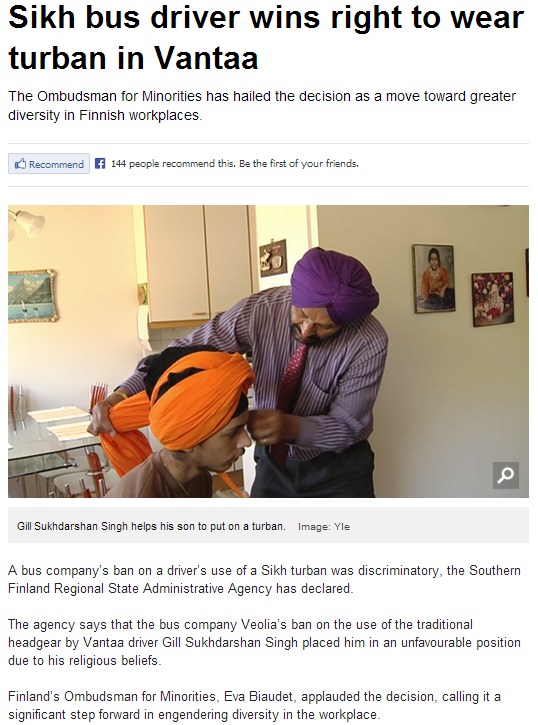
Finland’s Ombudsman for Minorities, Eva Biaudet, applauded the decision, calling it a significant step forward in engendering diversity in the workplace.
Gill Sukhdarshan Singh, who has lived in Finland for more than 26 years, decided to begin wearing the traditional turban last winter. A couple of months later, the bus company ordered him to stop doing so.
Gill Sukhdarshan Singh, who has lived in Finland for more than 26 years, decided to begin wearing the traditional turban last winter. A couple of months later, the bus company ordered him to stop doing so…………..This sound fishy as,……..lives in a country for 26 years then all of a sudden decides to start wearing the turban 3 questions (don shut up) 1. was Gill Sukhdarshan Singh a sikh BEFORE donning the turban 2, why suddenly start wearing it, 3 was this really written by Gill Sukhdarshan Singh????
A religious tradition is not an ideology, even when the tradition involves a dialectic that generates widely accepted ideological conclusions and a praxis that is codified in a system of law. The members of a religious community will identify themselves and one another through various elements of the religious tradition, which may involve prominently visible symbols such as certain styles of dress.
None of this has much to do with theories of meaning and truth or with the ontological argument.
Don, the claim ‘God is greatest’ contradicts itself because the notion ‘God’ entails self-contradiction. To expose this self-contradiction, you must examine what the notion ‘God’ purportedly refers to? According to common consensus it refers to a bodiless supernatural entity of pure consciousness possessing, amongst other attributes, omniscience and omnipotence – the power, for example, to create ex nihilo an entire universe (all that exists apart from itself) by a mere act of will. Don, do you really not see the internal incoherence – the self-contradiction – in the notion of an omniscient, omnipotent consciousness?
Don, consider this: To be conscious is to be conscious of something. Before a consciousness (any consciousness) can exist there must first exist physical entities beyond itself for it to be conscious of – for it to perceive and to know, thereby gaining knowledge content; thus a consciousness with nothing to be conscious of is a contradiction in terms. Furthermore, a consciousness with no sensory apparatus has no means of perceiving that which exists beyond itself and therefore has no means of acquiring any knowledge content; thus a consciousness with no physical sensory means of perception is a contradiction in terms. NB: A consciousness with nothing to be conscious of cannot introspect (turn itself inwards to be conscious only of itself) because when a consciousness introspects it is actually being conscious of its own consciousness being conscious of, directly or indirectly, that which exists beyond itself. But if nothing exists beyond itself, introspection is not possible; thus a consciousness conscious only of itself is a contradiction in terms.
In the light of this knowledge, Don, try to imagine what it must have been like for God ‘just before’ he created the whole of reality (including, of course, time and space) – the whole of existence apart from his own pure consciousness: pure consciousness existing in no space and at no time with no physical body and therefore no sensory means of acquiring complete knowledge of nothing, and thus nothing upon which to introspect. Such a consciousness, Don, would be no consciousness at all. So the basic contradiction at the root of the notion of ‘God’ is this: a consciousness which is no consciousness at all. The claim ‘God is greatest’ thus reduces to the claim ‘Consciousness-which-is-no-consciousness-at-all is greatest’, which is to say ‘Nothing is greatest’, which is, of course, a contradiction in terms.
In essence, the notion of ‘God’ is a futile attempt to put the horse before the cart – an attempt to give consciousness primacy over existence (reality). In reality existence has primacy over consciousness, which means that existence is what it is independent of any consciousness and that the purpose of consciousness is merely to perceive that which exists, not to create it or to make it conform to its will. Ayn Rand summarised pithily the proper relationship between existence and consciousness when she stated the following: Existence is identity; consciousness is identification.
One last thing, Don: When you say that God is defined according to common consensus, what you are actually saying is that common consensus defines God’s nature, including all of his “greatest conceivable” attributes – in other words, that God is a product of human imagination. The notion of God (as defined by common consensus) really relates only to an imaginary entity, an ‘entity’ existing only in the fanciful and immaterial universe of the human imagination (where contradictions are allowed), and with no relation whatsoever to any actual entity within reality (where no contradictions are allowed). If you still think otherwise, Don, then please explain clearly to me how you know that God is not at root a product of imagination.
Don, the claim ‘God is greatest’ contradicts itself because the notion ‘God’ entails self-contradiction.
How? We have to define what we are talking about. By common consensus God is defined as the highest conceivable being. Hence to call out his qualities which make him thus is not self contradictory. Hence I could say that he is the greatest intellect and this does not contradict the claim that he is the highest conceivable being. I can of course do this with other attributes that by common consensus are considered greatness making qualities such as power. I could say that he is the most powerful being, which again does not contradict the first sentence.
The method here is first definition and then the following statements must be in accord with that definition. Hence a cube must have the qualities of a cube and not be in any way spherical or it is not a cube. The same method is applied to God and we have seen in our analysis that the statements that follow our definition do not in fact contradict each other as they do in the case of the cube which has spherical features.
The connection with reality is not the key topic here. The topic is whether the statement God is the greatest is self contradictory, and we have seen that it is not contradictory.
A regular hexahedron with every point on its surface equidistant from its centre.
A number that yields a result of minus 1 when multiplied by itself.
These definitions are not devoid of reason or system. As with all definitions, we can construct true analytic statements from their elements. It does not follow from this that the definitions are or can be instantiated in any form of human experience or imagination.
***
None of this has the slightest relevance to personal identification through a religious tradition. Sikhs identify themselves and recognise one another as such through a complex web of customs, practices and worldviews that persist even when they are shown to be mistaken. Even the boys of “Lord of the Flies” are a community in this sense, and they can understand their history in terms of a tradition.
That collective and self-identification is as valid as any other. Indigenous Australians may recognise one another through their taste for witchetty grubs and affinity for Dreamtime mysticism. They do not vanish or cease to be indigenous Australians simply because someone else recommends jellied eels and the Western Branch of American Reform Presbylutheranism, or because someone else again is a vegetarian nihilist.
“personal identification through a religious tradition”.
Not discussing that. We are discussing the logicality of a statement. In any case everyone has some personal identification with something or other, including you. The examples you give do not include you of of course.
What do you believe in?
Don
That was where you entered the discussion, but the thread concerns an alleged conflict between the right of an individual to display visible elements of personal and collective identity and the right of an employer to prohibit such a display on pain of dismissal or refusal to hire.
The thread seemed to get sidetracked when George suggested that the reason for wearing a turban was “arbitrary”, which he variously understood to mean “unsupported by evidence”, “having no factual basis” or “asserted in the complete absence of evidence, either perceptual or conceptual”. An example of an arbitrary claim was then supplied in the form “all cubic spheres are red”.
I commented above that we can define “cubic sphere” in much the same way that we define complex numbers in mathematics, and we can express analytic truths about them in the same way as about any other defined entity. You did this yourself using the major premise of the ontological argument.
None of this 8th grade theology is in any way relevant to the main topic of the thread.
Precisely so. In the case of Sikhs this identification is to some extent formalised.
We normally understand that individuals have a right to their identity, which includes a right to express that identity in various ways. This right is not absolute, but must be proportioned to and balanced with other rights. The rights of an employer based on an employment contract are similarly not absolute (which defines the distinction between employment and slavery). To balance these conflicting claims, we look at the overall purpose and context of the employment situation, and perhaps also at the type of expression of identity in question. The usual outcome is some kind of compromise.
Employers of Sikh bus drivers – most recently in Finland – have been unable to demonstrate a sufficiently strong reason for prohibiting turbans, worn as a standard expression of Sikh identity, under an employment contract.
justicedemon that is good summary of the issues raised and the fact that we did in fact get side tracked.
Since head gear worn by sikhs are non threatening; however, I am sure the wearing of Nazi regalia including the head gear would not be in line with the bus company and its feelings. The point is the fact that as many posters claimed that their was no big issue here, and I believe that this was the reason i.e it was non threatening. So I just want to use some head gear that would raise concerns. One would of course be Nazi head gear, another would be KKK head gear (which conceals identity) and of course a muslim bus driver who is female may be interested in driving the bus wearing a face concealing burqa garment. So this issue was not fully explored but I am raising it now that you have given a good summary of the issues raised thus far.
Don
There are countless special contexts in which conflict may arise between expressions of personal and collective identity and other rights and interests. Each of these contexts has to be evaluated on its own merits. This evaluation will turn on questions such as whether the expression is sufficiently well established to constitute part of the identity of an individual or group, whether it really does defeat the purpose of the conflicting right or interest, and whether the conflicting right or interest is sufficiently strong to outweigh the expression of identity in certain circumstances.
The importance of the turban to Sikh identity is very well established. Indeed in the western world a man wearing a turban is generally assumed to be a Sikh unless otherwise shown. Particularly with the benefit of experience from several countries, it is also now quite obvious that a Sikh turban does not defeat the purpose of uniforms expressing status or service relationships. There are thousands of Sikh bus drivers, police officers, airline pilots and so on whose use of a turban does not significantly impede performance of their duties. This is not to say that a conflicting right or interest cannot in principle ever outweigh the right to express Sikh identity in this way. Perhaps the key issue of this kind concerns exemption from laws and regulations concerning the use of helmets for personal protection. There is a lot of case-law on this subject and no international consensus.
For an example of a United Kingdom case in which a symbol was not held to outweigh an employer’s stipulated dress code, see Lisk v Shield Guardian Co Ltd (the poppy incident).
One can discuss rights objectively only on the basis of an objective principle of rights. And, in accordance with the hierarchical structure of knowledge, an objective principle of rights is possible only on the basis of an objective code of ethics, and, ultimately, an objective code of ethics is possible only on the basis of observable facts of reality. In short, a principle of rights, if it is to be objective, and therefore true, must be derived logically from observable facts of reality. Thankfully, such a derivation has been made, but, regrettably, in the space of a blog comment it is not possible to explicate it fully. I strongly urge, therefore, that you read carefully Craig Biddle’s lucid essay ‘Ayn Rand’s Theory of Rights: The Moral Foundation of a Free Society’, which you can find here: http://www.theobjectivestandard.com/issues/2011-fall/ayn-rand-theory-rights.asp If you have the time (approximately six hours) you might consider watching the four-part seminar ‘The Nature and Source of Rights’ (also by Craig Biddle), which you can find here: http://craigbiddle.com/courses.htm#source
Suffice it to say here that a ‘right’ is a moral principle defining and sanctioning a man’s freedom of action in a social context. Rights apply only to individuals – all individuals – and apply only in regard to action, not to goods, services or privileges of any kind. One man’s ‘right’ is not a right if its enactment involves the violation of another man’s right. Rights, therefore, are never in conflict – they conflict only with non-objective (or pseudo-) ‘rights’ – and can never be compromised; in any ‘compromise’ between food and poison only poison wins. The objective principle of rights in essence says that a man can act in any way he chooses, provided that in doing so he does not violate the rights of any other man to act likewise. Rights, properly recognised and protected by legitimate government (government constitutionally limited to the purpose and function of protecting rights), are the means of banning the initiation of force from all social relationships, and in this manner define a free society. In a society based on an objective principle of rights, men deal with one another on the basis of trade, voluntarily exchanging value for value to mutual benefit; there is no compulsion in a society based on an objective principle of rights. The proper relationship between employer and employee is merely that of long-term traders, the time element necessitating a contract. There is no such thing as ‘a right to a job’ – there is only the right of free trade, i.e., a man’s right to take a job if another man chooses to hire him.
Specifically, the right to property is the right to earn, keep, use or dispose of the product of one’s effort as one sees fit, i.e., in accordance with one’s own judgement, whether that judgement is rational or reasonable or not. In this particular case, and unless Veolia is in breach of its employment contract with Mr Singh (and there is nothing in the news article to suggest this), by compelling Veolia to comply with Mr Singh’s desire or need to wear his turban while driving Veolia’s buses, the government agency is in violation of Veolia’s objective right to use its bus company – its private property – in accordance with its own judgement. It matters not one iota whether Veolia’s judgement in this instance is rational or reasonable or not; nor do Mr Singh’s customs, practices, worldview or traditions have any bearing on the matter. The government agency’s ruling in this matter may be lawful, but, if reason is one’s standard of judgement, and man’s life one’s standard of value, it is not just and it is not moral.
I think you have made a clear case for the identity issue involved here. The turban is clearly an important element of identity.
However, a little ingenuity from helmet manufactures could see them bringing out tough bands that could be placed around the turban to help with some degree of protection especially for the forehead. Sometimes we humans need to just start thinking in ways that help us both with our identity issues and with our protection issues. It could be profitable new market for the right product.
“objective code of ethics”
There is no such thing. All ethics are subjective. Animals do not have ethics and humans do. Humans differ with regards to ethics from country to country, tribe to tribe, and person to person.
“an objective code of ethics is possible only on the basis of observable facts of reality”
All observations of reality go through a filter called the subjective analysis of them and this differs from country to country, tribe to tribe and person to person. Hence the sheer impossibility of an objective code of ethics; and who is to pronounce this objective code or reality? What if someone pronounces another objective code of ethics, which differs from the official one. Then we end up in a mess.No one can stop anyone anywhere from pronouncing his or her objective code of reality.
unless Veolia is in breach of its employment contract
unless you have a copy of that contract you are speculating.
Plus of course the company can amend the contract and change it as they will with the consent of the employee concerned and within the boundary of the law. Nothing is written in stone as their is no objective standard of ethics. All ethics change based on differing subjective ethical stand points.
Justicedemon could point to hundreds of cases in law where the nuances of the law changed on the basis of experience and this study is called case law. Law is an ever changing thing.
“The government agency’s ruling in this matter may be lawful, but, if reason is one’s standard of judgement, and man’s life one’s standard of value, it is not just and it is not moral.”
Is this the objective understanding of ethics based on reality. What if someone disagrees?Do you see how impossible it is to have and objective basis for ethics.
I’m afraid I see little point in getting into debate with some fundamentalist who feels that a debate is already finally settled merely by dropping the name of some guru into a conversation and alleging that the final truth on highly intractable questions of moral philosophy can be found by reading sacred books and watching long presentations.
***
The specific case of Sukhdarshan Singh Gill is governed by Finnish law, as enacted by the democratically elected Parliament of Finland after thorough public consultation.
More specifically, with certain simplifications and in the relevant respects, Gill’s case is governed by the Employment Contracts Act (työsopimuslaki, no. 55 of 2001) and the Non-Discrimination Act (yhdenvertaisuuslaki, no. 21 of 2004).
The duties of an employer in an employment relationship are set out in chapter 2 of the Employment Contracts Act, with section 2 of this chapter specifically outlawing arbitrary discrimination on the grounds of age, health, disability, national or ethnic origin, nationality, sexual orientation, language, religion, opinion, belief, family ties, trade union activity, political activity or any other comparable circumstance. The said section also includes referring provisions to the Non-Discrimination Act and the Act on Equality between Women and Men (laki naisten ja miesten välisestä tasa-arvosta, no. 609 of 1986).
The said statutes establish legally enforceable standards that must be satisfied by any employment contract. To this extent we do not need to examine the employment contract of Sukhdarshan Singh Gill in order to understand that it prohibits the foregoing arbitrary discrimination. We need only verify that this contract is governed by Finnish law and then recognise that no such contract can permit arbitrary discrimination.
Compliance with the relevant legally enforceable standards is officially supervised by the occupational safety and health authorities, which are nowadays administratively subordinate to the regional State administrative agencies. As employment contracts are civil agreements, enforcement is a matter for the regular courts. A decision of an occupational safety and health authority in a matter of this kind is not directly enforceable, but is merely an expert specialist opinion. The expertise runs deep, however, as the occupational safety and health authority can call on highly authoritative specialist advice. In other words, Gill’s employer would be foolish to contest this point without legal advice of at least the same standard. We shall see how the case turns out, but frankly I expect the employer to comply.
The only possible open question in the case of Sukhdarshan Singh Gill concerns whether the discrimination is arbitrary. To show otherwise, the employer would have to demonstrate that the turban somehow significantly impedes the purpose of the employment contract.
Well I am a fundamentalist and you and I have had a great conversation. I have learned a lot about the law in Finland from you justicedemon.
“I’m afraid I see little point in getting into debate with some fundamentalist who feels that a debate is already finally settled merely by dropping the name of some guru into a conversation and alleging that the final truth on highly intractable questions of moral philosophy can be found by reading sacred books and watching long presentations.”
Hmm.
***
The main issue here, although a legal one, is fundamentally a moral one, and the essential questions are these: Do the owners of the bus company have the objective right to run their bus company as they see fit, providing that in doing so they do not violate the objective rights of anyone else, or do they not, and on what grounds? Crucial to answering these questions correctly is a full and clear understanding of what objective rights are, where they come from, and how they are validated. From what you have said here so far – and with all due respect to you – it is clear to me that you do not have a full and clear understanding. Traditional theories of rights are demonstrably false; they comprise ideas and principles that have never been, and can never be, fully integrated or validated. A demonstrably true theory of rights – a fully objective theory – comprising fully integrated concepts, generalizations and principles that can be fully validated all the way down to the observable facts of reality has been defined. But before dismissing my claims, you might try reading carefully the essay to which I linked in my previous post, the content of which essay I fully endorse; that way you’ll have a better understanding of exactly what it is you are dismissing. The choice to do so, or not, is, of course, entirely yours.
I fully acknowledge that a democratically elected Parliament of Finland has, after public consultation, enacted laws forbidding arbitrary discrimination by an employer in an employment relationship on a number of specified grounds, and that Veolia may well be in breach of these laws. But the key point is this: Do the owners of the bus company – indeed, any company – have the objective right to choose, freely and without restriction and in accordance with their own judgement, whom they employ and what their employees may and may not wear, or do they not? In other words, do they have the objective right to discriminate, on whatever grounds, or do they not? I claim that they do have this right and that the laws denying them this right, by threat of physical force, are not fully objective, and thus not fully legitimate. And for a validation of my claim, you know where to begin looking.